
SaaS Valuation Multiples: How to Price Your Software Business

Modest Mitkus · November 23, 2026
SaaS valuation multiples are the numbers buyers multiply by your revenue (or profit) to arrive at a price, and for private software companies they often land well below the top of the range, with the middle half of recent deals falling between about 2.4x and 8.1x revenue. Where you land in that range depends on how fast you're growing, how many customers stick around, and how profitable the business is. If you're building your first app and wondering what it could eventually be worth, this guide breaks down the numbers in plain English.
What a SaaS valuation multiple actually is
A SaaS valuation multiple is a single number that turns your business's recurring revenue or earnings into a price tag. If your app makes $10,000 a month, that's $120,000 in annual recurring revenue (ARR). A buyer who pays 3x ARR would offer $360,000. A buyer paying 5x would offer $600,000.
Software gets valued on revenue instead of just profit because subscription income repeats. A customer who pays you this month will probably pay next month too, so buyers treat that stream like an annuity. They're paying for future cash flow, and the multiple is shorthand for how confident they are in it.
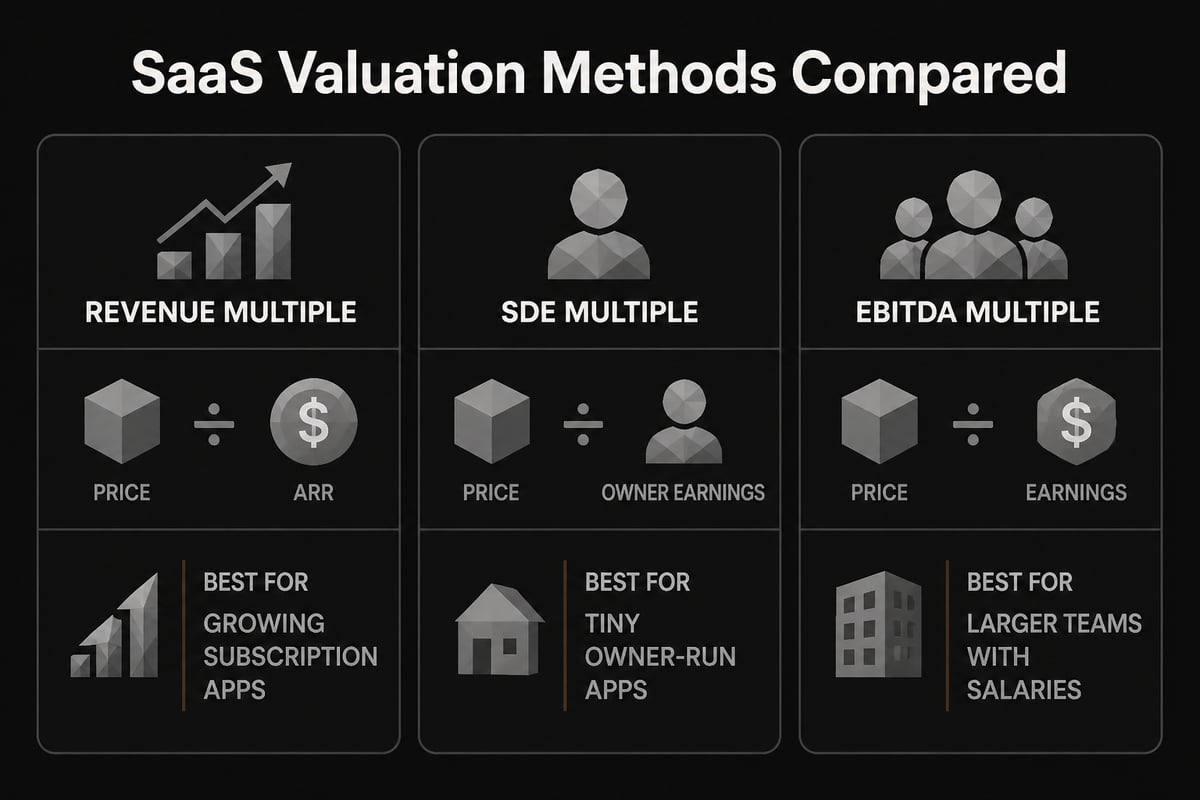
There are three common ways to express it:
- Revenue multiple (EV/revenue or EV/ARR): price divided by annual revenue. The most common for SaaS.
- SDE multiple: price divided by seller's discretionary earnings, which is profit plus the owner's salary and perks. Common for tiny, owner-run businesses.
- EBITDA multiple: price divided by earnings before interest, taxes, depreciation, and amortization. Used once a business is bigger and has real staff costs.
NetSuite's overview of startup valuation multiples walks through EV/revenue, EV/ARR, and EV/EBITDA, plus the comparable-company and precedent-transaction methods that sit behind them. It's a good reference if you want the textbook version.
What are common SaaS valuation multiples in 2026?
Common SaaS valuation multiples for private companies vary a lot by dataset and deal type, but recent private deal medians have run below the public-market index, and the exact figure depends on which dataset you trust and what kind of deal you're looking at. Public-market indexes run higher than small private sales, and small private sales run higher or lower depending on the year.
Here's what the recent data says:
| Source | Metric | Multiple |
|---|---|---|
| SaaS Capital | Index median, start of 2025 (current run-rate annualized revenue) | 7.0x |
| SaaS Capital model | Bootstrapped private businesses | 4.8x |
| SaaS Capital model | Equity-backed private businesses | 5.3x |
| Array Capital | Private SaaS M&A median, 2024 | 2.9x |
| Array Capital | Private SaaS M&A median, across 2025 | 3.8x |
| Array Capital | Long-run median, 2015 to 2026 | 4.5x |
Notice the gap. The 7.0x figure is an index median, while the 4.8x and 5.3x numbers are what SaaS Capital's model estimates for private companies after accounting for their growth and retention. The actual sold-deal medians from Array Capital were lower in 2024 and 2025.
So when you hear someone say "SaaS sells for 7x," ask what they're measuring. A headline multiple from a large, fast-growing company tells you almost nothing about a one-person app.
The range is wider than the median
Averages hide a lot. In Array Capital's 2015 to 2026 dataset, the middle half of private SaaS M&A deals fell between 2.4x and 8.1x revenue. That's more than a threefold spread between the lower and upper quartile.
The same dataset shows how much timing matters. The median private SaaS multiple was 6.4x in 2021, dropped to 3.3x in 2023, and hit 2.9x in 2024. Same kind of business, wildly different price depending on the market mood. You can't control the market, so don't build your plan around a single multiple.
How much is my SaaS worth?
Your SaaS is worth roughly its annual recurring revenue multiplied by a multiple between about 2x and 8x, with most small private deals landing in the lower half of that range. The quickest estimate takes three steps.
- Calculate your ARR. Take your monthly recurring revenue and multiply by 12. If you're new to the metric, this breakdown of MRR for SaaS shows how to count it correctly.
- Pick a starting multiple. For a small, steady, bootstrapped app, start toward the lower end of the range. For one with fast growth and low churn, start higher.
- Adjust for your specifics. Add or subtract based on the factors in the next section.
Hypothetical example: an app with $8,000 in MRR has $96,000 in ARR. At 3x, that's about $288,000. At 4.8x, which is roughly the bootstrapped estimate from SaaS Capital's model, it's about $460,800. That spread is the honest answer to "what's my business worth": a range, not a point.
One caveat. These multiples apply to businesses with real, repeatable recurring revenue. If you've got three months of sales and no retention history yet, a buyer has little to base a multiple on. Age and track record matter, which is why most of the work early on is just getting to steady revenue.
What pushes a multiple up or down
A multiple moves with a handful of factors, and growth and retention carry the most weight. Buyers are really asking one question: how likely is this revenue to keep showing up, and grow?
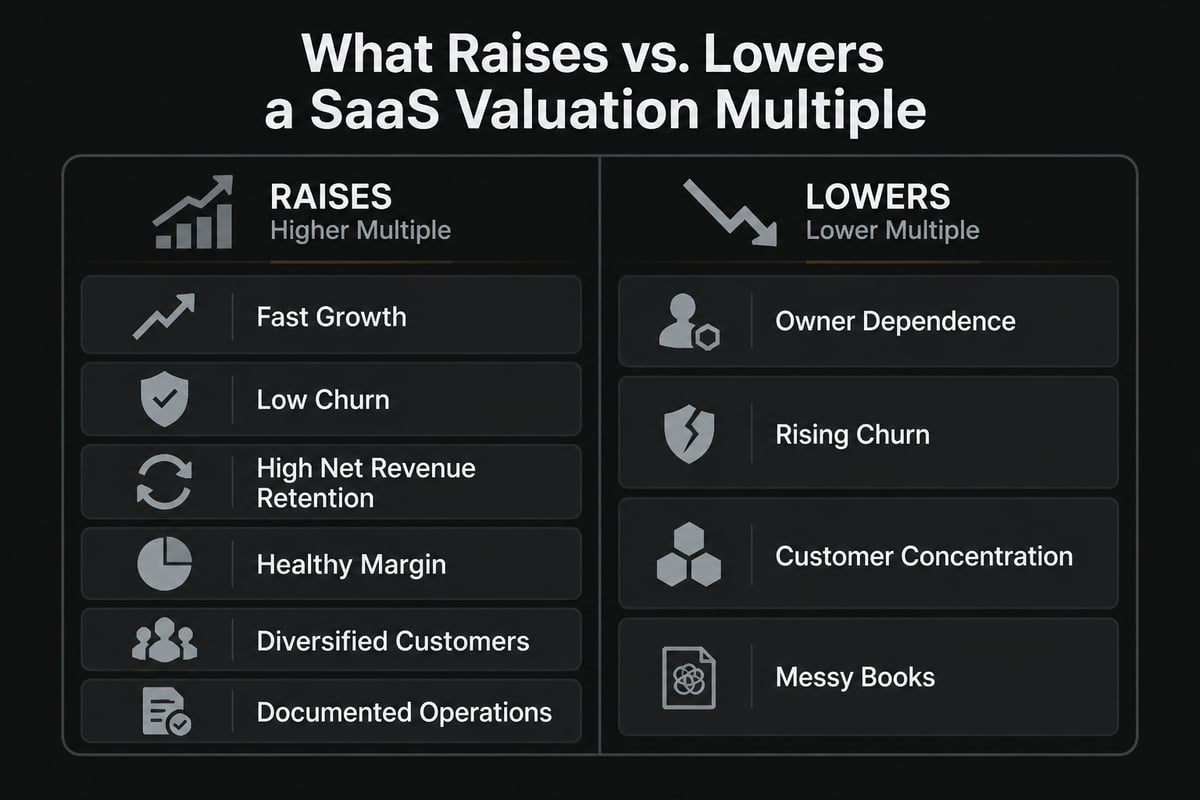
Things that raise your multiple:
- Fast, steady growth. A business adding revenue every month looks safer than a flat one.
- Low churn. Customers who stay are worth more. If you want benchmarks, see this guide to average churn for SaaS.
- High net revenue retention, meaning existing customers spend more over time.
- Healthy profit margins. A business that makes money while growing is rare and tends to be priced more favorably.
- Diversified customers. No single customer should make up a big share of revenue.
- Clean, documented operations that a new owner can run without you.
Things that lower it:
- Heavy reliance on you personally for support, sales, or code
- Rising churn or a leaky onboarding flow
- One or two customers driving most of the income
- Messy books or unclear revenue recognition
- A product built on a shaky technical foundation
If you want a deeper look at the metrics buyers will request, key SaaS metrics covers the ones worth tracking from day one. And since churn does so much damage to a valuation, how to reduce SaaS churn is worth a read before you ever think about selling.
The Rule of 40 and the 3 3 2 2 2 rule
The Rule of 40 says your revenue growth rate plus your profit margin should add up to at least 40%, and it's a widely used shortcut for judging whether a SaaS business is healthy. A company growing 30% with a 10% margin scores 40. One growing 10% with a 30% margin also scores 40. Buyers like the rule because it lets growth and profit trade off against each other.
It connects to price. SaaS Capital's private-company analysis, covering growth, profitability, and the Rule of 40, reports predicted valuation multiples of 4.8x for bootstrapped and 5.3x for equity-backed companies. Higher Rule of 40 scores generally tend to go with higher multiples.
You may also see the "3 3 2 2 2" rule floating around. It's a growth benchmark for SaaS companies: after reaching about $1 million in ARR, triple revenue for two years, then double it for three years. It's a stylized path popular in venture-backed circles, and it's useful as a mental model for ambition. Most bootstrapped solo founders won't track it, and you don't need to hit it to build a business worth buying.

Revenue, SDE, or EBITDA: which one applies to you?
Which multiple applies depends mostly on your business's size and whether you pay yourself a salary out of it. Smaller, owner-run apps lean on SDE, and bigger ones lean on EBITDA or revenue.
Here's a rough way to think about it:
- Revenue multiples fit businesses that are growing and reinvesting, where profit is low or deliberately suppressed. Buyers care about the revenue stream.
- SDE multiples fit tiny apps where the owner does everything. The buyer is mostly buying a job plus an asset, so they look at how much total income it produces for one person.
- EBITDA multiples fit companies with a team and salaries, where profit after paying people is the meaningful number.
For a solo founder with a micro product, the SDE view is usually the most realistic. If your app clears $5,000 a month in profit after tools and hosting, a buyer is going to price that against what a year of owner earnings looks like. Looking at micro SaaS examples gives you a feel for what small, profitable products look like.
Don't pick the method that gives you the biggest number. Pick the one a buyer in your size bracket would actually use, since they're the ones writing the check.
How SaaS companies scale (and why it changes the multiple)
SaaS companies scale by adding customers faster than they lose them, increasing what each customer pays, and keeping costs from growing at the same rate as revenue. Each of those moves shows up in your valuation.
The practical levers look like this:
- Acquire customers cheaply. Content, email, and community beat expensive paid ads for small products. See content marketing for SaaS for how that plays out.
- Keep them. Better onboarding and support cut churn, which raises both revenue and your multiple.
- Expand revenue per customer. Tiered plans, add-ons, and annual billing all lift average revenue.
- Automate. The less your business depends on your daily time, the more a buyer will pay for it.
Pricing is the lever founders often under-use.
Pricing your software business when you're still early
If you're pre-revenue or just getting started, a revenue multiple doesn't apply yet, because there's no recurring revenue to multiply. The value at this stage lives in the idea, the audience you're building, and how fast you can get to paying customers.
That's actually good news if you're an aspiring app builder. Your job right now isn't to optimize a multiple. It's to get to real, repeatable revenue, because every dollar of MRR you add is multiplied by a number later. A business at $0 can't be valued on revenue, and one at $10,000 a month suddenly can.
So the order of operations matters:
- Find an idea people will pay for.
- Build a simple version, with or without writing code.
- Sell it and learn from the first customers.
- Fix retention before pushing growth.
- Track your numbers so a buyer can verify them later.
If you're still hunting for the idea, browsing SaaS business ideas and app ideas that make money is a decent place to start. Building doesn't require a developer anymore either; building an app with AI is a realistic route for people with no coding background. CreateSell's approach covers the full path from finding an idea people will pay for to selling the app, with a focus on marketing and selling, which is where most app projects stall. Some products built on the system have reached $40k, $60k, and $30k per month in revenue, though results vary and nothing here is a promise of income.
Getting ready to sell: a short checklist
You can raise the price a buyer will pay by cleaning things up months before you list. Most of this is boring, and that's exactly why it works.
- Keep a clear monthly record of MRR, churn, and new customers.
- Separate business and personal finances.
- Write down how the product runs, from support to billing to updates.
- Reduce your own involvement wherever you can.
- Spread revenue across more customers.
- Fix the obvious bugs and the worst churn leaks.
When you're ready, selling your business online walks through the process, from listing to closing.
FAQ
Is a higher SaaS multiple always better?
Not necessarily. A high multiple on a small or declining revenue base can still produce a lower price than a modest multiple on a bigger, healthier business. Focus on growing the revenue number and keeping retention strong, since that's what earns the multiple in the first place.
Do SaaS valuation multiples change year to year?
Yes, quite a bit. According to Array Capital, the median private SaaS M&A multiple was 6.4x in 2021, 3.3x in 2023, and 2.9x in 2024. Market conditions and interest rates swing prices, so treat any single figure as a snapshot.
Can I sell a SaaS with no profit?
You can, if the revenue is growing and retention is solid, since buyers will often price on revenue rather than profit. That said, profitable businesses tend to command better multiples and attract more buyers, so even a small margin helps.
Your next step is simple: calculate your current ARR, even if it's tiny, and write down your churn and growth rate so you know where you stand. If you're not at revenue yet, the fastest way to get there is learning to build and sell an app the right way, and CreateSell teaches exactly that, with no coding required and a community shipping alongside you. Add your name through Join Waitlist at CreateSell to get in line for when the doors open.


