
MRR SaaS: Track Your Recurring Revenue Like a Pro

Modest Mitkus
May 13, 2026
If you're building a SaaS product in 2026, you've probably heard people throwing around terms like "MRR" in casual conversation like it's no big deal. But here's the thing: understanding mrr saas metrics isn't just fancy business jargon. It's the difference between guessing how your business is doing and actually knowing whether you're on track to build something sustainable. Monthly recurring revenue gives you a crystal-clear picture of your subscription income, helping you make smarter decisions about everything from hiring to feature development. Let's break down what you really need to know about tracking and growing your recurring revenue.
What Makes MRR SaaS Different from Traditional Revenue
Traditional businesses count money when it hits the bank account. You sell a widget, money comes in, you celebrate. Simple, right?
SaaS businesses operate in a completely different universe. When someone subscribes to your product, you can't count all that money upfront because they might cancel next month. Monthly recurring revenue gives you a normalized view of what you're actually earning each month from active subscriptions.
Think of it this way: if you have ten customers each paying $100 per month, your MRR is $1,000. It doesn't matter if they pay annually or monthly, you're breaking it down to understand your monthly run rate.
The Core Components of MRR
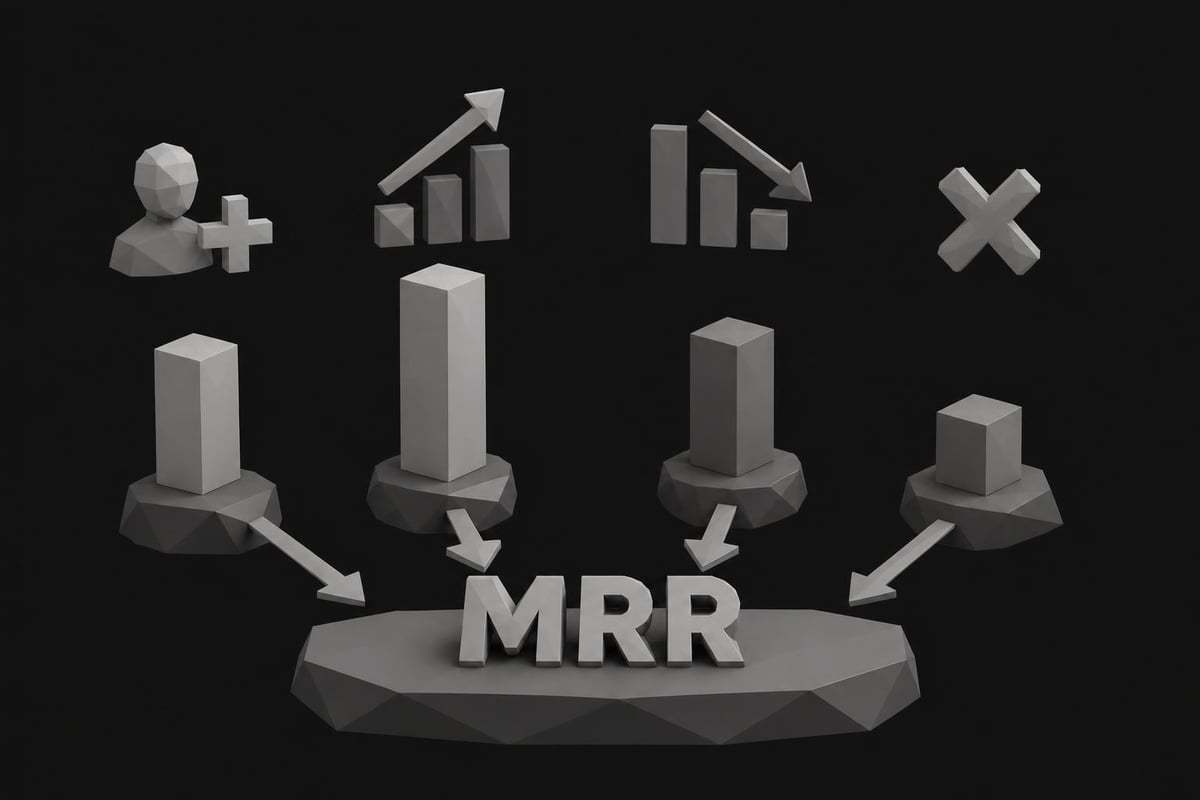
Your mrr saas calculation isn't just one number. It's made up of different moving parts that tell you exactly where your growth is coming from (or where you're losing ground).
New MRR comes from brand-new customers who just signed up. This is the exciting stuff, the validation that people want what you're building.
Expansion MRR happens when existing customers upgrade their plans or buy add-ons. This is actually the best kind of growth because you're getting more value from people who already trust you.
Contraction MRR is the opposite side of the coin. When customers downgrade to cheaper plans, you lose recurring revenue even though they're still around.
Churned MRR represents the revenue you lose when customers cancel completely. This one hurts, but it's essential to track.
Calculating Your MRR SaaS Metrics the Right Way
Here's where people get tripped up. The calculation seems straightforward, but there are nuances that matter a lot.
The basic formula is simple:
Total MRR = Sum of all recurring revenue for the month
But what counts as recurring? Your annual subscriptions need to be divided by 12. One-time setup fees don't count. Usage-based charges that vary wildly each month? Those shouldn't be in your MRR calculation either.
Let's say you have:
- 50 monthly subscribers at $29/month
- 10 annual subscribers who paid $299/year upfront
- $500 in one-time setup fees this month
Your MRR would be: (50 × $29) + (10 × $299 ÷ 12) = $1,450 + $249.17 = $1,699.17
Notice how we completely ignored those setup fees? That's because MRR focuses on predictable, recurring income, not one-off payments.
Tracking Different MRR Movements
Your total MRR is just the starting point. The real insights come from breaking down how that number changes month over month.
| MRR Type | What It Means | Why It Matters |
|---|---|---|
| New MRR | Revenue from new customers | Shows acquisition effectiveness |
| Expansion MRR | Upgrades and add-ons | Indicates product value and upsell success |
| Contraction MRR | Downgrades | Early warning sign of value issues |
| Churned MRR | Canceled subscriptions | Direct hit to growth |
| Net New MRR | New + Expansion - Contraction - Churn | Your actual month-over-month growth |
That last one, Net New MRR, is what you should be obsessing over. It's the truest measure of whether you're actually growing or just replacing lost customers with new ones.
Why MRR SaaS Matters More Than Total Revenue
You might be thinking, "Why can't I just look at how much money came in this month?" Fair question.
The problem is that revenue can be super misleading in subscription businesses. Maybe you had a great month because three customers prepaid for the year. Does that mean your business tripled? Nope. It means you got lucky with timing.
MRR gives you a normalized view that smooths out these fluctuations. It's the metric that helps you:
- Forecast accurately because you know your baseline recurring income
- Spot trends early before they become major problems
- Make hiring decisions with confidence about sustainable revenue
- Pitch investors with the metrics they actually care about
When you're building a one-person digital product business, understanding your mrr saas metrics helps you know when you can afford to quit your day job or when you need to double down on customer retention.
Benchmarking Your MRR Against Industry Standards
So what's a "good" MRR? That depends entirely on your stage, market, and business model.
Industry benchmarks vary significantly based on your target customer and pricing strategy. B2B SaaS targeting enterprises typically has higher MRR per customer but slower growth. Consumer SaaS might have lower MRR per customer but faster scaling potential.
For early-stage SaaS in 2026, here's what you're generally looking at:
- Pre-seed stage: $1K - $10K MRR
- Seed stage: $10K - $50K MRR
- Series A ready: $100K+ MRR with strong growth
But honestly? These numbers matter less than your growth rate. A SaaS growing at 15-20% month-over-month with $5K MRR is way more interesting than one stuck at $50K with zero growth.
Growth Rate Expectations
Your MRR growth rate tells investors and potential acquirers everything they need to know about your trajectory.
In the early days (under $10K MRR), you should be seeing 20%+ monthly growth if you've found product-market fit. As you scale past $100K MRR, that naturally slows to 10-15% monthly.
The math is simple but powerful: at 15% monthly growth, you'll roughly 5x your MRR in a year. That's the kind of trajectory that turns side projects into real businesses.

Common MRR SaaS Mistakes You Need to Avoid
Let's talk about where people screw this up, because I see it all the time.
Mistake #1: Including non-recurring revenue
Your customer paid for annual support? Cool, but that's not MRR unless they're going to automatically renew. Professional services, one-time migrations, setup fees - none of that belongs in your MRR calculation. Accurate MRR reporting requires discipline about what counts and what doesn't.
Mistake #2: Ignoring contraction and churn
Some founders only track new MRR and conveniently forget about the revenue they're losing. That's like only looking at your income and ignoring your expenses. Your net new MRR is what actually matters.
Mistake #3: Not segmenting by plan or cohort
All MRR is not created equal. Revenue from customers who signed up six months ago and are still active? That's way more valuable than revenue from customers who just signed up yesterday. Segment your data to understand retention patterns.
Setting Up Proper MRR Tracking
You don't need fancy enterprise software to track mrr saas metrics when you're starting out. A simple spreadsheet works fine until you hit around $10K MRR.
Track these columns at minimum:
- Customer name/ID
- Plan type
- Monthly rate (normalize annual to monthly)
- Start date
- Status (active/churned)
- Upgrades/downgrades with dates
Once you're growing consistently, invest in proper analytics tools. But early on, manual tracking helps you really understand the numbers intimately.
Strategies to Grow Your MRR Sustainably
Now for the fun part - actually increasing that mrr saas number every month.
Strategy #1: Optimize your pricing tiers
Most SaaS products start with pricing that's way too low. Don't be afraid to test higher prices, especially if you're solving a real problem. Consider adding a premium tier that's 3-4x your basic plan with high-value features.
Strategy #2: Focus on expansion revenue
It's way easier to get existing customers to pay you more than to find new customers. Build upgrade paths into your product. If someone's hitting usage limits, that's a perfect time to suggest an upgrade.
If you're building your first SaaS product and want a structured approach to creating something people actually want to pay for monthly, the Build and Launch Your SaaS App in 14 Days course walks you through the entire process from validation to launch.

Strategy #3: Reduce involuntary churn
A shocking amount of churn happens because credit cards expire or payments fail. Set up dunning sequences - automated emails that remind customers to update their payment info. This alone can reduce churn by 10-20%.
Strategy #4: Annual plans with incentives
Getting customers to commit to annual plans gives you more predictable cash flow and typically reduces churn. Offer a 15-20% discount for annual commitments. Even though you're discounting, the improved retention usually makes it worth it.
The Role of Customer Success in MRR Growth
Here's something that surprised me when I started tracking mrr saas metrics closely: customer success initiatives directly impact your bottom line faster than almost any marketing channel.
When you help customers actually succeed with your product, three things happen:
- They stick around longer (lower churned MRR)
- They upgrade more often (higher expansion MRR)
- They tell their friends (more new MRR)
Even as a solo founder, you can do this. Send onboarding emails. Check in with customers after 30 days. Ask for feedback. Create helpful content that shows them how to get more value from your product.
Understanding the Relationship Between MRR and ARR
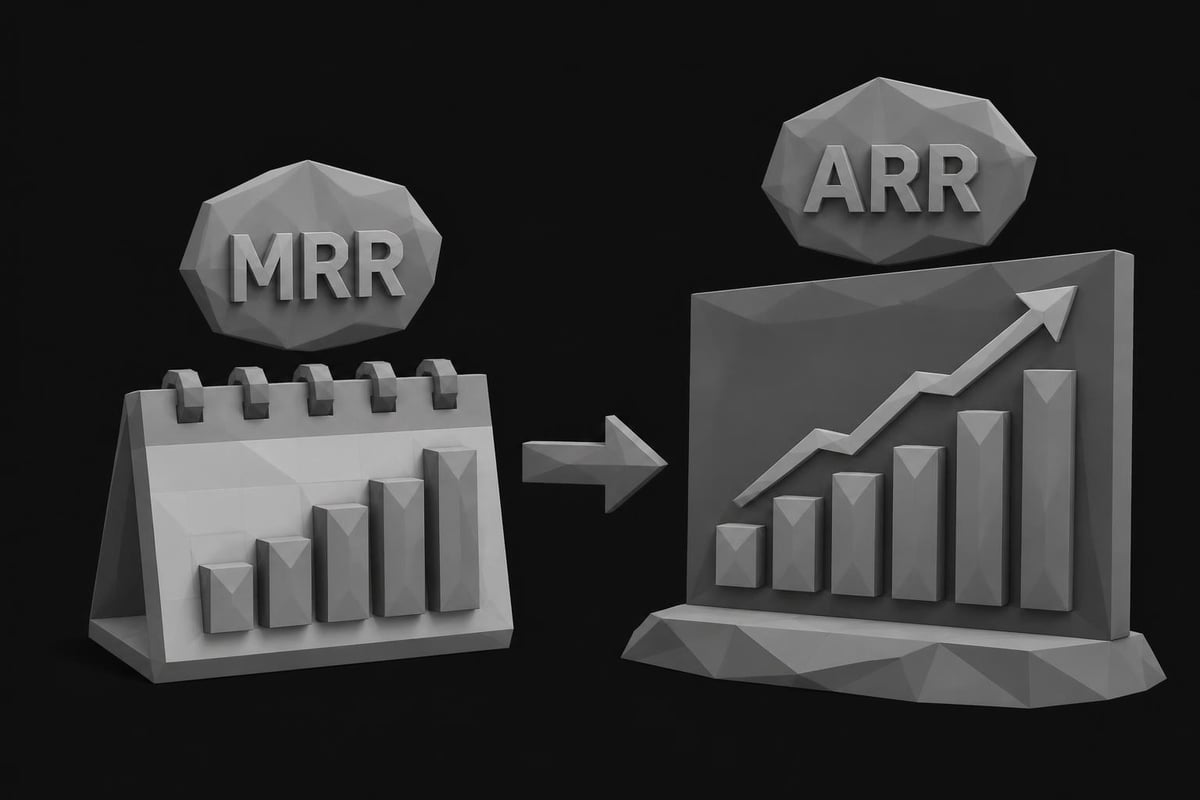
You'll often hear people talk about ARR (Annual Recurring Revenue) alongside MRR. They're related but serve different purposes.
ARR is simply MRR × 12, giving you an annualized view of your recurring revenue. Most early-stage companies focus on MRR because it's more granular and helps you spot trends faster.
ARR becomes more useful when you're at scale (typically $1M+ in revenue) and talking to investors or planning long-term strategy. At that point, the volatility of month-to-month changes matters less than your annual trajectory.
| Metric | Best For | When to Use |
|---|---|---|
| MRR | Month-to-month tracking | Early stage, under $1M revenue |
| ARR | Annual planning, investor discussions | Scale stage, $1M+ revenue |
| Net New MRR | Growth analysis | All stages |
For most solo founders and small teams in 2026, MRR should be your primary focus. It's actionable, it updates monthly, and it gives you the feedback loops you need to iterate quickly.
Advanced MRR Metrics for Serious Growth
Once you've got the basics down, there are some advanced mrr saas metrics that'll give you even deeper insights.
MRR Growth Rate = (Current MRR - Previous MRR) / Previous MRR × 100
This percentage tells you how fast you're growing. Aim for double-digit monthly growth in your early stages.
Quick Ratio = (New MRR + Expansion MRR) / (Churned MRR + Contraction MRR)
This shows whether you're gaining revenue faster than you're losing it. A ratio above 4 is excellent, indicating healthy, sustainable growth. Below 1 means you're in trouble - you're losing revenue faster than you're gaining it.
Customer Lifetime Value (LTV) relative to MRR helps you understand how long customers stick around and how much you can afford to spend acquiring them.
Using MRR for Financial Forecasting
One of the biggest advantages of tracking mrr saas metrics is the ability to forecast with actual data instead of wishful thinking.
Take your current MRR and your average growth rate over the past 3-6 months. Apply that growth rate forward to project where you'll be in 6, 12, or 24 months.
For example, if you're at $5,000 MRR growing at 15% monthly:
- Month 6: ~$11,300 MRR
- Month 12: ~$26,000 MRR
- Month 24: ~$150,000 MRR
Obviously, growth rates change over time, but this gives you a baseline to plan around. When should you hire help? When can you go full-time? Your MRR projections answer these questions.
Communicating MRR to Different Audiences
Here's something nobody tells you: different people care about different aspects of your mrr saas metrics.
For investors, they want to see:
- Total MRR and growth rate
- Net revenue retention (shows expansion minus churn)
- Unit economics (CAC vs LTV)
For your team, focus on:
- New MRR (validates marketing and sales efforts)
- Churn rate (shows product quality and customer success effectiveness)
- Specific goals and how close you are to hitting them
For yourself, track everything. The more granular your understanding, the better decisions you'll make.
When you're pitching your SaaS or explaining traction, lead with Net New MRR and growth rate. These tell the most compelling story about your business trajectory.
If you're serious about improving your visibility and attracting more customers to grow that MRR, working with specialists like Shawn the SEO Geek can help you rank higher and drive consistent organic traffic to your landing pages.
The Psychological Impact of Watching Your MRR
Let's get real for a second. Tracking your mrr saas metrics month after month does something to you psychologically.
When that number goes up, you feel invincible. You start thinking about scaling, hiring, maybe taking a real vacation. When it goes down or stalls, you question everything. Is the product bad? Is the market too small? Should you pivot?
The key is remembering that MRR is a lagging indicator. The actions you take today won't show up in your MRR for weeks or even months. Don't panic over one bad month, and don't get overconfident from one great month.
Look at 3-month trends minimum. That's where the real story lives. Are you trending up overall, even if there are bumps? Are certain customer segments churning more than others? Is expansion MRR growing as a percentage of total revenue?
These patterns tell you where to focus your energy. And focusing your energy on the right things is what separates SaaS products that fizzle out from ones that become sustainable businesses.
How MRR Connects to Other Key Metrics
Your mrr saas metrics don't exist in a vacuum. They're connected to every other part of your business in important ways.
Key revenue metrics work together to give you a complete picture of business health. Here's how they connect:
Customer Acquisition Cost (CAC) ÷ MRR per customer tells you how many months it takes to recover your acquisition costs. Under 12 months is healthy for most SaaS businesses.
Churn rate directly impacts how long you keep MRR. A 5% monthly churn rate means the average customer stays 20 months. That's hugely important for calculating lifetime value.
Gross margin affects how much of your MRR actually contributes to growth. If you're spending 60% on hosting and support, only 40% of MRR is available for growth investments.
Understanding these connections helps you see the business as a system rather than a collection of random numbers. When MRR growth slows, you can trace it back - is CAC too high? Is churn increasing? Did expansion revenue dry up?
Understanding and tracking your mrr saas metrics gives you the clarity you need to build a sustainable subscription business instead of just guessing your way forward. The patterns in your recurring revenue tell you exactly where to focus your energy for maximum growth.
Ready to stop trading hours for dollars and start building products that generate recurring revenue while you sleep? CreateSell gives you everything you need to create and launch your own SaaS or mobile app - even if you've never written a line of code. Learn vibe coding, validate your ideas, and build a one-person business that scales beyond your available time.