
MVP Agile Guide: Building a Minimum Viable Product in Sprints

Modest Mitkus · November 21, 2026
MVP agile is the practice of building the smallest version of a product that real users can try, and doing it in short, fixed-length sprints so you learn from feedback after every cycle. The MVP tells you what to build first, and agile tells you how to build it without wandering off for six months. If you're making an app you hope to sell, this pairing keeps you from sinking time into features nobody asked for.
This guide walks through how the two ideas fit together, how to plan sprints for a first product, and how to decide when your MVP is ready to put in front of buyers.
What does MVP mean in agile?
In agile, an MVP is the smallest working version of a product that delivers real value to a specific user and lets you test an assumption with actual behavior. It isn't a demo, a mockup, or a half-broken app. It's a real product with a deliberately narrow scope.
The term comes from lean startup thinking, where MVP stands for minimum viable product. The "viable" part matters. Your product has to solve one problem well enough that someone would use it, and ideally pay for it.
Agile gives that idea a rhythm. Instead of one giant build followed by a big reveal, you ship small increments, check what happened, and adjust. Each sprint ends with something usable, so your MVP grows out of evidence instead of guesses.
MVP, MMP, and MMF: what's the difference?
An MVP is the first version used to learn, an MMF (minimum marketable feature) is the smallest single feature worth releasing, and an MMP (minimum marketable product) is the first version polished enough to sell broadly. They sit at different points in the same journey.
| Term | What it is | Main goal |
|---|---|---|
| MVP | Smallest version that tests your core idea | Learn what users want |
| MMF | Smallest feature that has value on its own | Release something useful fast |
| MMP | First version good enough to market widely | Earn revenue at scale |
A rough way to remember it: the MVP answers "should we build this?", the MMF answers "what's the next useful piece?", and the MMP answers "is this ready to sell to everyone?"
Plenty of solo builders skip the MMP label entirely and just keep improving the MVP while charging for it. That's fine. What matters is that you know which question you're answering at each stage.
Which comes first, MVP or proof of concept?
A proof of concept comes first. A PoC checks whether something is technically possible, a prototype shows how it might look and feel, and an MVP is the first thing real users can actually use.
Think of it as three questions in order:
- Proof of concept: Can this be built at all?
- Prototype: Does the flow make sense to people?
- MVP: Will people use it, and will they pay?
If you're using AI tools to build, you can often collapse the first two steps into a single afternoon. That's one reason building an app with AI has become so approachable for people who've never written code.
How MVP and Scrum sprints fit together
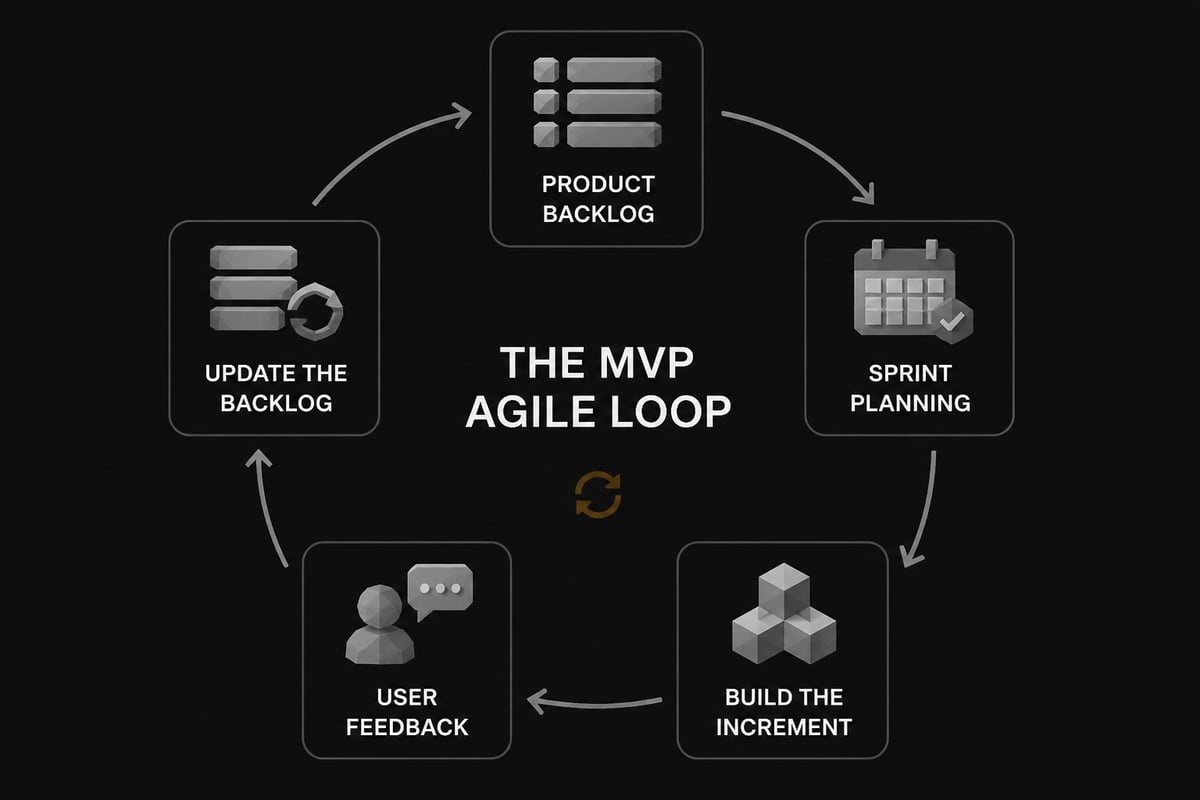
Scrum sprints give your MVP a structure: fixed-length cycles, a ranked list of work, and a usable result at the end of each cycle. You don't need a team of ten to borrow the useful parts.
According to the Scrum Guide, Sprints are fixed-length events of one month or less, and a new Sprint begins immediately after the previous one ends. For an MVP, that fixed length is a gift. It forces you to cut scope instead of extending the deadline.
Here's how the main Scrum pieces map onto an MVP:
- Product Backlog: The Scrum Guide describes it as an ordered, evolving list of what is needed to improve the product, and the single source of work for the Scrum Team. For you, it's every feature idea you've had, ranked.
- Sprint Goal: One sentence describing what this sprint should prove, such as "a user can sign up and generate their first result."
- Sprint Backlog: The Sprint Goal, the items you pulled from the backlog, and your plan for delivering them.
- Increment: The working piece you have at the end, which you can show to someone.
Solo builders often skip the ceremonies, and that's okay. Keep the goal, the ranked list, and the review at the end.
How to plan your MVP sprints
Plan your MVP sprints by defining one problem, ranking features by how directly they solve it, and giving each sprint a single goal you can verify with a real person. Here's a workable sequence.
Start with one problem and one user
Write down who you're building for and the one painful thing they want solved. If you can't say it in a sentence, the scope is still too wide. Strong starting points often come from app ideas that make money because they begin with a problem people already pay to fix.
Build the backlog and rank it hard
Dump every feature idea into your Product Backlog, then rank them by one test: does the product still solve the core problem without this? If yes, it waits. First-time builders often cut a large share of their list, and the product tends to get better for it.
Make backlog items sprint-sized
The Scrum Guide says Product Backlog items are considered ready for Sprint Planning when the Scrum Team can complete them within one Sprint. If a feature won't fit, split it. "User accounts" can become "email sign-up" now and "password reset" later.
Set a sprint length that matches your pace
Shorter is usually better for a first product. Scrum.org notes that a Sprint that is too long can allow the Sprint Goal to become invalid and increase complexity and risk. A short sprint keeps your goal fresh and your feedback loop tight.
Planning doesn't need to eat your week either. The Scrum Guide caps Sprint Planning at a maximum of eight hours for a one-month Sprint, and shorter sprints should get proportionally less time. Keep planning brief for a short sprint.

A sample four-sprint MVP plan
A realistic first MVP can take shape in four short sprints: one to prove the core action, one to make it usable, one to add payment, and one to get real feedback. Treat this as a template, not a rulebook.
Hypothetical example: a simple web app that turns a user's notes into a formatted checklist.
- Sprint 1, core action: A user pastes text and gets a checklist back. No design, no accounts. Goal: does the main thing work?
- Sprint 2, usable flow: Add a clean screen, basic sign-up, and the ability to save results. Goal: can a stranger finish the task without help?
- Sprint 3, payment: Add a paywall or subscription. Goal: will anyone actually pay?
- Sprint 4, feedback and fixes: Talk to your first users, fix the biggest friction point, and rewrite the backlog based on what you heard.
Notice that payment arrives in sprint three, not at the end. Charging early is the cleanest signal you'll ever get that the product has value. If you're deciding how to charge, SaaS pricing strategy is worth reading before sprint three starts.
What does MVP have to do with KPIs?
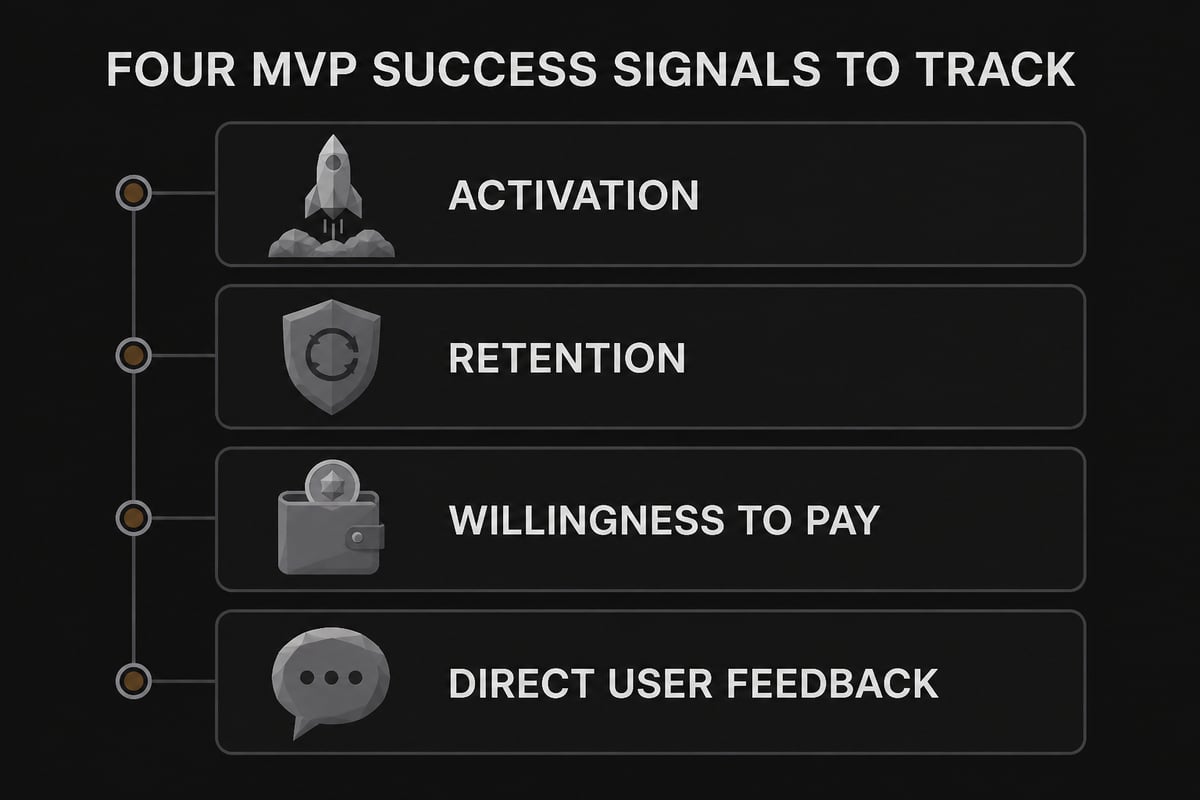
KPIs are the numbers you use to judge whether your MVP is working, and you should pick two or three before the first sprint ends. A KPI turns "I think people like it" into something you can check.
Good MVP metrics are simple and tied to the problem you're solving:
- Activation: How many visitors complete the core action at least once?
- Retention: Do users come back after a week?
- Willingness to pay: How many people reach checkout, and how many finish?
- Qualitative signal: What do users say when you ask what they'd miss if it disappeared?
Skip vanity numbers like page views. A hundred visitors who never try the product teach you less than five who use it and complain about one specific thing.
Common MVP agile mistakes to avoid
The most common mistakes are building too much, polishing too early, and treating sprint reviews as a formality. Each one quietly turns a learning project back into a long, risky build.
- Feature creep inside the sprint. New ideas go to the backlog, not into the current sprint.
- Confusing "minimum" with "low quality." Narrow the scope, but make the one thing you ship work reliably.
- Skipping real users. Showing the app to friends who won't be honest doesn't count as feedback.
- Building before validating demand. An MVP tests an assumption. If you haven't named the assumption, you can't tell whether you tested it.
- Never launching. A sprint that ends with "almost ready" every time is a warning sign. Cut scope until something ships.
If you want a deeper walkthrough on scoping the first release, CreateSell's posts on developing an MVP and MVP software development cover the build side in more detail.
The part where most app MVPs actually fail: selling
Most MVPs don't fail because the code is bad. They fail because nobody ever hears about them, and the builder never planned for that. A working product with zero audience teaches you nothing about demand.
This is where agile thinking pays off a second time. Treat marketing as a backlog item with its own sprint goals:
- Sprint goal example: "Get ten people who match my target user to try the MVP this week."
- Another goal: "Get three of them on a call to watch them use it."
- Another: "Publish one landing page and see how many visitors sign up."
Your landing page is part of the MVP, not an afterthought, so it helps to know what makes product landing pages convert. And since you'll need people to show up, building an audience alongside the product, not after it, makes every later sprint easier.
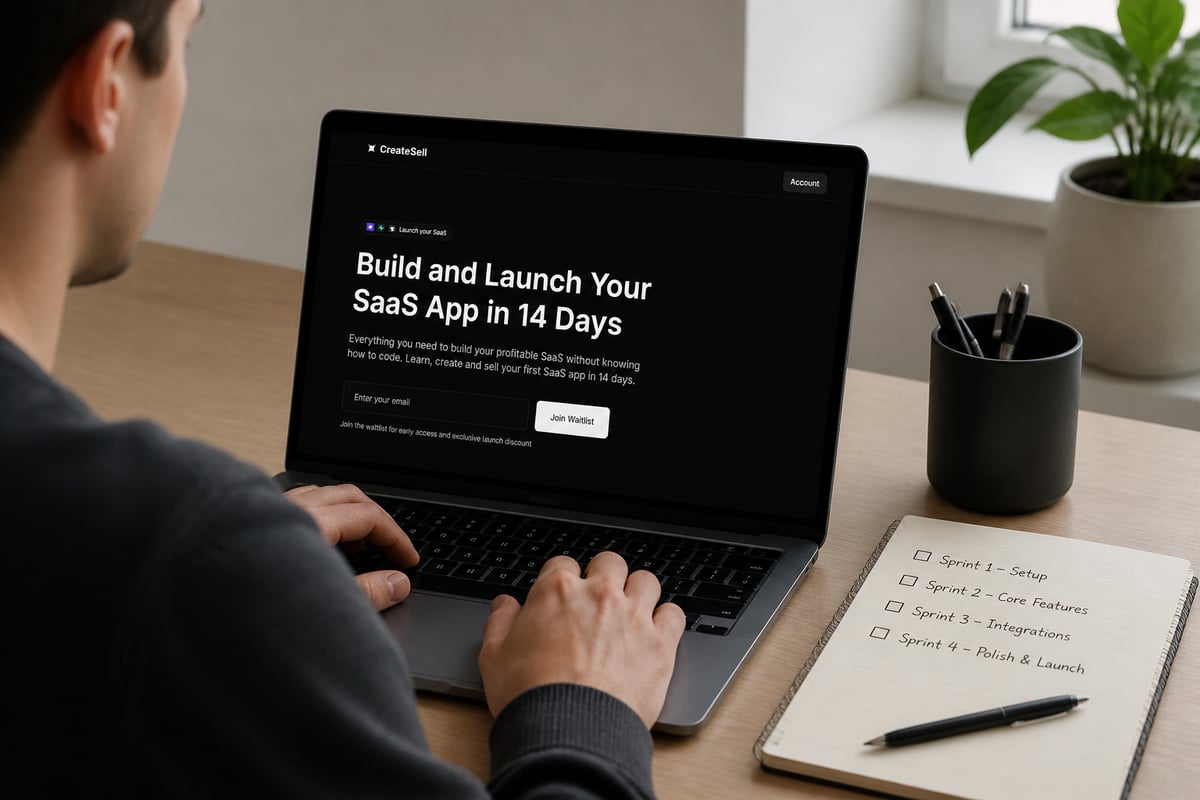
For builders who want a single path through all of this, from picking an idea people will pay for to getting the first sale, the Build and Launch Your SaaS App in 14 Days course covers it end to end. It's built on a system used to scale several products to tens of thousands of dollars per month, it works for web or iOS apps, and it assumes no coding experience.
How to know when your MVP is done
Your MVP is done when it solves the core problem for a defined user and gives you enough evidence to decide what happens next. "Done" doesn't mean finished. It means ready to learn from.
A quick checklist:
- A new user can complete the core task without you explaining it.
- At least a handful of real people have used it.
- You've asked for payment, or have a clear reason you haven't yet.
- You know the top one or two things users want next.
From there, one of three things happens. You persevere because the numbers and feedback point the right way, you pivot because users want something adjacent, or you stop because the problem isn't painful enough. All three are good outcomes, because you found out in weeks rather than a year.
FAQ
What does MVP stand for in lean startup?
MVP stands for minimum viable product. In lean startup, it's the version of a product with just enough features to test a core assumption with real customers, so you learn before investing heavily.
Can I use MVP agile without a development team?
Yes. Solo builders can use the same ideas with a ranked backlog, a one- or two-week cycle, a clear goal for each cycle, and a review at the end. You can skip the formal meetings and keep the habits that matter.
How long should an MVP take to build?
It depends on scope, but the sprint structure helps you keep it short. Many first MVPs fit in a handful of short sprints because the scope is cut down to one problem and one user, and anything that doesn't serve that goes to the backlog.
Your next step is small: write one sentence naming the person you're building for and the single problem you're solving, then turn it into your first sprint goal. If you'd like a full path from idea to first sale, including the marketing side, the Build and Launch Your SaaS App in 14 Days course lays it out step by step, and you can join the waitlist at CreateSell to be first in line for what's coming next.


