
SaaS Pricing Strategy: The Complete 2026 Guide

Modest Mitkus
May 27, 2026
Pricing your SaaS product is probably one of the most nerve-wracking decisions you'll make as a digital product creator. Set it too high, and you scare away potential customers. Set it too low, and you're leaving money on the table while struggling to cover costs. The truth is, your saas pricing strategy isn't just about picking numbers that sound good - it's about understanding your value, your customers, and how to align both in a way that makes your business sustainable and profitable.
Understanding SaaS Pricing Fundamentals
Before we jump into specific models and tactics, let's talk about what makes SaaS pricing different from traditional products. You're not selling a one-time purchase here. You're building recurring revenue streams that compound over time, which means your pricing needs to reflect the ongoing value you deliver.
The beauty of SaaS is that you can adjust, test, and optimize your pricing as you learn more about your customers. Unlike physical products sitting on store shelves, you've got flexibility to evolve your saas pricing strategy based on real data and customer feedback.
The Value Metric Foundation
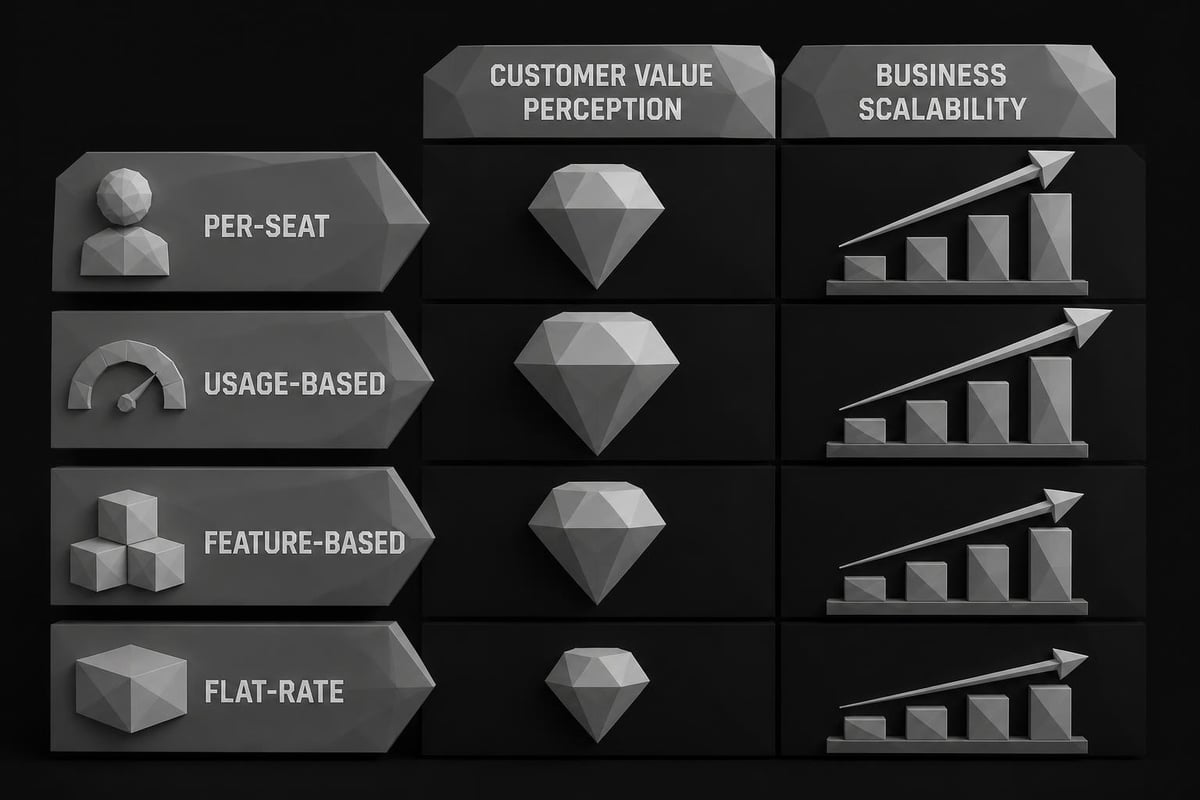
Your value metric is basically the unit that determines how customers pay. Are they paying per user? Per feature? Per usage? This single decision shapes everything else about your pricing model.
- Per-seat pricing: Customers pay based on team size or number of users
- Usage-based pricing: Costs scale with actual consumption (emails sent, API calls, storage used)
- Feature-based pricing: Different tiers unlock different capabilities
- Flat-rate pricing: Single price for unlimited access
According to data from over 3,500 SaaS tools, per-seat models remain dominant but usage-based pricing is growing fast in 2026. The right choice depends on how your customers actually experience value from your product.
Common SaaS Pricing Models That Work
Let's break down the most effective pricing models you'll see in the wild. Each has its own strengths and works better for certain types of products and audiences.
Freemium vs. Free Trial
This is where most first-time SaaS creators get stuck. Should you give away a limited version forever, or give full access for a limited time?
Freemium lets users access basic features indefinitely. Think Notion's free tier or Mailchimp's starter plan. You're betting that enough users will eventually upgrade to paid plans to support the free users. The best practices for SaaS pricing suggest freemium works best when your product has viral potential or benefits from network effects.
Free trials give complete access for a set period, then require payment. This works better when your full product delivers obvious value quickly and you've got strong onboarding to get users to that "aha moment" fast.
| Approach | Best For | Main Risk |
|---|---|---|
| Freemium | Products with viral loops, low marginal cost per user | Free users never convert |
| Free Trial | Complex products with clear ROI, strong onboarding | Users don't engage during trial |
| No Free Option | Established brands, enterprise products | Higher barrier to entry |
Tiered Pricing Architecture
Most successful SaaS products use tiered pricing - and for good reason. It lets different customer segments self-select into the option that fits their needs and budget.
Your basic tier should be attractive enough to convert free users or new customers, but limited enough that growing businesses naturally bump into its constraints. The middle tier is usually your sweet spot where most customers land. Your top tier? That's for power users and teams who need everything you've got.
When designing tiers for your saas pricing strategy, resist the temptation to create too many options. Three to four tiers is the sweet spot. More than that and you create decision paralysis.
Building Your Pricing Strategy Step by Step
Now that you understand the models, let's talk about actually building your strategy. This isn't something you do once and forget - it's an ongoing process that evolves with your product and market.
Step 1: Know Your Costs and Target Margins
Start with your unit economics. What does it cost you to serve one customer? Include hosting, support, payment processing, and a slice of your development costs. If you're spending $15 per customer per month to deliver your service, you obviously can't charge $10 and survive.
Most SaaS companies target gross margins of 70-90%. That gives you room to invest in growth, customer acquisition, and product development while staying profitable.
Step 2: Research Your Competitive Landscape
Look at what competitors charge, but don't just copy them. Understand why they price the way they do. Are they competing on price? Premium positioning? Different target markets?
Microsoft's framework for SaaS pricing strategies emphasizes aligning your pricing with customer usage patterns and product complexity. If your product solves a more painful problem or delivers faster results than alternatives, you can command premium pricing.
Step 3: Calculate Customer Lifetime Value
Your SaaS pricing strategy should maximize Customer Lifetime Value (LTV) while keeping Customer Acquisition Cost (CAC) sustainable. The magic ratio? You want LTV to be at least 3x your CAC.
Here's a simple calculation:
- Average revenue per customer per month: $50
- Average customer lifespan: 18 months
- Gross margin: 80%
- LTV = $50 × 18 × 0.80 = $720
If it costs you $300 to acquire a customer, you're in good shape. If it costs $600, you've got problems.

Advanced Pricing Tactics for Growth
Once you've got your basic strategy down, these advanced tactics can help you optimize revenue and serve different customer segments better.
Usage-Based Pricing Sophistication
Usage-based models have exploded in popularity because they align perfectly with "you only pay for what you use" customer expectations. The comparison of seat-based versus usage-based models shows usage pricing can reduce friction for new customers while automatically capturing more revenue from power users.
The trick is picking usage metrics that customers understand and can predict. API calls work great for developer tools. Email sends work for marketing platforms. Storage works for cloud services. Avoid metrics that feel arbitrary or punitive.
Grandfathering and Price Changes
Eventually, you'll need to raise prices. The question isn't if, but when and how. Most SaaS companies grandfather existing customers at their old rates, at least for a period. This builds goodwill and reduces churn risk.
When you do raise prices, communicate the value you've added since launch. New features, better support, improved infrastructure - all justify higher prices. Give plenty of notice (30-60 days minimum) and consider offering annual plans at current rates as a transition option.
Annual vs. Monthly Billing
Offering both monthly and annual options is standard practice, but the discount you offer for annual commitments matters. Too small (5-10%) and nobody bites. Too large (40%+) and you're giving away revenue for no reason.
The sweet spot is usually 15-25% off for annual plans. So if your monthly price is $50, offer annual at $500-510 ($41.67-42.50 per month effective rate). You get cash upfront and better retention, they save money.
Pricing Psychology and Presentation
How you present your prices matters just as much as the numbers themselves. Small changes in presentation can significantly impact conversion rates.
Anchoring and Positioning
Always show your prices left to right, cheapest to most expensive. But here's the trick - make your middle tier the most visually prominent. Use color, larger buttons, or "Most Popular" badges to draw the eye there.
This psychological anchoring makes your middle tier feel like the "right" choice. Customers see the basic tier as too limited and the premium tier as more than they need, so they land exactly where you want them.
Price Point Sweet Spots
Certain price points convert better than others. The comprehensive pricing framework reveals that prices ending in 9 ($29, $99) work well for consumer products, while round numbers ($30, $100) perform better for B2B tools.
For monthly SaaS pricing, these ranges see high conversion:
- Entry tier: $9-29
- Mid tier: $49-99
- Pro tier: $149-299
- Enterprise: $500+
Transparent vs. Custom Pricing
Should you show prices on your website? For lower-priced tiers aimed at individuals and small teams, absolutely yes. Hidden pricing creates friction and distrust.
For enterprise tiers, "Contact us" makes sense because deals involve customization, negotiation, and relationship building. Just make sure your public tiers go high enough that mid-market customers don't feel forced to talk to sales.
Testing and Iterating Your Strategy
Your initial saas pricing strategy is basically an educated guess. The real optimization happens through systematic testing and learning from customer behavior.
What to Test and When
Don't test pricing in your first few months. You need baseline data first. Once you've got at least 100 customers and understand your conversion funnel, then start experimenting.
Safe tests to start with:
- Annual discount percentage
- Tier names and feature positioning
- Add-on pricing for extra features
- Trial length (7 vs. 14 vs. 30 days)
Riskier tests that can pay off:
- Core price point changes
- Switching value metrics entirely
- Adding or removing tiers
- Freemium vs. trial approach
The data-driven guide to SaaS pricing strategies emphasizes testing one variable at a time and running experiments long enough to reach statistical significance. In practice, that usually means at least 2-4 weeks per test.
Learning from Customer Feedback
Your customers will tell you if your pricing is off - you just need to listen. If you're hearing "too expensive" repeatedly, that's a signal. But dig deeper. Too expensive compared to what? Too expensive for the value delivered? Or just too expensive for their budget?
Exit surveys for churned customers reveal pricing issues faster than anything else. If 40% of cancellations mention price, you've got work to do. If only 10% do, price probably isn't your main problem.
Packaging Features Across Tiers
Which features go in which tier? This is where art meets science in your saas pricing strategy. You're trying to create clear differentiation without making lower tiers feel crippled.
The Core Features Everyone Gets
Your base tier should deliver real value - enough that users can accomplish meaningful work and experience your product's core benefit. If you're a project management tool, basic tier users should be able to manage projects. If you're an email platform, they should be able to send emails.
Don't gate fundamental functionality behind higher tiers. That just frustrates users and creates negative word-of-mouth.
Features That Drive Upgrades
The features that live in higher tiers should be ones that naturally matter more as usage scales or businesses mature:
- Collaboration features: Multiple team members, permissions, roles
- Advanced analytics: Custom reports, dashboards, data exports
- Integrations: Connects to other tools, API access, webhooks
- Support level: Priority support, dedicated account manager, phone support
- Customization: White labeling, custom domains, advanced settings
- Limits removal: More projects, storage, users, or whatever your metric is
If you're building your SaaS from scratch and want to get to market fast, programs like Build and Launch Your SaaS App in 14 Days teach you how to create products that customers actually want to pay for, including how to structure your features and pricing for maximum conversion.
Special Pricing Considerations for Digital Product Creators
As someone building digital products, you've got some unique advantages when it comes to pricing. Your marginal costs are incredibly low - adding another customer doesn't cost you much. This gives you pricing flexibility that physical product businesses can only dream about.
Pricing for One-Person Businesses
When you're running solo, your saas pricing strategy needs to balance revenue goals with operational capacity. You can't support thousands of $10/month customers if each one needs regular hand-holding.
Consider these approaches:
Higher prices, fewer customers: Charge $100-500/month and deliver white-glove service to 50-100 customers. More manageable, more profitable per customer, stronger relationships.
Lower prices, self-service focused: Charge $10-30/month but invest heavily in documentation, onboarding automation, and community support. Scale through systems, not personal time.
Hybrid model: Free or low-cost self-service tier, premium pricing for customers who want direct support and custom implementations.
Bootstrapper-Friendly Models
Most digital product creators are bootstrapping without venture capital. That means your pricing needs to generate positive cash flow quickly. Examples of real SaaS pricing models from successful bootstrapped companies show that focusing on profitability from day one isn't just viable - it's often smarter than optimizing for growth at all costs.
You don't need to give away free tiers forever if it doesn't serve your business. You don't need to undercut competitors if your product delivers superior value. You're building a sustainable business, not trying to win a land grab funded by investor money.
Regional Pricing and Payment Options
In 2026, SaaS products serve global markets. Should you charge everyone the same, or adjust pricing by region?
Geographic Price Optimization
Charging $99/month makes sense for US customers but might be completely out of reach for customers in developing markets. Some SaaS companies implement purchasing power parity pricing - adjusting prices based on local economics.
The argument for regional pricing: You capture revenue from customers who couldn't afford standard pricing, expanding your total addressable market.
The argument against: It's complex to implement, can create resentment if discovered, and introduces arbitrage risks.
A middle-ground approach? Keep standard global pricing but offer longer trials or extended payment terms in lower-income regions. Or create specific plans for education, nonprofits, or emerging markets.
Payment Flexibility Matters
Offer multiple payment methods. Credit cards are standard, but adding PayPal, bank transfers for larger accounts, and digital wallets increases conversion, especially internationally.
For annual plans, consider letting customers pay in installments (monthly payments, annual commitment). You get the retention benefits of annual contracts without requiring full upfront payment.
Monitoring Pricing Performance
Your saas pricing strategy isn't static. The market shifts, competitors adjust, and your product evolves. You need metrics to know if your pricing is working.
Key Metrics to Track
Average Revenue Per User (ARPU): Total MRR divided by total customers. Track this overall and by tier. If ARPU is growing, your pricing and upsells are working.
Pricing Tier Distribution: What percentage of customers land in each tier? If 80% cluster in your cheapest option, your higher tiers might be priced wrong or packaged poorly.
Conversion Rate by Tier: Do trials convert better to your mid-tier or premium tier? This tells you where your value proposition is strongest.
Expansion Revenue: How much additional revenue comes from existing customers upgrading or buying add-ons? Healthy SaaS businesses generate 20-40% of new revenue from expansion.
Price Sensitivity: When you raise prices, what happens to conversion and churn? Small decreases in conversion might be worth the revenue increase per customer.
When to Revisit Your Strategy
Plan to review your full saas pricing strategy at least annually, but trigger reviews when:
- You launch significant new features
- A major competitor changes their pricing
- You're consistently seeing specific objections in sales conversations
- Your costs change dramatically (up or down)
- You're entering a new market segment
- Your product positioning evolves
The comprehensive pricing guide recommends treating pricing as a product feature that requires the same attention and iteration as your core functionality.
Pricing for Different Customer Segments
Not all customers are created equal, and your saas pricing strategy should reflect that. B2B buyers think differently than individual consumers. Startups have different needs than enterprises.
Self-Service vs. Sales-Assisted
For customers under $100/month, self-service is essential. They should be able to sign up, start using, and get value without talking to anyone. Your pricing page, onboarding, and documentation do the selling.
Between $100-500/month, you're in a hybrid zone. Offer self-service signup, but make it easy to hop on a call if they want help or have questions.
Above $500/month, especially for annual contracts over $5,000, sales assistance becomes expected. These deals involve stakeholder buy-in, security reviews, and customization discussions that can't happen through automated flows.
| Monthly Price | Sales Motion | Typical Deal Cycle | Main Conversion Factors |
|---|---|---|---|
| $10-50 | Pure self-service | Minutes to hours | Price, trial experience, UX |
| $51-200 | Self-service with optional support | Days to weeks | Value clarity, feature fit, reviews |
| $201-500 | Sales-assisted | 2-4 weeks | ROI proof, implementation concerns |
| $500+ | Sales-driven | 1-3 months | Custom needs, security, integration |
Vertical-Specific Pricing
Should you price differently for healthcare companies versus retail versus agencies? Some SaaS products do, especially when value delivered or willingness to pay varies dramatically by industry.
Healthcare companies often have higher budgets and stricter requirements, which could justify premium pricing. Agencies might have tighter margins but need multi-client features. Retail might have seasonal budgets and different usage patterns.
The complexity here is managing different pricing tiers without creating operational nightmares. Most smaller SaaS companies stick with industry-agnostic pricing until they have enough customers to justify vertical-specific strategies.
Getting your SaaS pricing strategy right is a journey, not a destination - you'll keep refining it as you grow and learn more about your customers. The key is starting with a solid foundation based on real value delivery, then testing and optimizing as you gather data. If you're ready to stop selling your time and start building digital products that generate recurring revenue, CreateSell provides everything you need to create and launch web and mobile apps from scratch, even without coding experience. You'll learn not just how to build products, but how to position and price them for sustainable business growth.