
MVP Software Development: Your Practical Launch Guide

Modest Mitkus
May 9, 2026
Building a digital product can feel overwhelming when you're staring at a blank canvas. You've got ideas, enthusiasm, and probably a growing list of features you want to include. But here's the thing: trying to build everything at once is exactly how most digital products fail before they even launch. That's where mvp software development comes in. It's your strategic approach to getting a working product into users' hands quickly, learning what actually matters, and iterating from there. Whether you're creating your first mobile app or launching a SaaS platform, understanding how to build a minimum viable product will save you months of wasted effort and thousands of dollars.
What Makes MVP Software Development Different
MVP software development isn't about building a stripped-down, half-baked product. It's about identifying the absolute core value proposition and delivering it flawlessly.
The difference between an MVP and just "launching fast" lies in intentionality. You're not cutting corners randomly. You're making strategic decisions about what solves the core problem for your target users. Everything else? That can wait.
Key characteristics of a true MVP:
Solves one specific problem exceptionally well
Can be built and launched in weeks or months, not years
Collects real user feedback from day one
Allows for rapid iteration based on actual data
Minimizes financial risk while maximizing learning
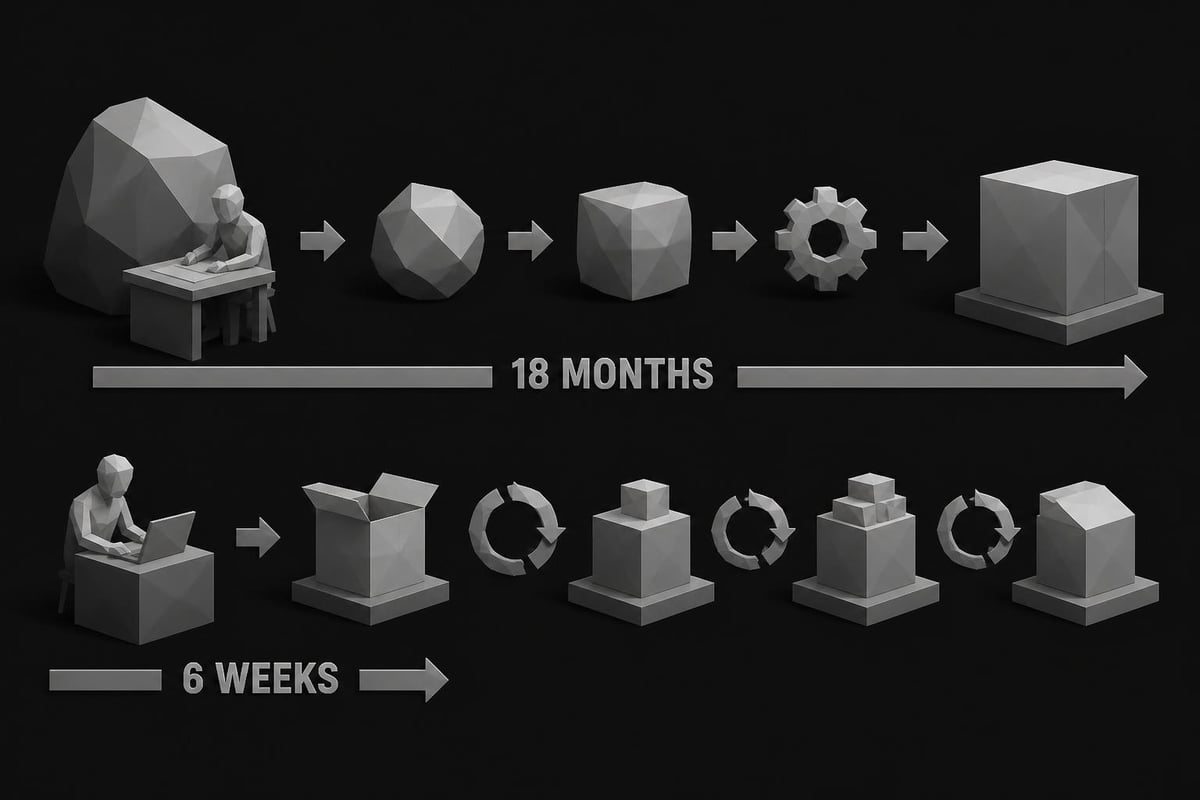
Think about it this way: if you spend 18 months building your dream product only to discover nobody wants it, you've wasted time you can't get back. But if you spend 6 weeks building an MVP, launch it, and get that same feedback, you've just saved yourself over a year of effort.
The Psychology Behind Building Less
There's something counterintuitive about deliberately building less when you could build more. We're conditioned to think more features equals more value. But in mvp software development, restraint is your superpower.
Your users don't want 47 features they'll never use. They want the three features that solve their actual problems without having to dig through menus to find them. This is especially true when you're building digital products as a solo creator or small team.
Identifying Your MVP's Core Features
Here's where most people get stuck. How do you decide what stays and what goes? Start by writing down every feature you think your product needs. Got your list? Great. Now cut it in half. Still too many? Cut it in half again.
The features that remain should pass this test: If this feature doesn't exist, does the product still solve the core problem? If the answer is yes, it's not essential for your MVP.
| Feature Type | Include in MVP? | Why |
|---|---|---|
| Core value delivery | Yes | This IS your product |
| User authentication | Maybe | Only if required for core function |
| Advanced analytics | No | You can track basics first |
| Social sharing | No | Add after proving core value |
| Payment processing | Yes | If monetization is part of validation |
| Admin dashboard | Maybe | Only basic functionality needed |
Let's get practical. Say you're building a habit tracking app. The core problem is helping people maintain daily habits. Your MVP needs a way to add habits, mark them complete, and show a streak. That's it.
Do you need graphs showing 47 different metrics? Nope. Social features to compete with friends? Not yet. Integration with 15 other apps? Definitely not. You need the absolute minimum to prove people will actually use a habit tracker.
Research-Backed Feature Prioritization
According to comprehensive MVP development research, successful teams use a structured approach to feature selection. They map features against two axes: user value and development effort.
High value, low effort: Build these first. These are your quick wins that prove your concept works.
High value, high effort: Schedule these for post-MVP iterations once you've validated demand.
Low value, low effort: Maybe add these later if users ask for them repeatedly.
Low value, high effort: Never build these. They're distractions disguised as features.
The MVP Development Process Step by Step
Building your MVP isn't mysterious, but it does require discipline. Here's how to approach it without getting lost in the weeds.
Step 1: Validate Your Problem
Before writing a single line of code, confirm that the problem you're solving actually exists and people care enough to use a solution. Talk to potential users. Not your mom or your best friend (they'll lie to make you feel good), but real people who fit your target audience.
Ask them about their current solutions. What frustrates them? What workarounds have they created? If they're not actively struggling with this problem, you might need to pivot before you build anything.
Step 2: Define Success Metrics
What does success look like for your MVP? Be specific. "Getting users" isn't a metric. "Getting 100 active users who each use the core feature at least 3 times in their first week" is a metric.
Your success metrics should focus on engagement and value delivery, not vanity numbers. Downloads mean nothing if nobody uses your product. According to best practices for MVP app development, clear objectives from the start prevent scope creep and keep your team focused.
Step 3: Choose Your Tech Stack Wisely
This is where many developers sabotage themselves. They pick the newest, coolest technology because it's fun to learn. Don't do this for your MVP.
Choose boring, proven technology that you already know or can learn quickly. Your goal is to ship, not to build the most elegant architecture in the world. You can refactor later once you know people actually want your product.
Recommended approach for different MVP types:
Mobile app MVP: Use cross-platform frameworks like React Native or Flutter to build for both iOS and Android simultaneously
SaaS MVP: Start with a proven stack like Ruby on Rails, Django, or Node.js with a simple frontend
No-code MVP: Tools like Bubble, Webflow, or Adalo can get you to market even faster if you're not a developer
If you're looking to build and launch quickly without extensive coding knowledge, programs like Build and Launch Your Mobile App in 14 Days or Build and Launch Your SaaS App in 14 Days can dramatically accelerate your timeline by teaching you vibe coding approaches that focus on shipping functional products fast.
Step 4: Build in Short Sprints
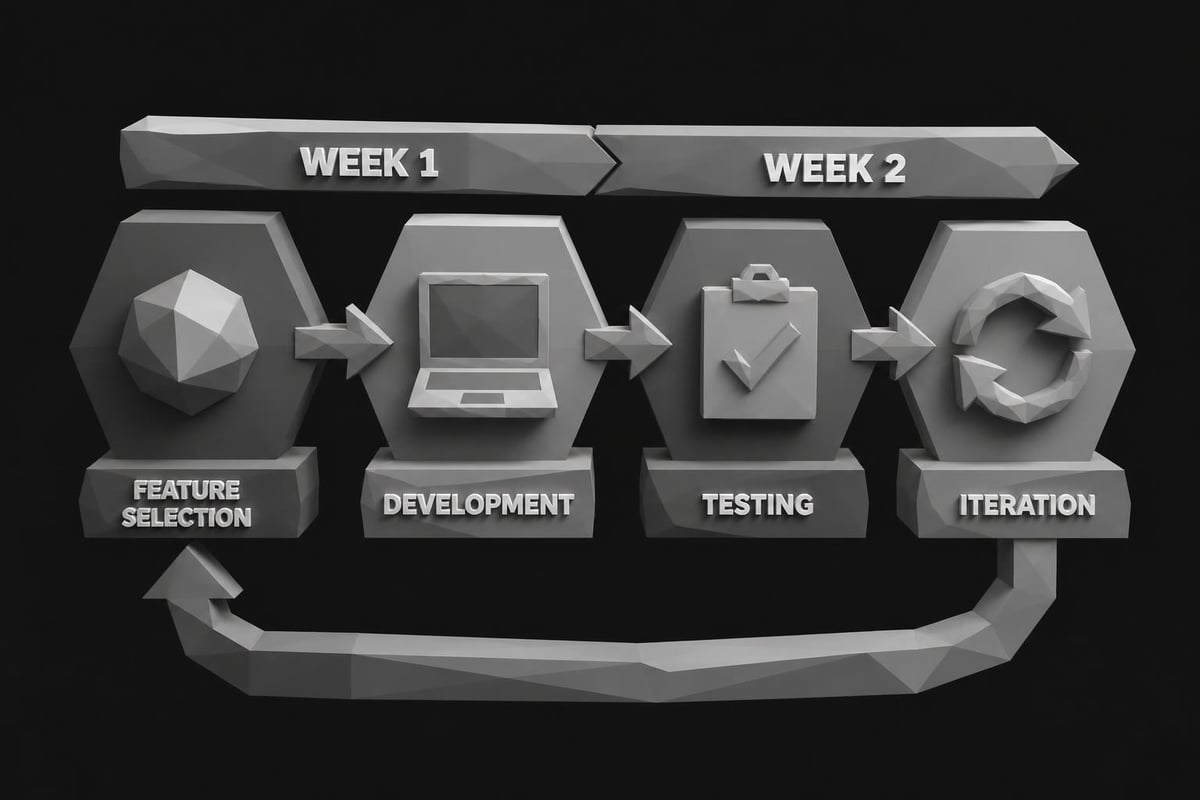
Break your development into one or two-week sprints. At the end of each sprint, you should have something that works, even if it's incomplete. This approach keeps momentum high and prevents you from disappearing into a coding cave for months.
Set a hard deadline for your MVP launch. Six to eight weeks is ideal for most solo creators. Twelve weeks maximum. Any longer and you're probably overbuilding.
Testing and Validating Your MVP
You've built something. Now comes the scary part: showing it to real people. Your MVP testing phase is where you learn whether you've actually solved the problem or just created a solution looking for a problem.
Getting Your First Users
Don't wait for perfection. Launch your MVP to a small group of early adopters who are willing to deal with rough edges in exchange for being first. These people exist in every niche.
Where to find early MVP testers:
Communities related to your niche (Reddit, Facebook groups, Discord servers)
Your personal network (but only people who genuinely fit your target audience)
Product Hunt for tech products
Industry-specific forums and communities
Direct outreach to people you've interviewed during validation
Start with 10-20 users who will give you honest feedback. More than that becomes hard to manage while you're still iterating quickly.
Collecting Meaningful Feedback
Not all feedback is created equal. Someone saying "I'd love if it had feature X" is interesting but not actionable until you see patterns. What you really want to know is whether they're using the core features and whether those features solve their problem.
Track behavioral data, not just opinions. What features do people actually use? Where do they get stuck? How often do they come back? This data tells you more than any survey ever will.
| Feedback Type | Value for MVP | How to Use It |
|---|---|---|
| "I wish it had..." | Low initially | Track requests, build only if repeated |
| "I can't figure out how to..." | High | Fix immediately, UX issue |
| "This solved my problem" | Highest | Identify and amplify this value |
| "I stopped using it because..." | High | Critical failure point to address |
The most valuable insight comes from watching people actually use your product. If possible, do live user testing sessions where you observe them navigating your MVP without helping. Their confusion points are your improvement opportunities.
Common MVP Software Development Mistakes
Let's talk about what tanks most MVPs. Spoiler: it's rarely the technology.
Mistake 1: Building for imaginary users. You've created this perfect persona in your head, but that person doesn't exist in the real world. Build for actual humans you've talked to, not idealizations.
Mistake 2: Ignoring marketing until launch. Your MVP development should happen alongside audience building. Creating engaging marketing content for your pre-launch phase means you'll have people ready to try your product the day you launch, not starting from zero.
Mistake 3: Overbuilding the first version. Every additional feature doubles your complexity and delays your launch. If you're debating whether something belongs in your MVP, the answer is probably no.
Mistake 4: Not defining done. Without clear completion criteria, MVP development drags on forever. Set specific feature requirements and stick to them.
Mistake 5: Skipping user research. Looking at how successful companies like Discord, Slack, and Figma used MVPs shows that even tech giants started by deeply understanding their users' needs before building.
The Perfectionism Trap
Here's the hard truth: your MVP will have bugs. The design won't be perfect. Some user flows will be clunky. That's okay. Actually, it's more than okay, it's the entire point.
Perfectionism kills more digital products than bad ideas ever will. You're not trying to win design awards with your MVP. You're trying to learn whether your core assumption (that people will use this product to solve this problem) is correct.
Ship it messy. Fix it fast. Iterate constantly. That's the mvp software development mantra.
Iterating Based on Real Data
Once your MVP is live and you're collecting data, the real work begins. This is where many creators stumble because they're not sure what to do with all the feedback and metrics they're gathering.
Making Sense of User Behavior
Focus on patterns, not individual requests. One user asking for dark mode is a preference. Twenty users asking for dark mode is a pattern worth addressing. One user confused by your onboarding is potentially an edge case. Eight users dropping off at the same step is a critical problem.
Set up basic analytics from day one. You don't need fancy enterprise tools. Google Analytics, Mixpanel, or even simple database queries can tell you what you need to know:
Which features get used most?
Where do users drop off?
How often do people return?
What actions correlate with long-term retention?
The Pivot vs. Persevere Decision
Sometimes your MVP data will tell you that your original idea isn't working. This is actually good news because you learned it in weeks instead of years. According to research on hypothesis-driven startup development, pivoting based on MVP feedback is a normal part of the process.
Signs you might need to pivot:
Users aren't engaging with your core feature
People use your product for something completely different than intended
Retention rates are terrible despite fixing bugs and improving UX
The market response is consistently lukewarm
Signs you should persevere:
Core engagement is strong but surrounding features need work
Users love it but discovery/onboarding needs improvement
Small passionate user base growing steadily through word of mouth
High retention among users who make it past onboarding
Don't pivot after one bad week. But don't ignore three months of data that says your approach isn't working either.
Scaling Beyond Your MVP
You've validated your concept. Users are engaged. Growth is happening organically. Now what?
Planning Your Next Iteration
Look at your usage data and user feedback to prioritize your post-MVP roadmap. What features would have the biggest impact on retention? What barriers are preventing growth? What's causing users to churn?
This is where those "nice to have" features from your original brainstorm might make sense. But evaluate each one against your current data, not your original assumptions. Things change once real users interact with your product.
Post-MVP development priorities:
Fix critical UX issues causing drop-off
Improve onboarding to reduce time-to-value
Add features that increase retention of existing users
Build features that enable new user acquisition
Polish and refine existing core features
Expand to adjacent use cases
The step-by-step MVP development guide emphasizes that planning for future iterations from the beginning helps you make architectural decisions that won't require complete rewrites later.
Technical Debt Decisions
Your MVP probably has some questionable code. Maybe you hardcoded things that should be configurable. Maybe your database design isn't optimized. Maybe you skipped writing tests. This is all normal.
But at some point, technical debt becomes technical bankruptcy. You need to balance new feature development with refactoring and infrastructure improvements. A good rule of thumb: spend about 20% of your development time paying down technical debt once you're past the MVP stage.
MVP Development for Different Product Types
Not all digital products are the same, and your mvp software development approach should reflect that.
SaaS Products
For SaaS MVPs, focus ruthlessly on the core workflow that delivers value. If you're building project management software, you need projects, tasks, and assignments. You don't need Gantt charts, resource allocation algorithms, or integrations with 47 other tools.
Start with a single, well-defined use case. Nail that completely before expanding. According to planning resources for MVP development, this focused approach allows startups to iterate faster and respond to user needs more effectively.
Many successful SaaS products started as incredibly simple tools. Basecamp began as an internal project management tool. Mailchimp started as a side project for a design agency's clients. They both proved their core value before becoming feature-rich platforms.
Mobile Apps
Mobile app MVPs face unique challenges. You're competing with highly polished apps in the App Store, so your MVP needs to meet minimum quality standards while still shipping fast.
Focus on one platform first unless you have a compelling reason to do both. iOS users generally monetize better, while Android has broader global reach. Pick based on where your target users are.
Your mobile MVP should nail the core experience but can skip things like:
Offline mode (unless that's your core value)
Push notifications (add these in v1.1)
Complex settings and customization
Social features and sharing
Advanced analytics and reporting
Content Platforms and Marketplaces
If you're building a marketplace or content platform, you face the chicken-and-egg problem. You need content/sellers to attract users, and users to attract content/sellers.
For your MVP, solve this by manually seeding initial content or working with a small group of initial creators/sellers. Don't build recommendation algorithms and complex discovery features until you have enough content to make them useful.
Real-World MVP Success Stories
Looking at how actual companies approached mvp software development provides valuable lessons. Dropbox's MVP was literally a video showing how the product would work. They validated demand before building the full platform.
Airbnb's MVP was a simple website with photos of the founders' apartment. No payment processing, no reviews, no fancy search. Just a basic listing that proved people would pay to stay in strangers' homes.
Instagram started as Burbn, a location check-in app with many features. They stripped it down to just photo sharing with filters, their actual core value, and renamed it Instagram. That focus on one thing done well led to their explosive growth.
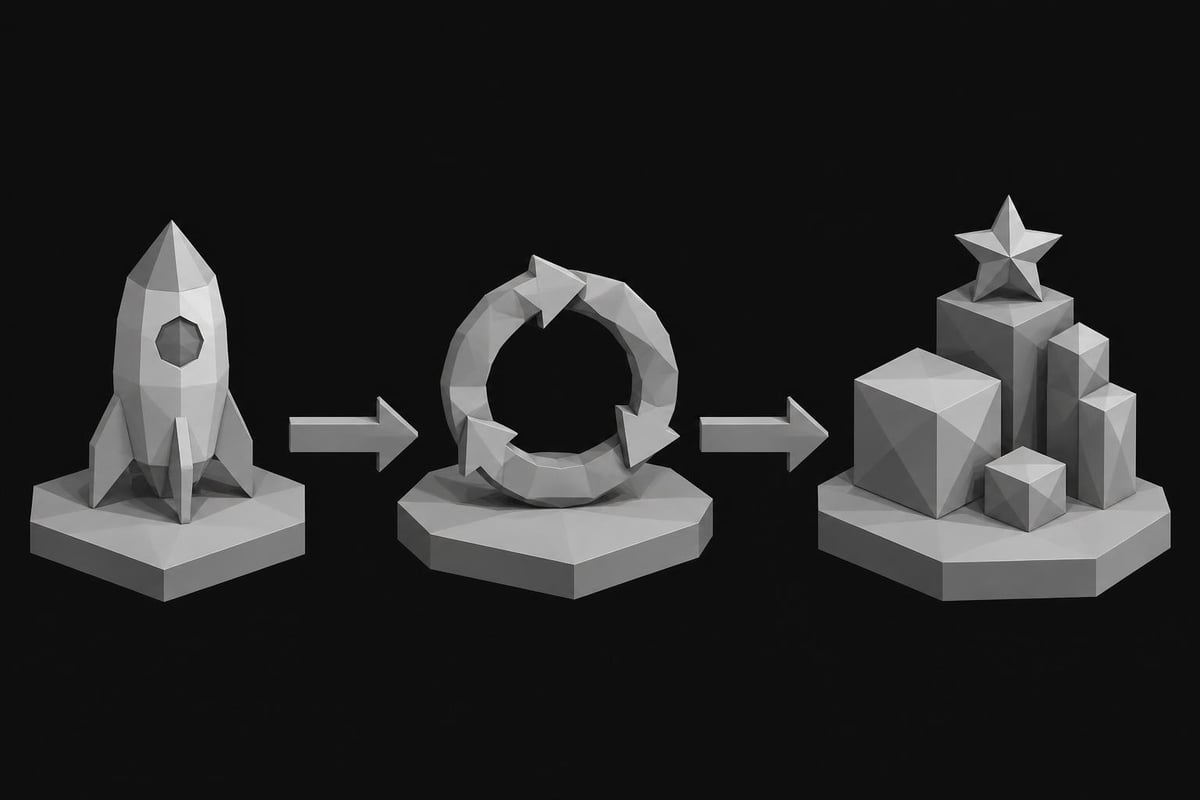
The pattern is clear: start simple, prove the concept, then expand. None of these companies achieved their final form on day one. They all began with focused MVPs that validated their core assumptions.
Cost and Timeline Realities
Let's talk money and time. How much does mvp software development actually cost, and how long should it take?
If you're building it yourself, your main investment is time. Expect 4-12 weeks of focused work depending on complexity. If you're hiring developers, costs vary wildly based on location and complexity.
Typical MVP development costs:
| Approach | Cost Range | Timeline | Best For |
|---|---|---|---|
| Solo developer (yourself) | $0-$500 in tools | 4-12 weeks | Technical founders |
| No-code platforms | $100-$1000 | 2-6 weeks | Non-technical founders |
| Freelance developer | $5,000-$25,000 | 6-12 weeks | Specific skill gaps |
| Development agency | $25,000-$100,000+ | 8-16 weeks | Complex products |
| Offshore team | $10,000-$40,000 | 8-16 weeks | Budget-conscious projects |
The most expensive approach isn't hiring developers - it's building the wrong thing. An MVP that costs $50,000 but validates a million-dollar opportunity is cheap. An MVP that costs $5,000 but proves your idea doesn't work is expensive if you ignore the data and keep building anyway.
Maximizing Your MVP Budget
Whether you're bootstrapping or have investor funding, treat your MVP budget as a learning investment, not a development cost. Your goal is to maximize learning per dollar spent.
Cut scope before you cut quality. A smaller product that works well beats a bigger product that's buggy and confusing. Choose proven technology over cutting-edge frameworks. Solve problems manually before automating them. Use existing tools and services instead of building everything custom.
The fastest way to run out of money is trying to build everything yourself when affordable solutions exist. Payment processing? Use Stripe. Authentication? Use Auth0 or Firebase. Email? Use SendGrid. Focus your custom development on your unique value proposition only.
Building an MVP is about disciplined focus, rapid learning, and strategic iteration. By identifying your core value proposition, shipping quickly, and letting real user data guide your decisions, you'll avoid the most common pitfalls that sink digital products. The key is starting small, validating ruthlessly, and scaling based on what actually works. If you're ready to turn your digital product ideas into reality, CreateSell offers the comprehensive guidance, courses, and community support you need to build, launch, and grow successful products that generate income while you sleep.