
Growth Marketing Guide for Solo Digital Product Sellers

Modest Mitkus · November 18, 2026
Growth marketing is a data-driven way of attracting, converting and keeping customers by running lots of small experiments across the whole customer journey, not just the top of the funnel. For a solo app seller, that means testing ideas fast, keeping what works and dropping what doesn't, all without a team or a big ad budget.
If you've built an app (or you're about to), you already know that shipping is the easy part. Getting strangers to find it, try it and pay for it is where most projects stall. This guide walks through how growth marketing works when it's just you, what to measure, which channels are worth your limited hours, and how to run experiments without drowning in spreadsheets.
What growth marketing actually means for a one-person business
Growth marketing treats every stage of the customer journey as something you can test and improve, from the first time someone hears about your app to the moment they recommend it to a friend. Traditional marketing tends to focus on awareness: get the word out and hope sales follow. Growth marketing asks a different question at every step: where are people dropping off, and what's the cheapest experiment that might fix it?
Most big-company definitions describe a whole team: analysts, designers, copywriters, engineers. You're all of those at once, so the idea needs shrinking down. Here's the solo version:
- Pick one number that matters. Usually that's paying customers per week or monthly recurring revenue.
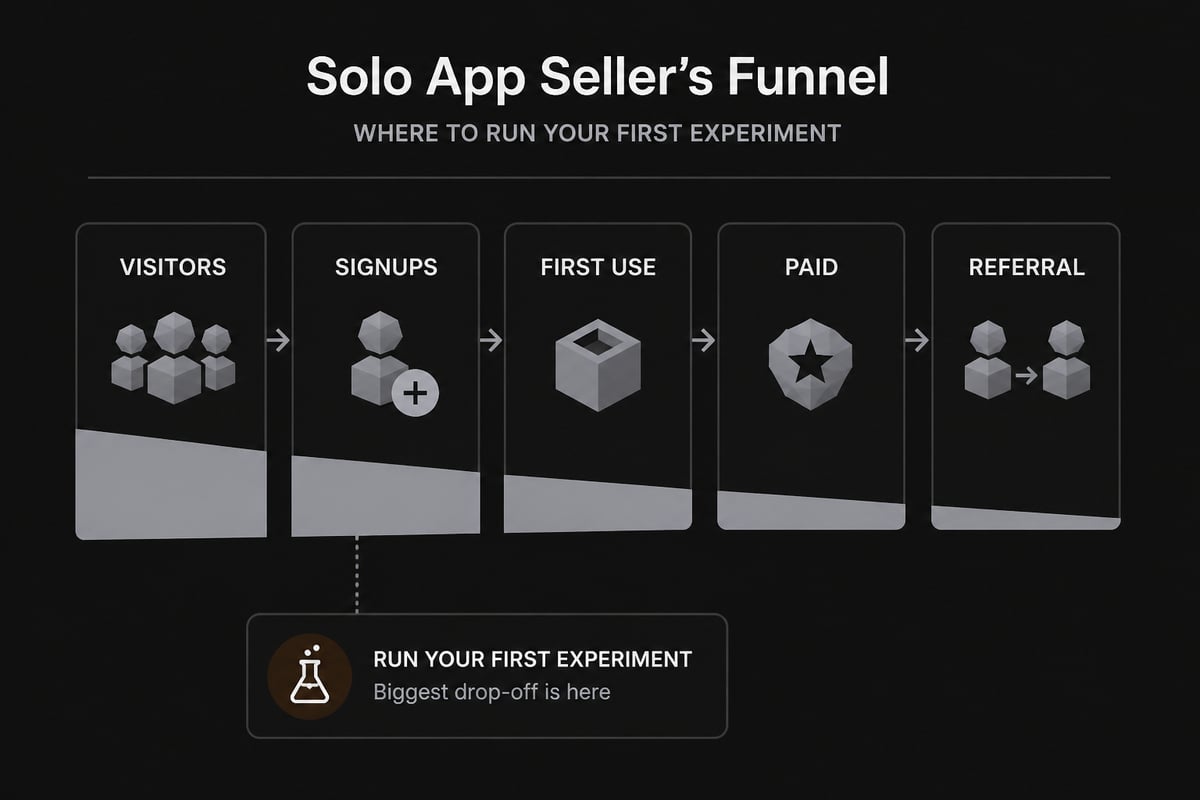
- Look at the journey in stages. Visitor, signup, first use, purchase, repeat use, referral.
- Run one experiment at a time. Small enough to finish in a week or two.
- Write down what you learned. Even failed tests save you from repeating them.
If you want a deeper look at how this overlaps with the scrappier side of the field, our post on growth hacking and marketing covers the differences.
How is growth marketing different from regular digital marketing?
Digital marketing is the toolbox, and growth marketing is the method you use to decide which tool to pick up next. Digital marketing covers channels like SEO, email, social and ads. Growth marketing sits above them and says: test across all of those, measure against revenue, and double down only on what moves the number.
A few practical differences:
| Traditional digital marketing | Growth marketing | |
|---|---|---|
| Focus | Awareness and traffic | The full journey, including activation and retention |
| Pace | Campaigns that run for weeks or months | Short experiments, often a week or two |
| Success measure | Impressions, clicks, followers | Signups, purchases, repeat usage, revenue |
| Decisions | Based on plans and instinct | Based on test results |
For a solo seller, that last row is the big one. You can't afford to spend three months on a content plan that might not work. You can afford to spend three days on a test that tells you whether it will.
The building blocks of a growth marketing system
A working growth system for one person comes down to four parts: data, experiments, a few chosen channels, and a feedback loop with real users. You don't need fancy software for any of them.
Data you can actually act on
Start with the basics. How many people visit your landing page? How many sign up? How many of those use the core feature once? How many pay? Even a rough funnel with four numbers tells you where to look first. If 1,000 people visit and 2 sign up, your problem is the page or the offer, not your product.
A/B testing and small experiments
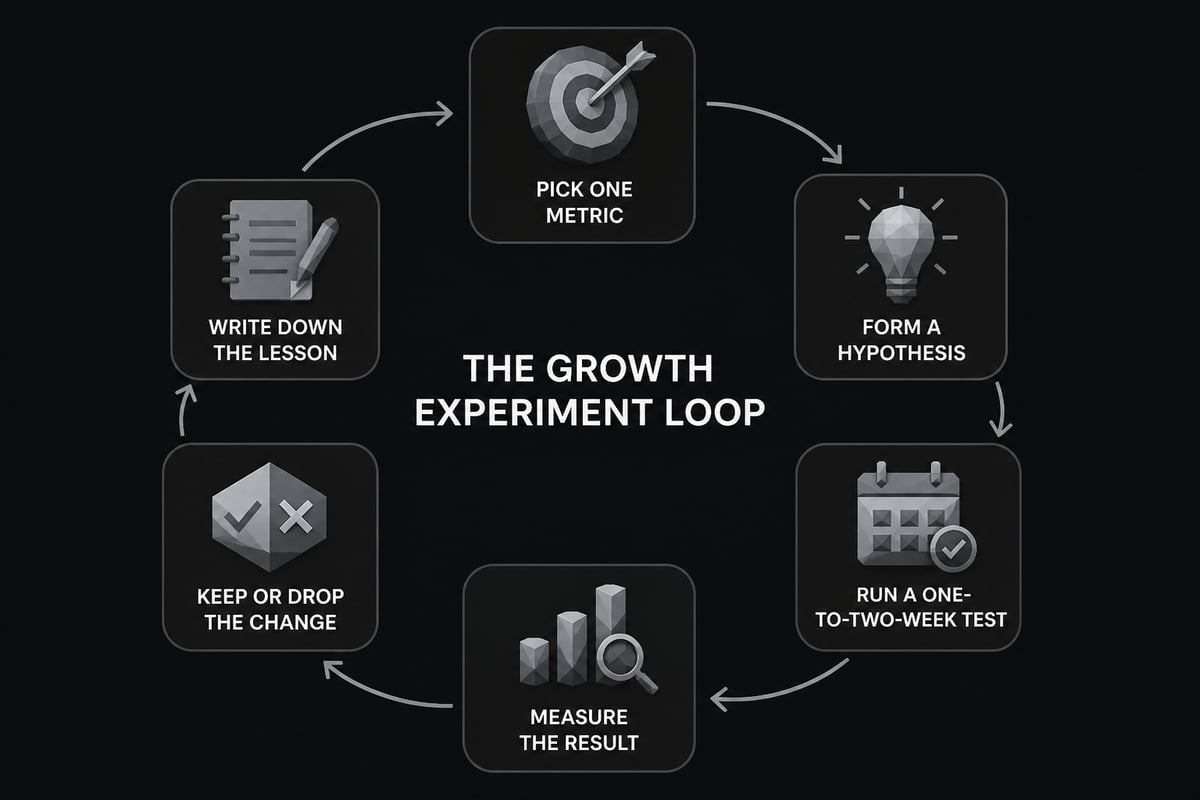
An experiment is just a question with a deadline. "Will a shorter headline lift signups?" "Will a free tier convert better than a 7-day trial?" Change one thing, run it long enough to see a difference, and decide. With small traffic you won't get statistical perfection, so look for big swings and treat small ones as noise.
Cross-channel testing
Try two or three channels in the early weeks, not ten. You're looking for the one where your type of customer actually hangs out and responds. Then you go deeper there.
Customer feedback
Talk to your first users. Five honest conversations will teach you more than a month of analytics, because they tell you why the numbers look the way they do.
Which growth marketing channels are worth your time?
The best channel for a solo seller is the one where your buyers already gather and where you can show up consistently without burning out. There's no universal winner, but some patterns hold up.
SEO and content. Slow to start, cheap to maintain, and it compounds. In BrightLocal's 2025 survey of 778 U.S. small-business owners and managers, SEO was rated as having a high impact on marketing by 40% of respondents, compared with 29% for email. That's a good reason to publish pages that answer the exact questions your buyers search for. If you want to go further on this one, our guide to hacking SEO is a good next read.
Email. Email still earns its place because you own the list. The DMA's 2025 benchmark report says email delivery rates rose to 98% in 2024. That's a lot of messages actually reaching inboxes. For a closer look at what good performance looks like, MoEngage's email benchmarks break down results by campaign type and personalization.
Social and community. Founder-led posting, build-in-public updates and showing up in communities where your buyers hang out all cost time, not money. Reddit, X, TikTok and niche forums each reward different styles, so pick one and learn its rhythm. Our posts on Reddit marketing strategy and TikTok digital marketing cover two of those in detail.
Partnerships and affiliates. Other creators and newsletter writers already have the audience you want. A simple revenue share can get you in front of them with no upfront cost. See affiliate marketing for beginners if that's new to you.
A quick rule of thumb: if you hate a channel, you won't stick with it long enough to learn anything from it. Pick the ones you can stomach for 90 days.
What skills do you need for growth marketing?
The skills that matter most are curiosity, basic number sense, clear writing and the patience to run tests properly. You don't need a marketing degree, and you don't need to be a data scientist.
Here's the short list worth building:
- Reading a funnel. Spotting where people leave and guessing why.
- Writing for conversion. Headlines, landing page copy, emails and app store descriptions that say what the product does in plain language.
- Simple analytics. Setting up tracking, reading a dashboard, avoiding false conclusions from tiny samples.
- Experiment design. Changing one variable, defining success before you start, stopping on schedule.
- Talking to users. Asking open questions and listening more than you pitch.
- Basic SEO and email know-how. Enough to publish pages that rank and send messages people open.
If you're a developer, you probably have the analytical part down and need practice on copy and distribution. If you're not technical, the reverse is often true, and AI tools can fill some gaps. Our roundups of top AI tools for marketing and online marketing skills are handy references.
How do I get into growth marketing as a solo builder?
The fastest way in is to treat your own product as the training ground: set a goal, run small tests and record the results. You'll learn more from ten real experiments than from ten courses.
Here's a simple path:
- Define your target buyer in one sentence. "Freelance designers who need a client invoicing app" beats "small businesses."
- Map your funnel. Write down each step from first visit to payment, with a rough number at each stage.
- Find the biggest leak. Fix the step with the worst drop-off before adding more traffic.
- Pick one acquisition channel. Commit for at least a month.
- Run a weekly experiment. One change, one metric, one decision.
- Keep a growth log. Date, hypothesis, result, next step.
Building the habit matters more than any single result. Our digital product marketing post goes deeper on the sales side if you're still shaping your offer.
Experiments that fit a tiny team (you)
The best experiments for a solo seller are cheap, quick and tied directly to revenue. You're not trying to win a statistics award, just to learn what nudges people to pay.
Some ideas to steal:
- Landing page headline test. Swap the benefit-led headline for a problem-led one and compare signups over two weeks.
- Pricing page experiment. Try monthly versus annual-first display, or add a middle tier to anchor price choices.
- Onboarding tweak. Cut one step from signup and see if more people reach the first "aha" moment.
- Welcome email sequence. Send three short emails over a week instead of one long one.
- Lead magnet. Offer a small, useful freebie in exchange for an email address. Our guide to lead magnets shows what works.
- Referral nudge. Ask happy users for an intro, with a small reward attached.
A good habit is to write the hypothesis in one sentence before you start: "If I shorten the signup form from five fields to two, signups will rise by at least 20%." That keeps you honest when the results come in.
Content distribution is another solid testing ground. The Content Marketing Institute's 2025 B2B benchmarks found that 42% of B2B marketers rated email and organic social media among their most effective distribution channels, with blogs and email newsletters also rated effective by many marketers. If you sell to businesses, that's a nudge to test both.

Retention and referral: where the money quietly stacks up
Keeping customers is usually cheaper than finding new ones, and for a solo seller it's often the difference between a hobby and a business. Growth marketing counts retention and referral as part of the job, not an afterthought.
For subscription apps especially, churn eats growth from the back end. If you lose 8% of customers a month, you need to win a lot just to stay flat. Tackle it by:
- Watching the first week of usage closely, since early drop-off predicts cancellations.
- Emailing inactive users with one clear reason to come back.
- Asking cancelling users why, in one question, and reading every answer.
- Adding small habits to the product, like reminders or saved progress.
Referrals are the other quiet engine. If someone loves your app, make it painless for them to tell a friend: a share link, a short pitch they can paste, maybe a free month for both sides.
Common mistakes in growth marketing for solo sellers
Most early growth mistakes come from doing too much at once or measuring the wrong thing. They're easy to fix once you can see them.
- Chasing vanity metrics. Followers and page views feel good but don't pay rent. Track signups and revenue.
- Running five tests at once. You won't know which change caused which result.
- Quitting a channel after one week. Some channels need a month or two before you can judge them.
- Ignoring the product. If users sign up and never come back, more traffic just fills a leaky bucket.
- Copying big-brand tactics. A tactic that works with a million visitors may mean nothing at a hundred.
- Skipping the written log. Without notes, you'll repeat old experiments and forget old wins.
Where CreateSell fits
Marketing and selling are the part where most app projects fail, and that's exactly where CreateSell puts its focus. It covers the full path from finding an idea people will pay for to selling the app, whether you're building for web or iOS, and no coding experience is needed. Products built with this system have reached $40k, $60k and $30k per month in revenue. There's also a community of builders shipping alongside you and sharing progress and first sales, which helps when you're running experiments alone. If you're a developer who can ship but struggles to sell, or you're starting from zero with vibe coding, vibe coding is a good place to see how the building side works.
CreateSell isn't free, and all sales are final, so it's not for anyone looking for a free course or a guaranteed income result. It's for people ready to put in the work.
FAQ
What exactly is growth marketing?
Growth marketing is a testing-led approach to gaining and keeping customers across the whole journey, from first visit to repeat purchase and referral. You run small experiments, measure the results against revenue and keep only what works. It's less about big campaigns and more about steady learning.
Do I need a big budget to start?
No. Many of the best early experiments cost nothing but time: rewriting a headline, trimming an onboarding step, emailing your first users or posting in a community. A tiny budget can help later for paid tests, but it isn't required to learn what your buyers respond to.
How long before growth marketing shows results?
Quick tests like headline or pricing-page changes can show a signal within two weeks if you have enough traffic. Channels like SEO and email list building take longer, often a few months. Judge each experiment against its own timeline, not a single deadline for everything.
Your next step is simple: open a doc, sketch your funnel in five stages, write your current number at each stage, and pick the single biggest drop-off to test this week. If you want a clearer route from idea to a product that sells, join the CreateSell waitlist and learn the marketing and selling system alongside other builders shipping their own apps.


