
Direct Response Marketing: A Guide for Digital Product Sellers

Modest Mitkus · November 25, 2026
Direct response marketing is advertising designed to make someone take a specific action right now, like buying, signing up, or starting a trial, and then measuring exactly who did it. If you sell an app or any digital product, it's one of the most practical ways to turn attention into revenue, because every ad, email, and page has one job and a number attached to it.
That's a big contrast to brand marketing, where you hope people remember you later. With a direct approach, you ask for the sale, track the result, and adjust. For solo builders, that feedback loop matters a lot. You don't have a big budget to burn on awareness, so you need to know what's working this week.
What Is Direct Response Marketing?
Direct response marketing is a style of promotion where every message includes a clear offer, a clear next step, and a way to measure whether people took it. Think of it as the opposite of "just get our name out there."
If someone asks what direct marketing is in simple words, here's the short version: you speak straight to a potential customer, ask them to do one thing, and count how many did. That could be an email with a buy button, a Facebook ad that leads to a checkout page, or a landing page with a free trial.
Three things make a campaign "direct response":
- A specific offer. Not "check out our app" but "get the habit tracker template for $29 today."
- A single call to action (CTA). One button, one link, one next step.
- Measurable results. You can see clicks, signups, and purchases tied back to the message that caused them.
For digital products, this fits perfectly. Your product is delivered instantly, checkout is online, and nearly every step of the buyer's path can be tracked. That's a huge advantage over a physical-goods business or a service you have to quote by hand.
Why It Suits Digital Product and App Sellers
It works well for digital sellers because your sales funnel lives entirely online, so you can see where people drop off and fix it quickly.
If you're an aspiring app builder without a coding background, you might feel like marketing is the scary part. If you're a developer, you might feel the opposite: the code is fine, but nobody's showing up. Either way, direct response gives you a simple structure to lean on. You don't need a brand voice guide or a huge audience. You need an offer, a page, and a way to count.
It also keeps you honest. A beautiful launch post that gets 300 likes and zero sales teaches you something uncomfortable but useful. When every message has a measurable action, you stop guessing about what "good marketing" looks like and start looking at what people actually did.
And the ceiling is real. CreateSell teaches a system that has been used to scale several products to tens of thousands of dollars per month. The common thread in that kind of growth isn't luck. It's repeating what converts.
The Building Blocks of a Direct Response Campaign
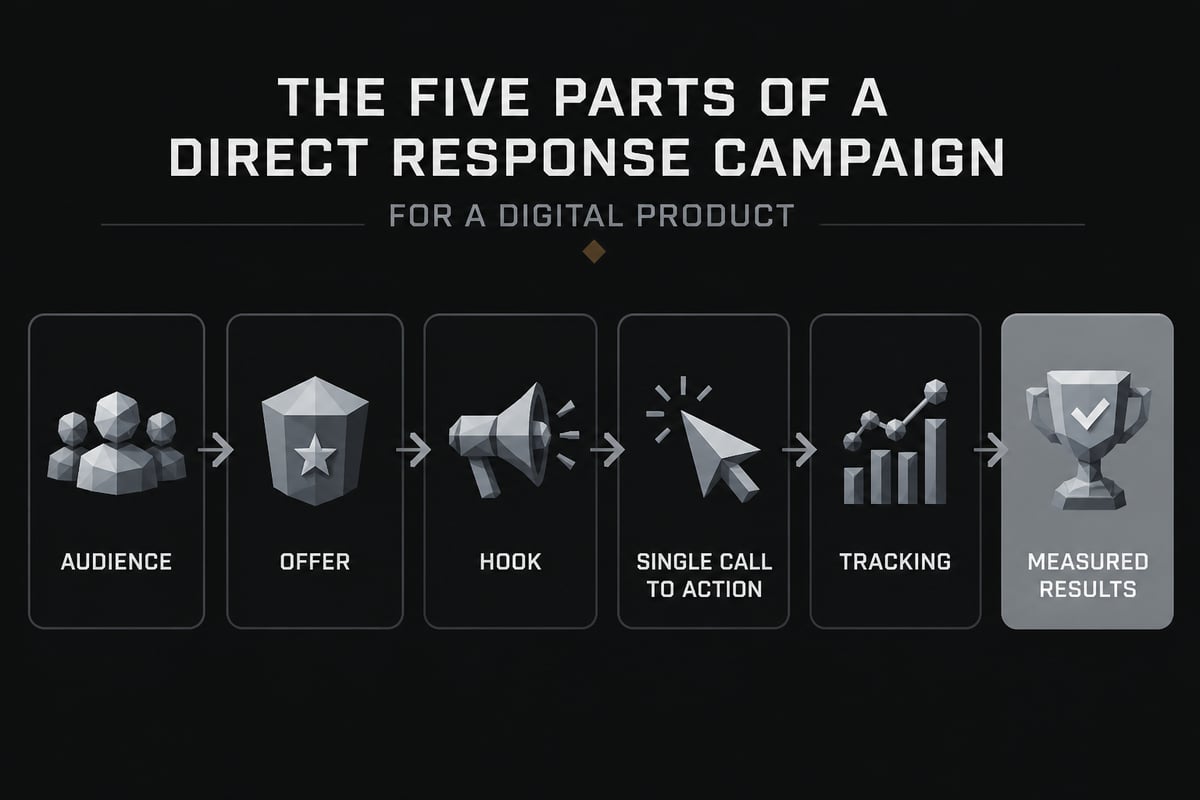
A direct response campaign needs five parts working together: an audience, an offer, a hook, a CTA, and a tracking setup. Skip one and the whole thing gets wobbly.
Start with one audience and one problem
Pick a specific person with a specific pain. "Freelance designers who lose hours tracking invoices" is a campaign. "Small business owners" is a shrug. The tighter your audience, the easier it is to write copy that sounds like you've read their mind.
Build an offer that's easy to say yes to
Your offer is what they get, for what price, and why now. Strong offers for digital products often include:
- A low-friction entry point, like a free trial or a starter tier
- A clear outcome ("send your first invoice in five minutes")
- A reason to act soon, such as a launch price or a bonus that's actually limited
- A risk reducer, like a short demo video so they can see what they're buying
Be honest with urgency. Fake countdown timers might spike a day's sales, but they wear out trust fast.
Write a CTA that names the action
"Learn more" is vague and gives people a reason to wander off. "Start my free trial" or "Get the template" tells them exactly what happens next. Keep one primary CTA per page or email. If you need a secondary one, make it visually quieter.
Where Direct Response Shows Up: Channels and Examples
Direct response media includes any channel where the viewer can act immediately and you can trace that action back to the message. For digital sellers, that's mostly online.
Common examples:
| Channel | What the ad or message looks like | Action you measure |
|---|---|---|
| Paid social ads | Short video or image with one offer | Click, signup, purchase |
| Search ads | Text ad matching a buying phrase | Click to landing page, purchase |
| Launch sequence or product announcement | Open, click, purchase | |
| Landing page | Single-offer page with one button | Conversion rate |
| Retargeting | Reminder ad to past visitors | Return visits, checkout completion |
| Direct mail and TV infomercials | Old-school offers with a phone number or code | Calls, redeemed codes |
That last row answers a common question about which medium counts as direct response: infomercials and mailers with a toll-free number are the classic cases, but a paid social ad with a tracked checkout link is the same idea in a newer package.
Here's what a few of these look like for an app seller:
- A short video ad: Show the app solving one problem in 15 seconds, then say "Try it free" and point to the link.
- A launch email: Subject line names the outcome, body gives three bullet benefits, one button goes to checkout.
- A landing page: Headline repeats the promise from the ad, a demo clip proves it, and one button closes the deal.
If you want more on picking tactics once your offer is set, this breakdown of direct and digital marketing covers how the two overlap.
Writing Copy That Gets People to Act
Good direct response copy is plain, specific, and focused on the reader's result. You're not trying to impress anyone. You're trying to make the next step feel obvious.
A simple structure that works for most pages and emails:
- Hook. Name the problem or the payoff in the first line.
- Proof. Show it working, with a demo, a screenshot, or a real number you can back up.
- Offer. Say exactly what they get and what it costs.
- CTA. Tell them the one thing to do.
- Follow-up. If they don't act, send a reminder with a new angle.
Some habits that keep copy sharp:
- Use the words your customers use. Read their reviews, forum posts, and comments.
- Lead with the result, then explain the feature.
- Cut any sentence that doesn't push toward the click.
- Test one change at a time so you know what caused the difference.
On social platforms, shorter is usually better. A headline like "Invoice in 5 minutes" beats a clever line that needs a second read. If you're leaning on short-form video, this guide to TikTok digital marketing shows how to fit an offer into a few seconds.
Tracking: The Part That Makes It "Direct"
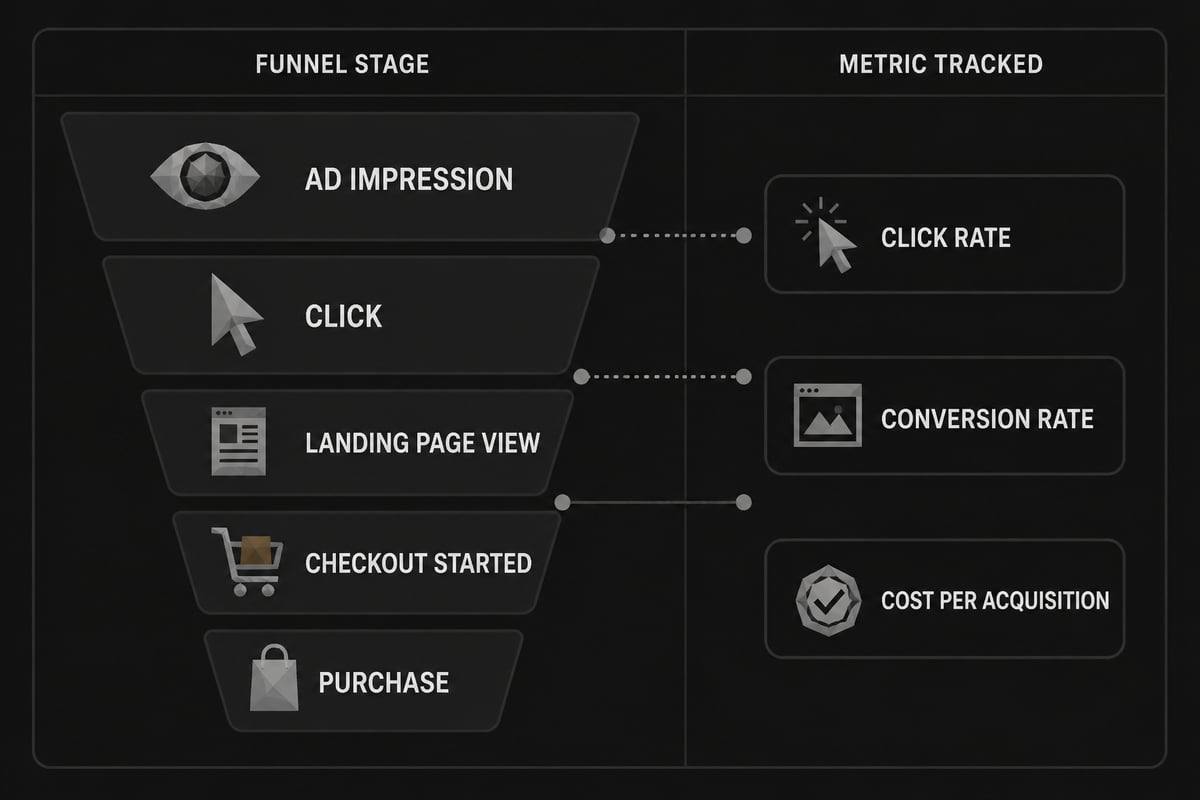
Tracking is what separates direct response from plain advertising, and setting it up properly early saves you from flying blind later.
At minimum, you want to know which ad or email led to which purchase. Both major ad platforms have tools for this:
- Meta says its Pixel can record standard events, custom events, and custom conversions, which you can use to analyze a conversion funnel and return on ad investment. See the details in Meta's conversion tracking documentation.
- Meta also offers its Conversions API for sending website, app, messaging, and offline events to its systems for ad optimization and outcome measurement, per Meta for Developers. If you're ready to wire it up, here's Meta's getting-started overview.
- On the Google side, enhanced conversions can supplement your existing conversion measurement with hashed first-party customer data, like email addresses, to improve accuracy. Google says it can be set up through Google Tag Manager, the Google tag, or the Google Ads API.
If that sounds technical, here's the plain-English version: browsers and privacy settings block more tracking than they used to, so sending purchase data directly from your own site or server helps fill the gaps. You don't need to master it on day one. Start with a basic pixel, confirm purchases are being counted, and add the more advanced setup once you're spending real money.
Numbers worth watching:
- Conversion rate: visitors who bought divided by total visitors
- Cost per acquisition: what you spent to get one customer
- Revenue per visitor: how much each click is worth on average
- Return on ad spend: revenue divided by ad cost
For app sellers, it also helps to know your benchmarks. This look at SaaS conversion rates gives you a sense of what's normal before you panic over a number.
Email: The Follow-Up Engine
Email is where most direct response sales for digital products actually close, because people rarely buy on first contact.
Someone sees your ad, visits your page, gets distracted, and leaves. A short email sequence brings them back. A solid starter sequence for a product launch looks like this:
- Welcome email: Deliver what they signed up for and set expectations.
- Problem email: Describe the pain they came with, in their words.
- Demo email: Show the product doing the job.
- Offer email: State the price, the bonus, and the deadline if there's a real one.
- Last-call email: A short, honest reminder.
Relevance matters more than volume. A 2025 email benchmark page from MoEngage analyzed events across several industries over one year, and it reports that behavior-personalized emails were associated with a large increase in conversions compared with generic emails. That's a big number, but the page doesn't promise a universal lift for individual sellers, so treat it as a sign of direction, not a forecast. The takeaway for you: send people messages based on what they did, like viewing pricing or abandoning checkout, rather than blasting everyone the same thing.
For deeper tactics on this channel, check out email marketing for SaaS.
A Simple Testing Routine for Solo Sellers
You don't need a data team to test properly. You need patience and a habit of changing one thing at a time.
Try this weekly rhythm:
- Monday: Pick one page or ad with the weakest result.
- Tuesday: Change one element, like the headline, the CTA wording, or the main image.
- Wednesday to Sunday: Let it run without touching it.
- Next Monday: Compare, keep the winner, and pick the next element.
A word of caution on sample size. If an ad has had 40 visitors, a "winning" variation might just be noise. Wait until you have enough traffic that the difference isn't a coin flip, and don't chase tiny gaps early on.
Don't build your testing around a catchy rule of thumb. Build it around your own numbers.
If you want a broader frame for where these tests fit, this overview of a marketing plan helps you slot direct response into the bigger picture.
How CreateSell Fits Into This
Direct response only works if you've got something people want to buy, and that's where CreateSell comes in. It covers the full path from finding an idea people will pay for to actually selling the app, and it teaches marketing and selling, which is the part where most app projects fail. It works for web or iOS apps with no coding experience needed, and there's a community of builders shipping alongside you and sharing progress and first sales.
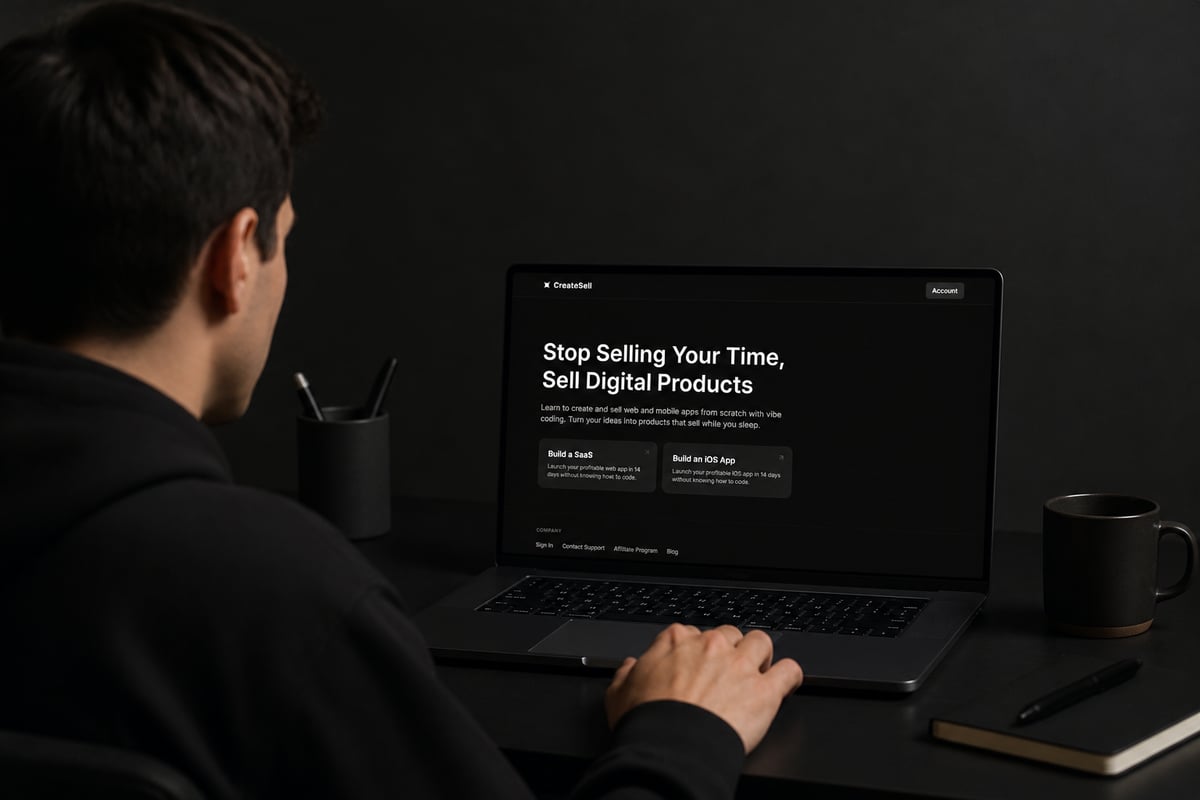
That mix matters for both kinds of readers. If you can't code, you learn to build and sell an app from scratch with vibe coding. If you can code, you get the marketing side that usually gets left until it's too late. You can check out CreateSell to see how the program is laid out.
Common Mistakes to Avoid
Most direct response flops come from a handful of repeat errors, and every one is fixable.
- Too many CTAs. Three buttons mean none get clicked.
- A vague offer. If the reader can't say what they're getting in one sentence, rewrite it.
- Mismatch between ad and page. If the ad promises a free trial and the page shows a pricing table, people bounce.
- No tracking before spending. Set up your pixel and test a purchase before you pay for traffic.
- Giving up after one test. One weak ad tells you about one ad, not about your product.
- Overhyping. Promising results you can't back up gets you refunds and bad word of mouth.
It's also worth pairing this approach with a view of the whole customer journey. A look at digital product marketing shows how direct response sits alongside content and community.
FAQ
What are the 7 types of marketing?
There isn't one official list, but common groupings include content, social media, email, search, influencer, affiliate, and direct response marketing. Different sources split them differently, so pick the few that match where your buyers already spend time.
What is the difference between direct response and brand marketing?
Direct response asks for an immediate action and measures it, while brand marketing builds familiarity over time and is harder to attribute to a single sale. Most digital product sellers lean on direct response first because it pays back faster and shows clear results.
Do I need a big budget for direct response marketing?
No. You can start with a small ad spend, a single landing page, and a short email sequence. The point is to learn quickly which message converts, then put more money behind what works.
Your next step today: write one sentence that states your offer, the person it's for, and the single action you want them to take, then build one page around it. If you're still figuring out what to build or how to get it in front of buyers, the CreateSell community and system walk you from idea to first sale, and you can join the waitlist to get started when the doors open.


