
How to Write a Marketing Plan for a Digital Product Business

Modest Mitkus · November 14, 2026
A marketing plan is a written document that spells out who you're selling to, what you want to achieve, which channels you'll use, how much you'll spend, and how you'll measure results. For a digital product business, it can be one or two pages, as long as it tells you what to do this week and how you'll know it worked.
If you're building an app or any other digital product on your own, you probably feel the pull of two extremes: skip planning and post randomly, or write a 40-page strategy deck nobody reads. Neither works. This guide walks you through a lean version that fits a one-person business.
What goes in a marketing plan?
A solid marketing plan has seven parts: a situation summary, a target audience, goals, positioning, channels and tactics, a budget, and metrics. That's it. Everything else is decoration.
Here's what each piece does for a digital product business:
- Situation summary: where you are right now, including your product stage, audience size, and any revenue.
- Target audience: the specific person who'll pay for your product, and the problem they want gone.
- Goals: a handful of numbers with deadlines.
- Positioning: one sentence on why someone should pick your product over alternatives.
- Channels and tactics: where you'll show up and what you'll actually do there.
- Budget: money, tools, and your own hours.
- Metrics: how you'll track progress and decide what to change.
If you want the bigger picture on how this fits with everything else you're building, our guide on how to write a business plan covers the company-level view. Your marketing plan is the part that answers, "How will anyone find this thing?"
Start with the situation: where you are right now
Before you plan anything, write down an honest snapshot of your current position, because goals only make sense relative to a starting point.
Keep it short. Answer these in a few lines each:
- What stage is the product in (idea, prototype, live, earning)?
- How big is your audience today (email list, followers, waitlist)?
- What have you already tried, and what happened?
- Who else sells something similar, and at what price?
That last question deserves real effort. The U.S. Small Business Administration says market research should look at demand, market size, customer location, market saturation, and competitor pricing. For a software product, that translates to searching app stores, scanning competitor landing pages, and reading their reviews. The complaints in one-star reviews are free positioning ideas.
If you're a developer, this is probably the step you'll want to skip. Don't. Shipping features is comfortable, and a clear read on the market is what tells you which features are worth marketing.
Define the one customer you're writing for
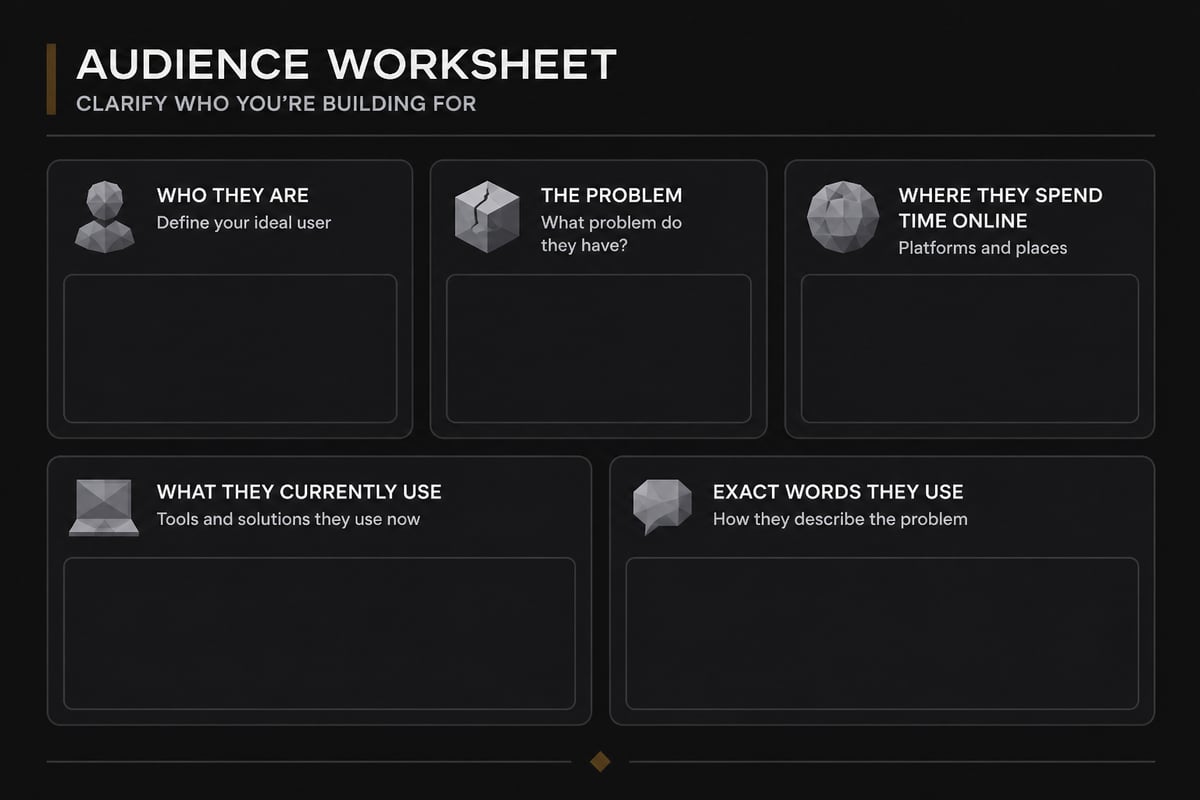
Your target audience is a specific type of person with a specific problem, not "anyone who needs an app." The narrower you go early on, the easier every other decision becomes.
Try this fill-in-the-blank: "My product helps [who] do [what] without [pain they hate]." For example, "helps freelance designers send invoices without spreadsheets." One sentence like that tells you where those people hang out, what words they use, and what they'd pay.
The SBA also lists direct research methods such as surveys, questionnaires, focus groups, and in-depth interviews. As a solo founder, interviews are your best bet. Talk to five to ten people in your target group and ask what they currently do, what annoys them, and what they've paid for before. Don't pitch. Just listen and copy their phrasing, because that phrasing becomes your headline.
Set goals you can actually measure
Good marketing goals are specific numbers tied to a date, and they should connect directly to revenue. "Grow my brand" isn't a goal. "Get 300 email signups and 20 paying customers by the end of the quarter" is.
Think of the standard SMART shape (specific, measurable, achievable, relevant, time-bound), but keep it practical. Pick three goals at most:
- An awareness goal: such as 1,000 visitors to your landing page per month.
- A lead goal: such as 300 waitlist or email signups.
- A revenue goal: such as 20 customers at your launch price.
Work backward from the revenue number. If you expect 3 out of every 100 visitors to buy and you want 20 sales, you need roughly 650 visitors. Those conversion rates are guesses at first. That's fine. The plan's job is to replace guesses with real numbers over time.
For ideas on what to measure beyond launch week, the breakdown of key SaaS metrics is a handy reference.
Nail your positioning before you pick channels
Positioning is the short statement that explains why your product is the right choice for your chosen customer, and it needs to exist before you spend a minute on channels.
A simple formula works: "For [customer] who [problem], [product] is a [category] that [main benefit]. Unlike [alternative], it [key difference]."
Say you've built a meal-planning app for people with food allergies. Your difference might be "built around allergen filters first, not recipes first." That's a message you can repeat in a tweet, a landing page, and a video without it getting stale.
Test it on a stranger. If they can repeat it back in their own words after ten seconds, it works. If they squint, simplify.

Choose channels and tactics you can sustain alone
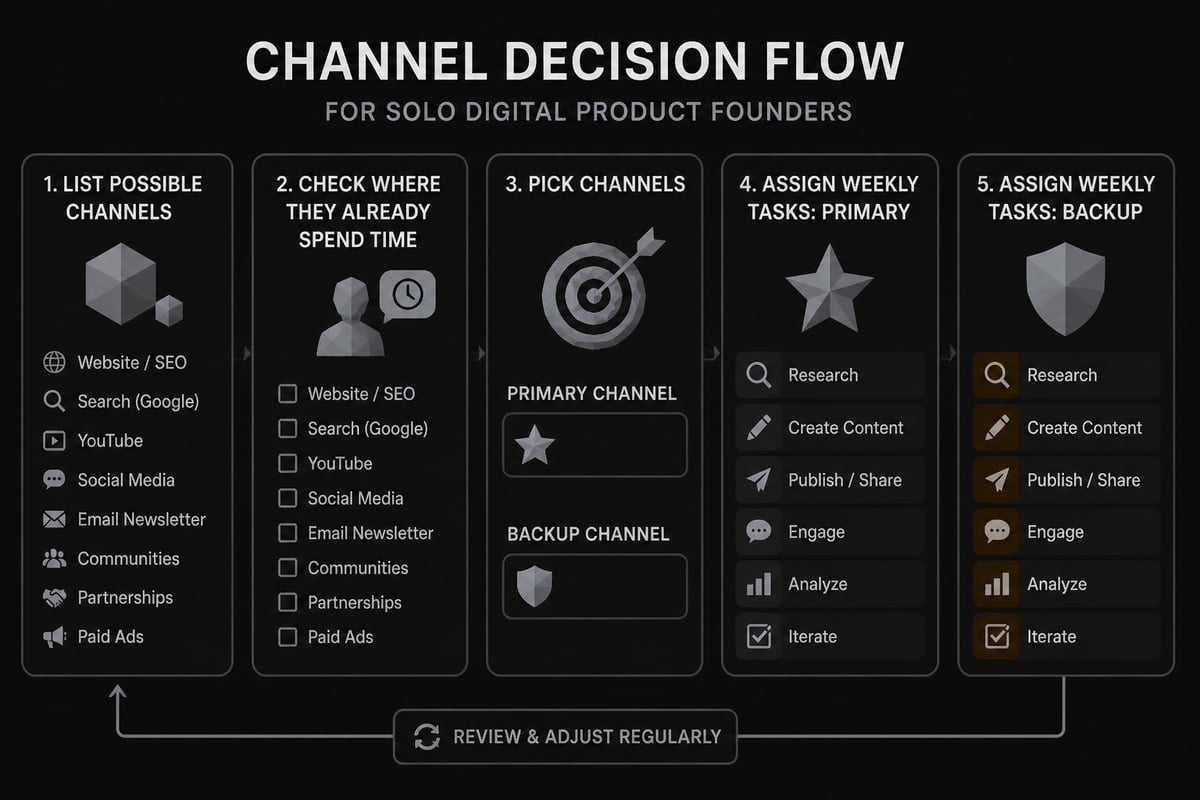
The best channel for a one-person business is the one that matches where your audience already hangs out and that you can keep up for at least three months. Don't try to be everywhere.
Here's a quick way to compare common options for a digital product:
| Channel | Speed of results | Cost | Good fit when |
|---|---|---|---|
| SEO and blog content | Slow (months) | Low, mostly time | Your audience searches for solutions |
| Short-form video | Fast, unpredictable | Low, mostly time | Your product demos well on screen |
| Email list | Medium | Low | You have any audience at all |
| Communities (Reddit, forums) | Fast | Free | Your niche has active discussion spaces |
| Paid ads | Fast | Real money | You've confirmed people convert |
Pick one primary channel and one backup. Then turn each into specific weekly tasks, such as "publish two posts and answer five questions in relevant communities." If you're weighing options, these guides go deeper: Reddit marketing strategy for community-led growth and email marketing for SaaS for building a list you own.
Offers also matter. A free checklist, template, or mini-tool gives people a reason to join your list before they're ready to buy. Our roundup of lead magnet examples shows what works.
Build a budget that includes your time
A realistic budget covers money, tools, and your own hours, not just ad spend. HubSpot's digital strategy guide points out that a digital marketing budget can account for media spend, production, software, and staff time, and it recommends assigning channel owners and estimating monthly hours. When you're a team of one, you're the owner of every channel, so the hours matter most.
Try a simple monthly table in a notebook or spreadsheet:
- Tools: email platform, analytics, design software.
- Content and creative: freelancers, stock assets, video editing.
- Paid promotion: a small test budget, only after your offer converts organically.
- Your hours: for example, 10 hours a week split across your chosen channels.
That last line is the one that keeps plans honest. If your plan needs 40 hours a week and you have 8, cut tactics until it fits. A smaller plan you finish beats a bigger one you abandon.
If you're comparing software options, the list of best digital marketing tools can save you some trial and error.
Track results with campaign tags and a simple scorecard
Tracking is how a marketing plan turns into learning, and the easiest way to start is tagging every link you share so you know where each visitor came from.
Google Analytics supports UTM parameters in campaign URLs to identify which campaigns send traffic, and those values show up in the Traffic acquisition report. Google generally recommends using Campaign Source, Campaign Medium, and Campaign Name as the core set, with Term and Content as optional extras for paid-search keywords or ad detail.
Two habits help here:
- Test your tagged links before launch. Google recommends verifying campaign tags first. Campaign data may appear in real-time reports right away or in standard reports after a few hours, so don't panic if it isn't instant.
- Keep a naming convention. Pick lowercase names and stick with them, or "Twitter," "twitter," and "x" will split your data three ways.
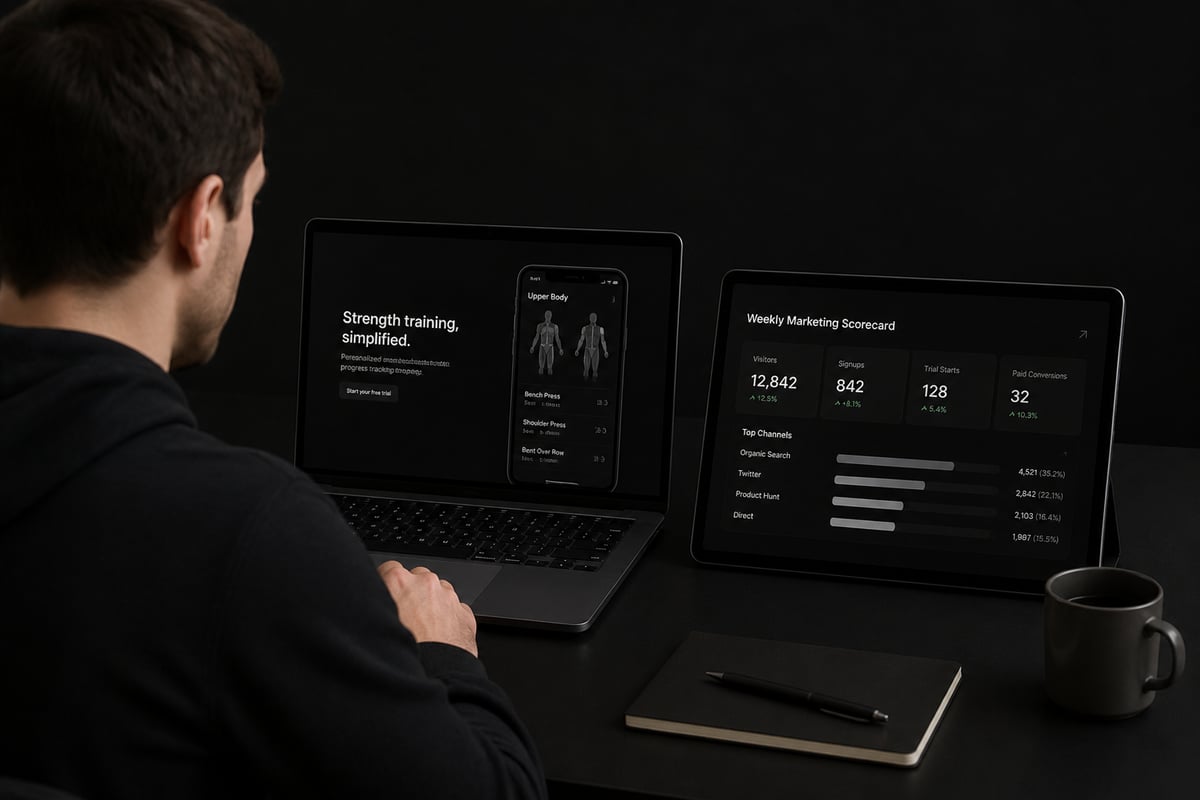
Then build a weekly scorecard with five numbers: visitors, signups, trial or demo starts, sales, and revenue. Look at it every Friday. Whatever moved, do more of. Whatever didn't, change or cut after a fair test.
Many app projects stall at this exact point. The product ships, and then nobody knows how to get it in front of buyers. CreateSell is built around that gap: it teaches marketing and selling alongside building, covering the full path from finding an idea people will pay for to selling the app. It teaches building web and mobile apps with vibe coding, and it includes a community of builders sharing progress and first sales.
Turn the plan into a 90-day calendar
A plan only matters if it becomes a calendar, so break your goals into three 30-day sprints with one focus each.
- Days 1 to 30, foundation: finish audience interviews, write your positioning, set up tracking, build a landing page, and publish your first lead magnet.
- Days 31 to 60, traction: ship content on your main channel every week, grow your list, and run small experiments with headlines and offers.
- Days 61 to 90, conversion: launch or relaunch your offer to your list, gather testimonials, and review the scorecard to decide what to double down on.
At the end of 90 days, hold a short review. What did your audience respond to? Which channel produced customers, not just clicks? Rewrite the plan with those answers. Treat it as a living document, not a trophy.
FAQ
What are the main goals of digital marketing?
The main goals are to build awareness, generate leads, convert those leads into customers, and keep customers coming back. For a digital product business, that usually shows up as traffic, email signups, paid conversions, and repeat usage or renewals.
What is step 5 of the marketing plan?
It depends on the framework, but in many five-step versions, step 5 is setting the budget, right after situation analysis, objectives, and tactics. In the plan outlined here, budgeting also sits late in the process, because you can only price a plan once you know your channels and goals.
How long should a marketing plan be?
For a solo digital product business, one to two pages is plenty. If you can't scan it in five minutes and know what to do on Monday, trim it.
Your next step is to open a blank document and write your one-sentence customer description and three goals with dates, which takes about twenty minutes. If you'd like structured help going from idea to a product that actually sells, CreateSell is the place to start, and you can join the waitlist to get access when the next spot opens.


