
CAC SaaS Guide: Calculating and Lowering Customer Acquisition Cost

Modest Mitkus · November 24, 2026
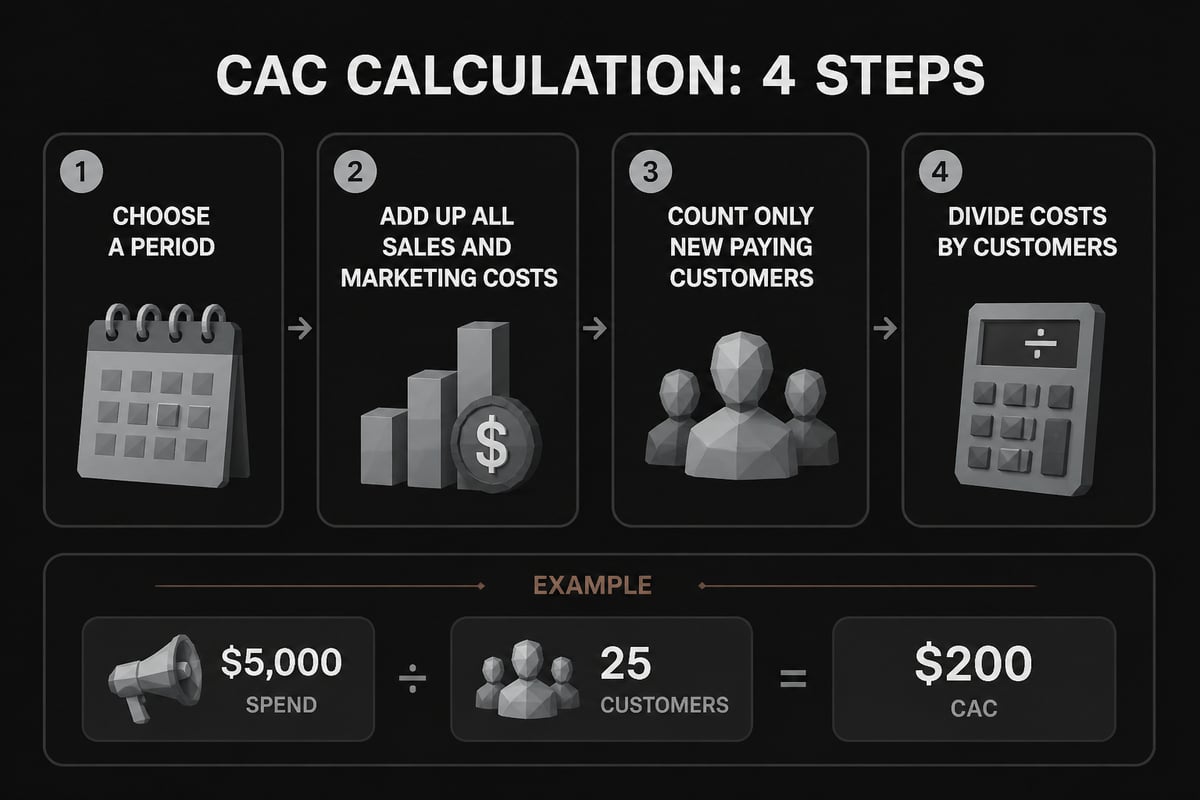
CAC in SaaS means customer acquisition cost: the total you spend on sales and marketing divided by the number of new paying customers you win in the same period. If you spend $5,000 in a month and land 25 customers, your CAC is $200. That one number tells you whether your app can grow profitably or just burn cash, and for a small SaaS the way you calculate it matters as much as the result.
This guide covers the formula, the version of CAC that makes sense for a solo builder, how to judge whether your number is any good, and the levers that actually bring it down.
What Does CAC Stand For in SaaS?
CAC stands for customer acquisition cost, and in SaaS it's the average amount you spend to turn a stranger into a paying subscriber.
It sounds simple, but the trick is deciding what counts as "spend." Ad budgets are obvious. Less obvious are the tools you pay for to run outreach, the freelancer who designs your landing page, and the hours you or a salesperson put into demos. If you leave those out, your CAC looks great on paper and misleads you in practice.
A quick note on the other half of the formula. "New customers" should mean people who actually paid, not free signups or trial starts. A thousand trials with ten conversions is ten customers.
How to Calculate CAC for a SaaS Product
The standard formula is CAC = total sales and marketing costs divided by the number of new customers acquired, which is how Stripe lays it out. Pick a time window (a month or a quarter), add up the costs, and divide.
Stripe's own example is a good sanity check: $50,000 in quarterly sales and marketing costs and 250 new paying customers gives a CAC of $200.
Here's a simple way to work it out:
- Choose a period. Monthly works for early-stage products, quarterly smooths out lumpy spending.
- Add up every acquisition cost. Ads, content production, email tools, landing page software, affiliate payouts, contractor fees, and a fair share of your own time if you'd otherwise pay someone to do it.
- Count only new paying customers. Leave out renewals, upgrades from existing accounts, and reactivations.
- Divide costs by customers. That's your blended CAC.
One refinement worth knowing about: if your sales cycle runs weeks or months, spend in one period produces customers in a later one. Andrew Chen's breakdown of how to actually calculate CAC covers matching expenses to the right cohort of customers, plus keeping new customers separate from reactivations. For a self-serve app with a short path from visit to purchase, a simple same-period calculation is usually close enough.
Blended CAC vs. Paid CAC
Blended CAC divides all your acquisition spend by all new customers, while paid CAC only looks at customers who came from paid channels and the money spent on them.
Both are useful, and they answer different questions. Blended CAC shows your overall efficiency, including the free customers you get from SEO, word of mouth, and social posts. Paid CAC tells you what happens if you pour in more ad budget, because you can't buy more word of mouth.
If your blended CAC is $40 but your paid CAC is $180, your business is leaning on organic traffic. That's fine, just don't assume ads will scale at $40. Track both from the start and the picture stays honest.
What Is a Good CAC for a SaaS Company?
A good CAC is one that's comfortably lower than the gross profit a customer brings in over their lifetime, and there's no single dollar figure that applies to everyone.
Stripe notes that small and middle-market B2B SaaS CAC often ranges from $300 to $5,000, depending on subindustry and sales complexity, and that there's no universal SaaS CAC benchmark. A cheap consumer app and a higher-priced B2B tool live in completely different worlds.
For a sense of the broader market, Benchmarkit's 2025 SaaS Performance Metrics report found the median New CAC Ratio rose 14% in 2024, reaching $2.00 in sales and marketing expense per $1.00 of new-customer ARR. In plain English, the median company in that data set spent two dollars to win one dollar of new annual recurring revenue. That's a median for companies running real sales teams, so a bootstrapped self-serve app can and should aim well below it.
The more useful question is whether your CAC works against your own numbers. That brings in two ratios.
LTV to CAC
Customer lifetime value divided by CAC tells you how many dollars of value you get back for each dollar spent. A common rule of thumb is 3 to 1 or better, though that's a guideline, not a law. If you haven't worked out your lifetime value yet, this breakdown of customer lifetime value for SaaS walks through the math. Churn feeds directly into it, so it's worth reading up on SaaS churn too, because a leaky bucket makes every CAC look worse than it is.
CAC Payback Period
CAC payback is how many months of gross profit it takes to earn back what you spent acquiring a customer. Benchmarkit defines it as the number of months needed to recover sales and marketing expenses for new customers, adjusted for gross margin.
Say your CAC is $120, your plan costs $30 per month, and your gross margin is 80%. You keep $24 per month, so payback takes five months. Anything under twelve months is generally comfortable for a small product, and shorter is better when cash is tight.
What About the Rule of 40?
The Rule of 40 says a healthy SaaS company's revenue growth rate plus its profit margin should add up to at least 40%.
It's a yardstick for mature companies balancing growth against profitability, and it's mostly relevant once you have real revenue and a team. For a solo builder with a first app, CAC, payback, and churn are far more useful day to day. Keep the Rule of 40 in your back pocket for later, and if you want a wider set of numbers to watch in the meantime, key SaaS metrics is a good place to start.

Why CAC Looks Different for Solo Builders
For a one-person SaaS, CAC is mostly your time plus a small ad or tool budget, so the honest calculation includes an hourly value for yourself.
Many indie hackers report a CAC of nearly zero when they never pay for ads. But if you spent forty hours writing posts and answering questions in communities, that's real cost. Put a rate on your hours, even a modest one, and watch your CAC. It stops you from celebrating a channel that quietly eats your week.
This is also where developers and non-coders end up in the same spot. Building the app is the easier half. Getting people to pay for it is where most projects stall, which is why it pays to know your numbers early.
How to Lower Your SaaS CAC
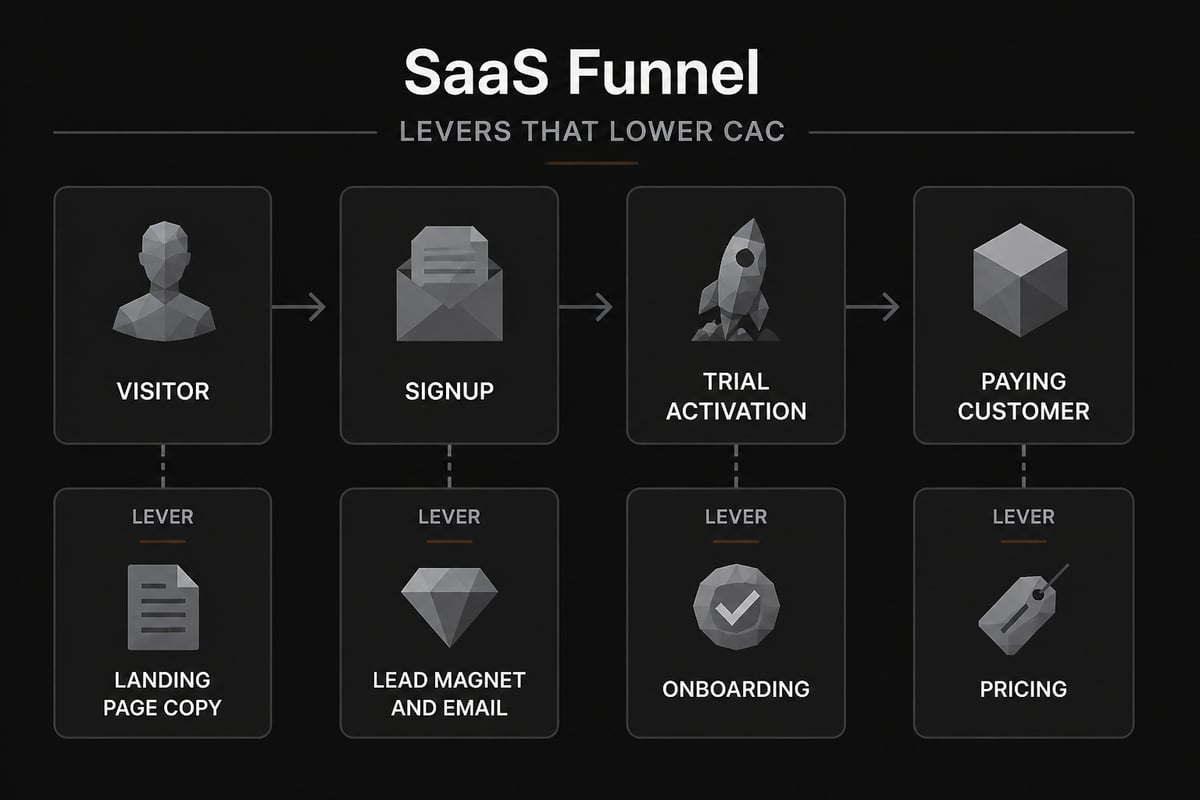
You lower CAC by raising conversion at each step of the funnel, choosing cheaper channels, and getting more value from every visitor you already have.
Try these in roughly this order:
- Fix conversion before buying traffic. If your landing page converts 1% of visitors, doubling that cuts your CAC in half without spending a cent more. Check how your numbers compare with SaaS conversion rates, and tighten your product landing pages.
- Lean on compounding channels. Content marketing for SaaS costs time up front, but a post that ranks keeps sending buyers for months. For help with search visibility, Best SEO Tools offers an AI-driven SEO service that's worth a look if you'd rather hand off the daily execution.
- Use email. Capturing visitors who aren't ready to buy and following up is far cheaper than paying for them twice. A good lead magnet feeds that list.
- Shorten time to value. Better onboarding means more trials become paying customers, which lowers CAC without touching marketing. SaaS onboarding best practices covers what to tighten.
- Price with intent. A higher price on the same traffic lifts revenue per customer and shortens payback. See SaaS pricing strategy for how to think about it.
- Cut channels that don't pay back. Rank each channel by its own CAC and stop feeding the worst one.
If you're doing outbound or freelancer-style lead generation on top of your product, Getmany offers AI-assisted proposal tooling for Upwork lead generation, which can be one low-cost way to find early customers for a service-flavored offer.
Starting With a Lower CAC Built In
The cheapest customer to acquire is the one you find before you build, so validating demand first keeps your CAC low from day one.
A lot of high CAC comes from building something nobody was searching for, then paying to convince people. Picking an idea with existing demand and a clear buyer changes the math entirely. If you're still choosing, these SaaS ideas and micro SaaS ideas are a good starting list.
Build and Launch Your SaaS App in 14 Days from CreateSell covers the full path from finding an idea people will pay for to selling the app, including the marketing and selling side where most app projects fail. It's built on a system that has been used to scale several products to tens of thousands of dollars per month, and it works for web or iOS apps with no coding experience needed.

Common CAC Mistakes to Avoid
Most CAC errors come from counting the wrong costs, the wrong customers, or the wrong time window.
- Leaving out your own time. It makes every channel look cheaper than it is.
- Counting free trials as customers. Only paying accounts belong in the denominator.
- Mixing in renewals and upgrades. They aren't acquisitions.
- Comparing yourself to enterprise benchmarks. Comparing companies of very different sizes is misleading, and that applies doubly to a solo founder against a funded team.
- Ignoring payback. A low CAC with a long payback period can still drain your bank account.
FAQ
What is an example of a SaaS?
SaaS, or software as a service, is software you use through a browser or app on a subscription instead of installing and owning it. Project management tools, email platforms, and accounting apps are common examples. Many indie products are small, focused tools that solve one problem for a niche audience.
Is CAC the same as cost per lead?
No. Cost per lead measures what you pay to get a signup or inquiry, while CAC measures what you pay to get a paying customer. Your CAC will always be higher than your cost per lead, since only some leads convert.
How often should I recalculate CAC?
Monthly is a good habit for an early product, with a quarterly view to smooth out spikes. Recalculate any time you change a channel, pricing, or your landing page, since those shift the result quickly.
Your next step is simple: open a spreadsheet, list last month's acquisition costs (including your own hours), count your new paying customers, and divide. Once you have a real number, you can make decisions instead of guesses. If you want a guided path from picking an idea to selling it, with a community of builders shipping alongside you, join the CreateSell waitlist to get in line for the next chance to learn the marketing and selling side alongside the build.


