
Customer Lifetime Value SaaS: Your Growth Guide

Modest Mitkus
May 16, 2026
If you're building a digital product business in 2026, understanding customer lifetime value saas metrics isn't just nice to have - it's absolutely essential. Whether you're launching your first mobile app or growing a full-fledged software platform, knowing how much each customer is truly worth over their entire relationship with your product changes everything. It shapes how much you can spend on marketing, which features to build next, and whether your business model actually works long-term. Let's dive into what this metric really means and how you can use it to build something sustainable.
What Makes Customer Lifetime Value Different for SaaS
Customer lifetime value saas calculations differ significantly from traditional e-commerce or one-time purchase businesses. In the SaaS world, you're not just making a single sale - you're entering into an ongoing relationship where revenue compounds month after month.
The beauty of subscription models lies in predictability. When someone subscribes to your digital product, they're not just a one-time buyer. They become a recurring revenue stream that potentially lasts for months or years. This fundamentally changes how you think about customer acquisition and retention.
The Core Components You Need to Track
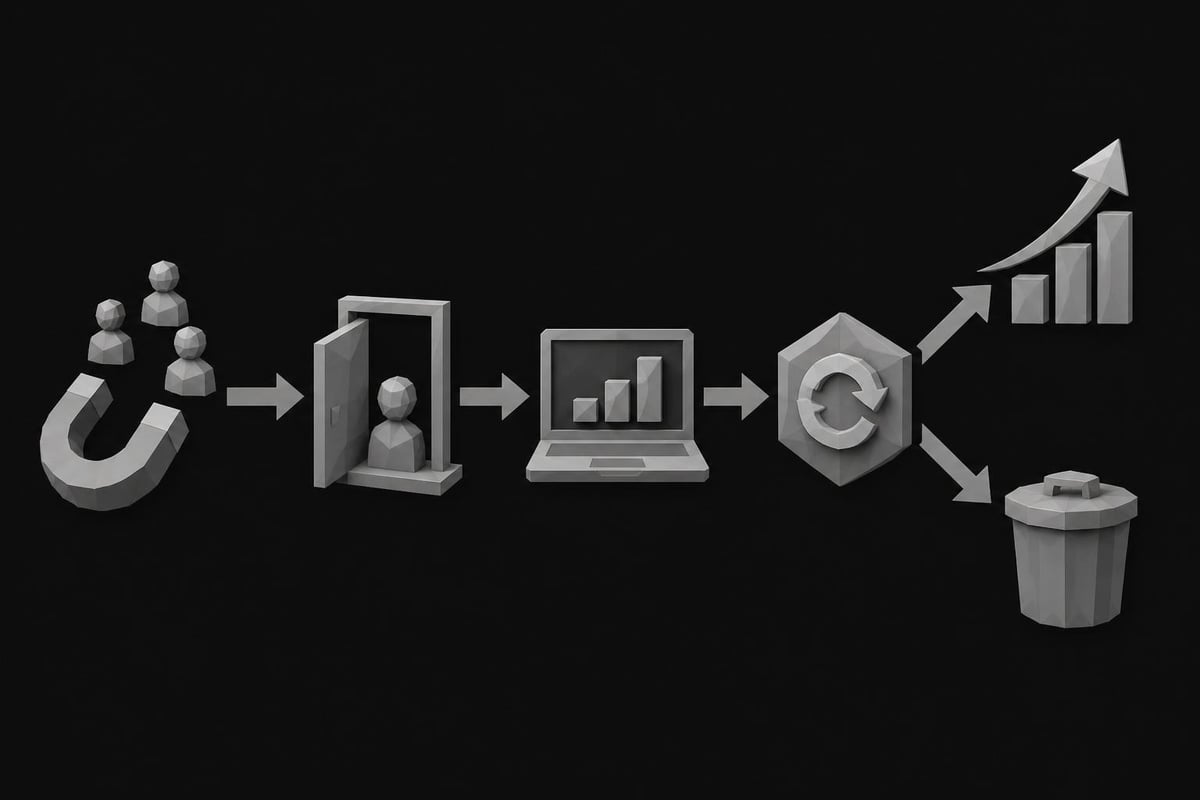
Before you can calculate anything, you need to understand the building blocks. Customer lifetime value in B2B SaaS contexts relies on three fundamental metrics that work together.
Monthly Recurring Revenue (MRR) per customer tells you how much each subscriber pays you every month. For a simple app with one pricing tier, this is straightforward. But if you've got multiple plans or usage-based billing, you'll need to calculate an average.
Retention rate measures how many customers stick around month over month. A 95% retention rate means 95% of your customers renew each month, while 5% churn. This single number has a massive impact on your lifetime value.
Customer acquisition cost (CAC) represents everything you spend to land a new customer - ads, content marketing, sales team salaries, the works. You need this to determine if your customer lifetime value saas ratio makes economic sense.
Calculating Your Customer Lifetime Value SaaS Metric
Let's get practical. There are several ways to calculate customer lifetime value saas numbers, and the method you choose depends on your business complexity and available data.
The Simple Formula
For many digital product creators just starting out, the basic formula works perfectly:
CLV = Average Revenue Per User (ARPU) × Customer Lifespan
If your average customer pays $29/month and stays for 18 months, your CLV is $522. Simple, right?
The tricky part is figuring out customer lifespan. If you're brand new, you won't have historical data. In that case, you can estimate based on your churn rate. The formula is:
Customer Lifespan = 1 / Churn Rate
So if 5% of customers cancel each month (0.05 churn rate), your average lifespan is 1 / 0.05 = 20 months.
The More Sophisticated Approach
As your business grows, you'll want a more nuanced calculation that factors in gross margin. After all, not every dollar of revenue is pure profit - you've got hosting costs, support expenses, and other operational overhead.
| Formula Component | What It Represents | Example Value |
|---|---|---|
| ARPU | Average revenue per user per month | $49 |
| Gross Margin | Revenue minus direct costs | 80% |
| Churn Rate | Monthly customer loss percentage | 3% |
| Customer Lifespan | 1 / Churn Rate | 33.3 months |
| CLV | (ARPU × Gross Margin) / Churn Rate | $1,307 |
This calculation methodology gives you a clearer picture of actual profitability per customer, which is what really matters when you're deciding how much to invest in growth.
Why Customer Lifetime Value SaaS Metrics Matter for Digital Product Creators
You might be thinking, "I'm just building apps or small SaaS tools - do I really need to obsess over these numbers?" The short answer: absolutely yes.
Understanding your customer lifetime value saas ratio transforms how you make decisions. When you know a customer is worth $800 over their lifetime, suddenly spending $200 to acquire them doesn't seem so crazy. Without this knowledge, you might panic at high acquisition costs and underfund your growth.
The LTV to CAC Ratio Sweet Spot
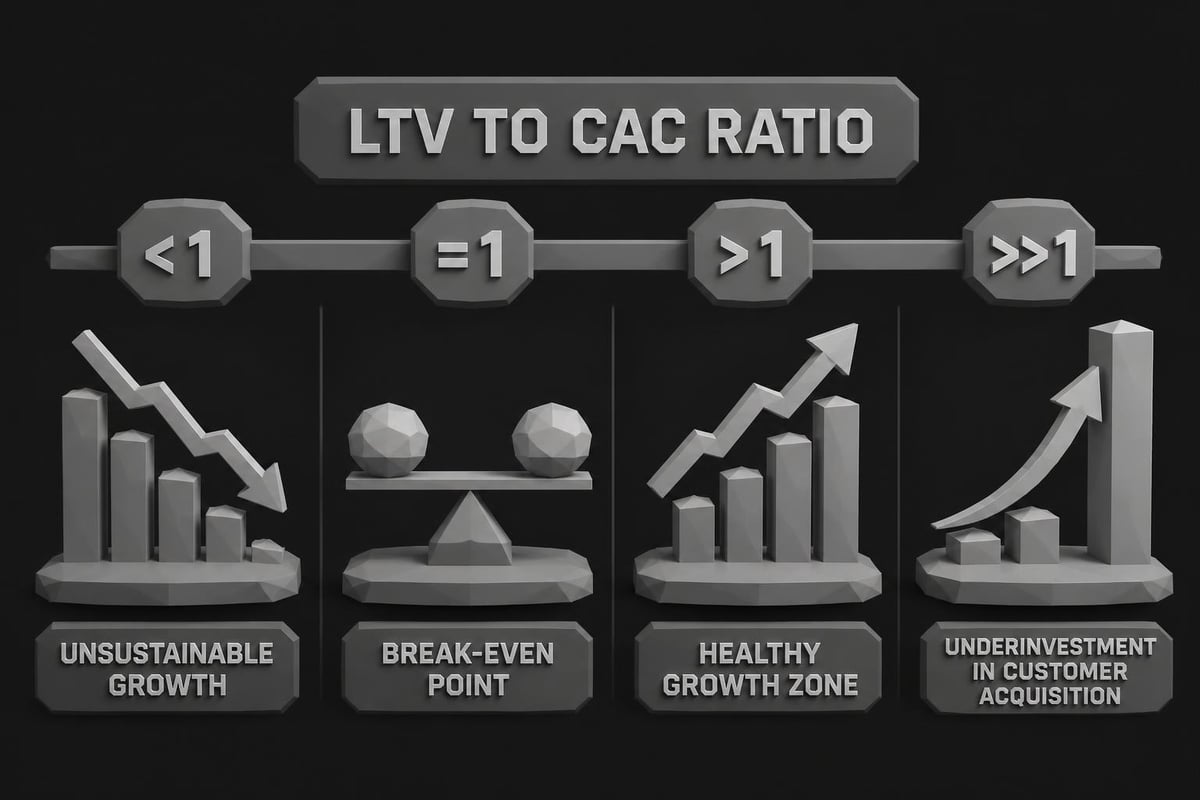
The golden rule in SaaS is maintaining a healthy ratio between lifetime value and customer acquisition cost. Most successful companies aim for an LTV:CAC ratio of at least 3:1.
- Below 1:1 - You're losing money on every customer. Crisis mode.
- 1:1 to 3:1 - You're growing but leaving money on the table or barely sustainable.
- 3:1 to 5:1 - The sweet spot. Profitable and scalable.
- Above 5:1 - You're probably under-investing in growth. Time to step on the gas.
If you're building mobile apps or SaaS products from scratch, tracking this ratio helps you know when you've found product-market fit and can start scaling aggressively. Tools like LTV calculators can help you monitor these metrics without building complex spreadsheets yourself.
Strategies to Increase Your Customer Lifetime Value
Now for the fun part - actually improving your numbers. There are really only three ways to increase customer lifetime value saas metrics: charge more, keep customers longer, or get them to buy more stuff.
Reduce Churn Like Your Business Depends on It
Because it does. Churn is the silent killer of SaaS businesses. Even a seemingly small improvement in retention creates a massive impact on lifetime value.
Going from 5% monthly churn to 3% monthly churn increases average customer lifespan from 20 months to 33 months - that's a 65% improvement! Here's how to make it happen:
- Nail your onboarding - Most churn happens in the first 30 days. Make sure new users experience value fast.
- Monitor usage patterns - Spot at-risk customers before they cancel. If someone hasn't logged in for two weeks, reach out.
- Build features people actually use - Vanity features don't reduce churn. Solve real problems consistently.
- Provide exceptional support - Especially for digital product businesses, being responsive and helpful creates loyalty.
Implement Strategic Price Increases
Many creators undercharge for their digital products out of fear or uncertainty. But if you're delivering real value, thoughtful price increases can significantly boost your customer lifetime value saas calculations without triggering massive churn.
When you raise prices, grandfather existing customers at their current rate for a period. This rewards loyalty while capturing more value from new customers who don't know the old pricing. Most well-run SaaS companies raise prices 10-20% annually as they add features and value.
Create Expansion Revenue Opportunities
The most elegant way to increase lifetime value is getting existing customers to spend more over time. This is called expansion revenue, and it's pure gold because you're not spending anything on acquisition.
Tiered pricing models let customers start small and upgrade as they grow. Someone might start on your $19 basic plan, then move to $49 standard, then eventually $99 premium.
Usage-based pricing naturally creates expansion as customers get more value. If you charge per project, per user, or per API call, your revenue grows as customers succeed.
Add-ons and complementary products give customers reasons to increase their investment. A project management app might offer time tracking or invoicing as optional upgrades.
If you're building and launching digital products, understanding these expansion mechanics is crucial. That's exactly what Build and Launch Your SaaS App in 14 Days teaches - how to structure your product and pricing for maximum lifetime value from day one.

Benchmarking Your Customer Lifetime Value SaaS Performance
Numbers without context are meaningless. So what's actually good when it comes to customer lifetime value saas metrics?
Industry benchmarks vary widely depending on your market segment, pricing, and customer type. But here are some general guidelines for 2026:
| Business Type | Typical ARPU | Average Lifespan | Benchmark CLV |
|---|---|---|---|
| Consumer Apps | $5-15/month | 6-12 months | $30-180 |
| SMB SaaS | $50-200/month | 24-36 months | $1,200-7,200 |
| Mid-Market SaaS | $500-2,000/month | 36-60 months | $18,000-120,000 |
| Enterprise SaaS | $5,000+/month | 60+ months | $300,000+ |
Don't panic if your numbers are below these ranges when you're just starting out. Early-stage products typically see higher churn and lower lifetime values. The key is tracking the trend - are things improving month over month?
Segment Your Customers for Better Insights
Not all customers are created equal. One of the biggest mistakes I see digital product creators make is treating customer lifetime value saas as a single number.
Break down your CLV by customer segment:
- Acquisition channel - Do customers from organic search stick around longer than paid ads?
- Pricing tier - Are premium customers really more valuable long-term?
- Use case - Which customer problems lead to the best retention?
- Company size - Do solo entrepreneurs or small teams have better economics?
This segmentation reveals where to focus your efforts. Maybe you discover that customers who come through content marketing have 2x the lifetime value of those from Facebook ads. That should dramatically shift your marketing strategy.
The Revenue Cohort Analysis Approach
Here's an advanced technique that separates amateur from professional SaaS operators. Instead of just calculating a single customer lifetime value saas number, track cohorts over time.
A cohort is a group of customers who signed up in the same month. You track each cohort's revenue month by month to see how long-term value evolves. This reveals patterns that aggregate numbers miss.
Why Cohort Analysis Changes Everything
Let's say you calculate your overall CLV at $600. Sounds decent. But when you break it down by cohort, you might discover:
- January 2025 cohort: $850 CLV
- April 2025 cohort: $420 CLV
- July 2025 cohort: $680 CLV
What happened in April? Maybe you ran a discount promotion that attracted price-sensitive customers. Or launched a half-baked feature that created bad first impressions. Without cohort analysis, you'd never know.
This kind of detailed tracking might seem overkill when you're just starting, but even simple spreadsheet tracking pays dividends. Speaking of spreadsheets, if you need help organizing your financial planning as you grow, JRen Digital offers minimalist templates that keep things simple without overwhelming formulas.
Common Mistakes That Destroy Customer Lifetime Value
Let's talk about what not to do. I've seen countless digital product businesses sabotage their own customer lifetime value saas metrics through totally avoidable mistakes.
Focusing only on acquisition while ignoring retention is like filling a leaky bucket. You're constantly churning through customers and never building momentum. The formula for sustainable growth requires balancing both sides.
Underpricing to grow faster feels good in the short term but creates an unsustainable business model. If your CLV is $200 and you're spending $180 to acquire customers, you've got no margin for error or investment in product development.
Ignoring customer feedback leads to building features nobody wants while missing the improvements that actually reduce churn. Your existing customers are literally paying you to tell you what they need - listen to them.
Over-complicating your product in an attempt to justify higher prices usually backfires. Customers value simplicity and reliability over feature bloat. Sometimes the best way to increase lifetime value is removing features that confuse people.
Making Customer Lifetime Value Actionable
Data is worthless if you don't act on it. Here's how to actually use your customer lifetime value saas insights to build a better business.
Set Your Customer Acquisition Budget
Once you know your CLV and target LTV:CAC ratio, calculating your maximum acquisition cost is simple math. If your CLV is $900 and you want a 3:1 ratio, you can spend up to $300 per customer.
This number becomes your guiding light for all marketing decisions. Should you invest in SEO? Content marketing? Paid ads? The answer depends on whether you can acquire customers profitably within your budget.
Prioritize Product Development
Not all features are created equal when it comes to lifetime value. Use your churn analysis to identify which features drive retention, then double down on making them even better.
If you notice customers who use your collaboration features have 40% lower churn, that's a clear signal to invest more in collaboration tools. Meanwhile, that fancy integration nobody uses? Probably not worth maintaining.
Optimize Your Pricing Strategy
Your customer lifetime value saas data should directly inform pricing decisions. Understanding LTV alongside CAC helps you find the sweet spot between maximizing revenue and maintaining growth.
Consider testing:
- Annual billing discounts that increase upfront cash and reduce churn
- Mid-tier pricing options that capture customers who find your basic plan limiting
- Enterprise plans for your highest-value segments
The Future of Customer Lifetime Value in Digital Products
As we move through 2026, customer lifetime value saas tracking is becoming more sophisticated and essential. AI-powered prediction models can now forecast individual customer lifetime values with scary accuracy, letting you personalize retention efforts and pricing.
The winners in the digital product space aren't just tracking CLV - they're optimizing every aspect of their business around it. From how you measure and grow it to how you structure your entire company, this metric touches everything.
For solo founders and small teams building digital products, the good news is you don't need enterprise tools to get started. Basic tracking in a spreadsheet, coupled with awareness of the principles we've covered, puts you ahead of 90% of competitors.
The key is starting now, measuring consistently, and improving incrementally. Your customer lifetime value saas metrics today might not be impressive, but tracking the trend and working to improve it month over month is what separates sustainable businesses from those that flame out after initial growth.
Understanding and optimizing your customer lifetime value saas metrics is the difference between building a real business and just having expensive customers. When you know these numbers cold, every decision becomes clearer - from pricing to product development to marketing spend. If you're ready to stop trading hours for dollars and start building digital products that generate revenue while you sleep, CreateSell gives you everything you need to create and launch profitable web and mobile apps from scratch, even without coding experience. Turn your knowledge into self-sustaining products that compound in value just like the customer relationships we've been discussing.