
Customer Segmentation Guide for Digital Product Sellers

Modest Mitkus · November 17, 2026
Customer segmentation is the practice of splitting your customers into groups that share something meaningful, like what they need, how they behave, or how much they spend, so you can market and sell to each group differently. For a digital product seller, it means you stop sending the same pitch to everyone and start talking to the specific people most likely to buy.
If you're building an app or any other digital product, this matters more than it sounds. You probably don't have a big team or a huge budget, so every email, ad and onboarding screen has to work harder. Segmentation is how you make a small audience punch above its weight.
Why Segmenting Your Customers Pays Off
Segmenting your customers pays off because people respond better to messages that fit their situation, and that shows up in spending and loyalty.
The research backs this up. In Twilio's 2024 study, more than half of consumers said they would spend more for a customized experience, and many reported spending more with brands that personalize. Twilio also found that a substantial share of surveyed consumers had made a repeat purchase because of the personalization they got.
There's a flip side, though. A BCG survey of more than 23,000 consumers found that most were comfortable with personalized experiences, but many had recently run into personalization they considered inaccurate or invasive. Bad segmentation can do more harm than none at all. Getting the groups right matters more than getting fancy.
Here's what good segmentation gets you as a solo builder:
- Higher conversion on launch emails, because each group hears what it cares about
- Less wasted ad spend, since you stop paying to reach people who'll never buy
- Better product decisions, because you can see which group actually drives revenue
- Lower churn, because you can spot at-risk users before they leave
The Main Types of Customer Segmentation
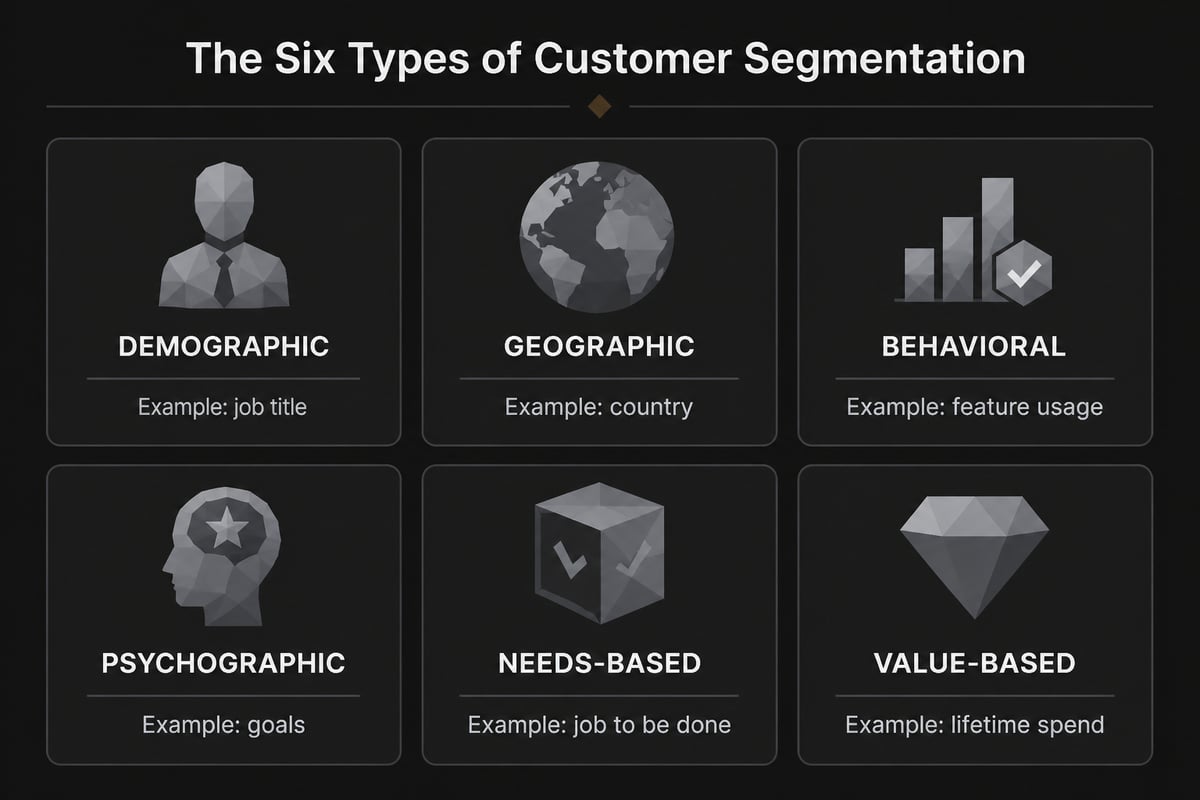
There are six common types of customer segmentation: demographic, geographic, behavioral, psychographic, needs-based, and value-based. You don't need all six. Most digital product sellers get 90% of the benefit from two or three.
Demographic segmentation
This groups people by age, gender, job title, income, or company size. It's the easiest to collect and the weakest on its own. Two people can share an age and a job and want completely different things from your app.
It works best for B2B products, where "freelance designer" versus "agency owner" tells you a lot about budget and use case.
Geographic segmentation
This groups people by country, region, city, or time zone. For digital products, the useful angles are practical: pricing in local currency, sending emails when people are awake, and handling language and tax rules. If you sell to customers in Europe, it also helps to understand GDPR rules on processing customer data, including purpose limitation and data minimization.
Behavioral segmentation
This is where digital sellers have a real edge. You can see exactly what people do: which features they use, how often they log in, what they clicked in your emails, and whether they abandoned checkout.
Common behavioral groups include:
- People who signed up but never finished onboarding
- Free users who hit a usage limit
- Customers who buy once and never return
- Power users who log in daily
Psychographic segmentation
This groups people by goals, values, attitudes, and motivations. Think "wants to save time" versus "wants to look professional" versus "is nervous about tech." It's harder to measure, but a handful of short customer conversations will often reveal more than any dashboard.
Needs-based segmentation
This groups people by the job they hired your product to do. A simple budgeting app might serve someone paying off debt, someone saving for a house, and someone tracking a side hustle. Same product, three different reasons to buy, and three different pitches.
Value-based segmentation
This groups customers by how much money they bring in, now or over time. Your top 10% of customers often generate a big share of revenue, so knowing who they are shapes everything from support priorities to product roadmap. If you want to go deeper here, our piece on customer lifetime value walks through how to calculate it.
What Are the Steps of Customer Segmentation?
The steps of customer segmentation are: define your goal, gather data, choose your variables, build the segments, tailor your approach for each, and test and refine. Here's how that looks in practice, in order.
- Define one goal. Don't segment "to understand customers." Pick something specific, like raising trial-to-paid conversion or cutting churn in the first 30 days.
- Gather the data you already have. Pull from your payment processor, email tool, analytics, and any signup form answers. Add a one-question survey if you're missing something important.
- Pick two or three variables. Maybe it's signup source, plan type, and feature usage. More variables mean more groups than you can realistically act on.
- Build the segments. Sort people into groups using those variables. Give each group a plain-English name like "stalled trial users" so everyone, including future you, knows who it is.
- Tailor your approach. Write a different email, onboarding flow, or offer for each group. This is the step where segmentation turns into money.
- Measure and adjust. Check whether each group responds the way you expected. Merge segments that behave the same and split ones that don't.
If you only do one thing from this article, do step one properly. A clear goal keeps the rest from turning into spreadsheet busywork.
Customer Segmentation When You Have Almost No Customers
Yes, you can do customer segmentation with a tiny audience, and you should start before you launch. The trick is to segment by intent and by conversation rather than by big datasets.
When you have 30 email subscribers instead of 30,000, statistical clustering isn't realistic. What works instead:
- Ask one question at signup. "What are you hoping to do with this?" with three or four answer choices gives you needs-based segments from day one.
- Tag by source. Someone who came from a tutorial video is a different person from someone who came from a "best tools" comparison post. Tag them differently.
- Talk to ten people. Spend 15 minutes each with early users and look for patterns in why they signed up.
- Segment your lead magnet. If you offer a free download to collect emails, make a few versions for different problems. Our guide to lead magnets covers how to pick ones that attract buyers rather than freebie hunters.
This is also where segmentation helps you validate an idea. If you can't describe a specific group of people with a specific problem, you probably don't have a product yet. The same logic runs through finding micro SaaS ideas: a narrow audience with a clear need beats a broad audience with a vague one.

Segmentation Examples for App and Digital Product Sellers
The best segmentation examples for app sellers focus on the moments where behavior and revenue meet. Here are a few you can copy.
Hypothetical example: a habit-tracking app
Imagine an indie habit tracker with a free tier and a paid plan. The founder could create four segments:
| Segment | Definition | What to send |
|---|---|---|
| New and stuck | Signed up, no habit created in 3 days | A short "create your first habit" walkthrough |
| Active free users | Logged in 4+ times last week, still on free | An upgrade offer tied to the feature they use most |
| Paying and engaged | Paid, using it weekly | A request for a review or referral |
| Paying but fading | Paid, no login in 14 days | A check-in email and a tip for getting back on track |
Each group gets a different message and a different goal. None of it needs expensive software, just a decent email tool and a few tags.
Segmenting by acquisition channel
If one channel brings in customers who stay longer, that's a segment worth knowing about. Maybe your SEO traffic converts slowly but sticks around, while social traffic signs up fast and churns. That tells you where to put your next hour of effort. If search is your focus, hacking SEO is a good next read.
Segmenting by pricing tolerance
Some customers want the cheapest option and some want the one that saves them the most time. Offering a simple tier structure lets each group self-select. If you're still working out how to charge, this overview of mobile app monetization strategies lays out the options.

What Are Customer Segments on a Business Model Canvas?
On a business model canvas, customer segments are the groups of people or organizations your business is built to serve, and it's the first block you fill in because every other block depends on it. Your value proposition, channels, revenue streams and costs all change depending on who the customer is.
A good canvas entry is specific. "Small business owners" is too vague to act on. "Solo consultants who invoice clients manually and lose track of payments" tells you what to build, where to find them, and what to charge.
If you're using the canvas to plan an app, write one segment per canvas column rather than cramming several together. You can always merge them later, and it's easier than untangling a muddy first draft.
Common Customer Segmentation Mistakes to Avoid
The most common customer segmentation mistakes are making too many segments, relying on one data point, and never acting on the results.
- Too many groups. If you can't write a different message for each segment, you have too many. Three to five is plenty for a solo seller.
- Stale segments. People move. A trial user becomes a customer; a customer becomes inactive. Rebuild your groups on a regular schedule.
- Guessing instead of checking. Assumptions about "who buys" are often wrong. Compare your guesses against actual purchase and usage data.
- Creepy personalization. Using data in ways customers don't expect is exactly what the BCG survey flagged as a problem. Only personalize with information people knowingly gave you or that clearly came from their use of your product.
- Ignoring tools you already have. Your email platform and payment processor probably support tags and filters already. If you're comparing options, this roundup of digital marketing tools is a useful starting point.
Segmentation also isn't only for software. Whatever you sell, the same thinking applies. For example, a sports gift brand like Mes Premiers Chants de Supporter, which makes interactive sound books that introduce young children to football chants, would naturally split its audience by team loyalty and by the age of the child, then speak to each group differently. A brand like PSF Collective, selling apres padel hoodies, tees and totes, can do the same by splitting fans who play often from those buying gifts.
FAQ
What is customer segmentation in simple terms?
It's sorting your customers into groups based on shared traits or behaviors so you can give each group a more relevant message, offer or product experience. Instead of one generic pitch, you speak to what each group actually cares about.
How many customer segments should I have?
Start with three to five. That's enough to tell groups apart and few enough that you can write different emails or onboarding for each one. Add more only when you've got the data and the time to act on them.
Which type of segmentation is best for apps?
Behavioral segmentation usually delivers the fastest results for apps, because you can see what users do inside the product. Pair it with needs-based segmentation from a simple signup question and you'll cover most of what matters early on.
Your next step is simple: pull up your current user or subscriber list and sort it into three groups based on what each person did in their first week, then write one tailored email for each. If you're still at the stage of figuring out what to build and who to sell it to, CreateSell teaches the full path from finding an idea people will pay for to marketing and selling a web or iOS app with no coding experience, and you can join the waitlist to be first in line when the next group opens.


