
How to Build a Go-to-Market Strategy for Your Digital Product

Modest Mitkus · November 28, 2026
A go-to-market strategy is your plan for getting a product in front of the right buyers and turning them into paying customers. It covers who you're selling to, what you're promising them, how much you charge, where you reach them, and how you'll measure whether it's working.
If you're building an app or any digital product, this plan matters more than the build itself. Plenty of good products stall because nobody ever planned how the first hundred customers would find them. This guide walks through the pieces in order, written for people who either can't code and want to earn from an app, or can code and keep struggling to sell what they ship.
What a Go-to-Market Strategy Actually Covers
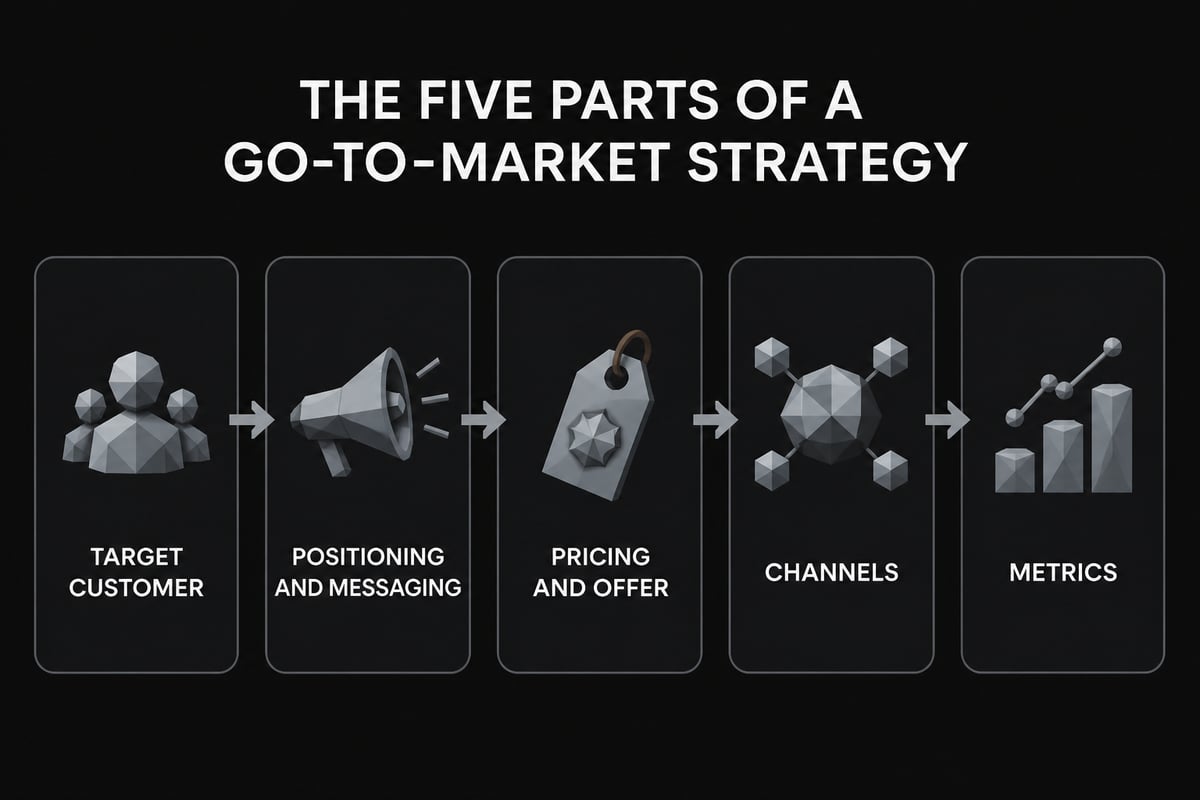
A go-to-market strategy answers five questions: who it's for, what problem you solve, what it costs, where you'll reach buyers, and how you'll know it's working. That's the whole skeleton. Everything else is detail.
If you've ever heard "strategy" and pictured a 40-page slide deck, relax. For a one-person product, a useful plan fits on a single page. The goal isn't to impress anyone. It's to stop you from building and launching on vibes.
A common question is how this differs from a marketing plan. A marketing plan usually covers ongoing promotion across a stretch of time. A go-to-market plan is narrower and more launch-focused: it decides who you target, how you position and price the product, and which channels get you the first wave of buyers. Marketing carries on after that.
Here are the five parts you'll build, which also answer the "five components of strategy" question for a digital product:
- Target customer: the specific person with the specific problem
- Positioning and messaging: why you, why now, in plain words
- Pricing and offer: what they pay and what they get
- Channels: where you'll reach them
- Metrics: the few numbers that tell you to keep going or change course
How to Identify Your Ideal Customer
You identify your ideal customer by describing one specific group of people with one urgent problem, then confirming it by talking to real people before you build or launch. "Everyone who wants to be productive" isn't a customer. "Freelance designers who lose hours chasing invoices" is.
Start with the problem, not the person. Write down the pain in the words a stranger would use. Then work backward to who feels it most strongly.
Narrow it until it feels almost too small
Early on, a tiny audience is an advantage. You can find them, speak their language, and write messaging that makes them feel seen. You can widen later once you have proof.
Check the signals that people will pay
Interest is cheap. Payment is the real test. Look for these:
- People already paying for a clumsy alternative (a spreadsheet template, a competitor, a freelancer)
- Complaints you can find in forums, comment sections and reviews, in their own words
- A job the person is hiring someone else to do right now
- Willingness to join a waitlist, answer a call, or pre-pay
Spend a week on this before you commit. A few honest conversations will tell you more than a month of guessing. If you're still hunting for something worth building, these SaaS ideas and micro SaaS ideas can help you spot problems with built-in demand.
Positioning: Say What It Does in One Sentence
Positioning is the short statement that tells your ideal customer what your product does, who it's for, and why it beats their current option. If you can't say it in one sentence, buyers won't be able to repeat it either.
A simple template works well:
For [specific customer] who [has this problem], [product name] is a [category] that [main benefit], unlike [current alternative] which [its weakness].
Fill that in, then pressure-test it. Does a stranger understand it in five seconds? Does it name a result rather than a feature? "AI-powered dashboard" describes a thing. "See which customers are about to cancel before they do" describes an outcome.
Turn positioning into messaging
Once the one-liner holds up, build the rest of your copy from it: the headline, the subhead, the three benefit bullets, the call to action. Reuse the exact phrases your customers used when you interviewed them. That's not lazy. It's why the copy lands.
Pricing and Offer Decisions
Your price should reflect the value of the result you deliver, not the hours it took you to build. For digital products this usually means choosing between a one-time purchase, a subscription, or a mix, and then making the offer easy to understand.
Think through these choices:
| Model | Works well when | Watch out for |
|---|---|---|
| One-time payment | The product solves a defined problem once | Revenue resets to zero every month |
| Subscription | Customers get ongoing value or ongoing use | Churn if value fades |
| Freemium | Usage spreads by word of mouth | Many free users, few buyers |
| Free trial | Value shows up fast after signup | Trial users who never activate |
Recurring revenue is attractive because it compounds, but only if people stay. If you want to go deeper on that side, read up on the recurring revenue model and SaaS pricing strategy before settling on a number.
A practical tip: don't price in a vacuum. Look at what people currently pay for the alternative you identified earlier. Pricing far below it signals low quality. Pricing far above it needs a clear reason.
Choose Channels You Can Actually Run Alone
Pick one or two acquisition channels where your ideal customer already spends time, and commit to them for at least a few weeks. Spreading thin across six platforms is the fastest way to get no results from any of them.
For a solo builder, the realistic options include:
- Content and SEO: slow to start, cheap to run, and it keeps working. See how this plays out in content marketing for SaaS.
- Communities: Reddit, niche forums and Slack groups, where you help first and mention your product second.
- Short-form video: a fast way to find out what messaging resonates, covered in TikTok digital marketing.
- Email: a list you own, which converts better than almost any social channel. A free lead magnet is the usual way to start one.
- Partnerships and affiliates: other people with your audience promote you for a cut.
- Paid ads: quick feedback, but only once your offer already converts organically.
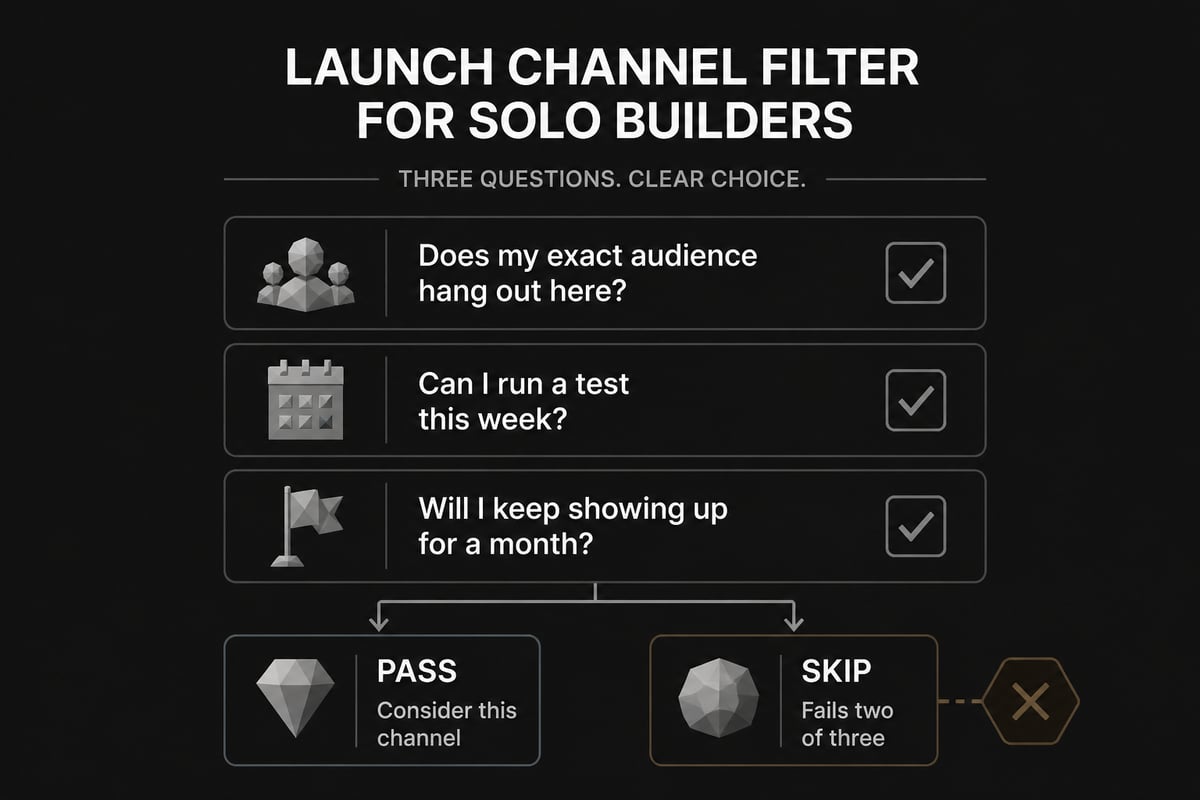
Here's a simple filter. Choose the channel where you can reach your exact audience, where you enjoy showing up, and where you can run a small experiment this week. If a channel fails two of those three, skip it for now.
Build Your Launch Plan Around Pre-Launch Demand
A strong launch plan starts before the product is finished, because the best time to collect interest is while you're still building. If you only begin promoting on launch day, you're launching to an empty room.
Break it into three phases:
Before launch
Build a simple landing page that states your positioning and collects emails. Share progress publicly, talk to your target customer, and offer early access or a discount to people who sign up. Your goal is a small, warm group who are ready to buy the moment the doors open.
Launch week
Email your list first. Then post in the communities and channels you've been participating in, and ask early users for feedback while the product is fresh. Keep the offer clear: one product, one price, one next step.
After launch
Most of the real work happens here. Follow up with buyers, fix friction in onboarding, and ask for testimonials. Strong onboarding turns first-time buyers into people who stick around, which matters because retention affects every number downstream.
For developers who tend to polish endlessly, a hard rule helps: launch to a small group sooner than feels comfortable. Early feedback beats another month of invisible features.
Metrics That Tell You What to Do Next
Track a small handful of numbers tied to each step of your funnel, and review them on a fixed schedule. Too many metrics create noise. Too few leave you guessing.
A starter set for a digital product:
- Traffic by source: which channel brings people in
- Visitor-to-signup rate: whether your messaging resonates
- Signup-to-paid rate: whether the offer and price work
- Activation rate: whether new users reach the first moment of value
- Churn or refund rate: whether the product delivers on the promise
- Revenue per customer vs. cost to acquire one: whether the business can grow
Match the fix to the weak spot. Low visitor-to-signup points to positioning or the landing page. Low signup-to-paid points to pricing or the offer. High churn points to the product itself or the wrong customer. Without this mapping, you'll change random things and learn nothing.
Where Can CreateSell Help With Your Go-to-Market Strategy?
If you want a guided path through all of this, CreateSell covers the full journey from finding an idea people will pay for to selling the finished app. It's built on a system that has been used to scale several products to tens of thousands of dollars per month. It works for web or iOS apps with no coding experience needed, and it puts marketing and selling front and center, which is the part where most app projects fail.

You also get a community of builders shipping alongside you and sharing progress and first sales, which helps when you're staring at an empty analytics page. Check CreateSell's product pages for details on what's included and how it works. It's a fit for people ready to put in the work, not for anyone hoping for a guaranteed income result.
Common Mistakes That Sink a Launch
Most failed launches trace back to a small set of avoidable errors. Knowing them in advance saves you months.
- Building before validating. You spend weeks on features nobody asked for.
- Targeting everyone. Vague messaging feels safe and converts poorly.
- Skipping pricing tests. Founders default to a low number out of fear.
- Chasing every channel. Energy gets split and nothing compounds.
- Treating launch day as the finish line. The week after launch is when the learning starts.
- Ignoring existing alternatives. If people already solve the problem somehow, you need to know how and why they'd switch.
Developers often over-invest in the product and under-invest in distribution. Non-technical founders sometimes do the opposite, planning for months and never shipping. The fix for both is the same: shrink the first version, put it in front of real people, and adjust.
For a fuller look at stages and team structure from another angle, this go-to-market strategy framework guide is a useful companion read.

FAQ
What is a go-to-market framework?
A go-to-market framework is a repeatable structure for planning a launch, usually covering your target customer, positioning, pricing, channels and success metrics. It keeps you from skipping steps and gives you a checklist to reuse for every new product.
What is market strategy in marketing?
Market strategy is the overall plan for how a company reaches and wins customers in a market, including who it targets, how it differentiates, and how it prices and promotes. A go-to-market plan is the launch-focused slice of that bigger picture.
How long should it take to build a go-to-market plan?
For a solo digital product, a first version can take a few days: a week at most if you include customer conversations. Keep it short, test it with real buyers, and revise it as results come in.
Your next step today is to write one sentence describing exactly who your product is for and the problem it solves, then book three conversations with people who match it. If you'd rather not work it out alone, CreateSell walks you through finding a profitable idea, building it, and selling it, with a community of builders alongside you. Reserve your spot and Join Waitlist to start turning your idea into a product that earns.


