
User Acquisition Strategy: A Complete Guide for 2026

Modest Mitkus
June 10, 2026
Getting users for your digital product feels like shouting into the void sometimes, right? You've built something amazing, but now you're stuck wondering how to actually get people to notice it, download it, and-fingers crossed-pay for it. That's where a solid user acquisition strategy comes in. It's not just about throwing money at ads or hoping viral magic happens. It's about understanding who needs what you've built and creating a systematic approach to reach them, convert them, and keep them coming back. Whether you're launching your first mobile app or scaling a SaaS product, the principles stay the same-you need a plan that's both strategic and sustainable.
Understanding User Acquisition Strategy Fundamentals
A user acquisition strategy is your roadmap for attracting and converting new users to your digital product. Think of it as your game plan for growth, covering everything from identifying your ideal customer to choosing the right channels and measuring what actually works.
The beauty of digital products is that once you crack the code on acquisition, you can scale without the linear time-for-money trap. But here's the thing-there's no one-size-fits-all approach. What works for a meditation app won't necessarily work for a project management tool.
The Core Components
Every effective user acquisition strategy needs these building blocks:
- Target audience definition that goes beyond basic demographics
- Channel selection based on where your users actually hang out
- Value proposition that resonates with real pain points
- Conversion optimization throughout the entire funnel
- Metrics and KPIs that tell you what's working and what's burning cash
The mistake most digital product creators make? They skip the foundation and jump straight to tactics. They'll start running Facebook ads before they even know if their target audience uses Facebook. Or they'll optimize their app store listing without understanding what actually motivates someone to download.
Defining Your Target User Profile
You can't acquire users if you don't know who you're trying to acquire. Sounds obvious, but you'd be surprised how many digital product businesses operate with fuzzy user definitions like "entrepreneurs" or "busy professionals."
Get specific. Really specific.
Start by identifying the problem your product solves, then work backward to understand who has that problem most acutely. What's their day like? What frustrates them? What solutions have they already tried? Where do they look for answers?

Create user personas, but make them actionable. Don't just list age ranges and job titles-describe their behaviors, motivations, and objections. A comprehensive framework for defining target users can help you avoid the common pitfall of targeting everyone and reaching no one.
Segmentation Matters
Not all users are created equal. Some will become power users who evangelize your product. Others will churn within days. Your user acquisition strategy should prioritize acquiring the right users, not just the most users.
Consider segmenting by:
- Problem severity - Users with urgent needs convert faster
- Willingness to pay - Free users are great, but paying users sustain your business
- Technical sophistication - Complex products need tech-savvy early adopters
- Use case - Different user segments might use your product in completely different ways
This segmentation shapes everything else-your messaging, your channels, even your pricing strategy.
Choosing Your Acquisition Channels
Here's where things get tactical. You've got dozens of potential channels, but limited time and budget. The key is matching channels to your specific audience and product type.
Paid vs. Organic: The Balance
| Channel Type | Pros | Cons | Best For |
|---|---|---|---|
| Paid (ads, sponsorships) | Fast results, predictable scaling | Requires budget, stops when you stop paying | Products with proven PMF and solid unit economics |
| Organic (SEO, content, social) | Compounds over time, builds authority | Slow to start, requires consistency | Long-term growth, thought leadership |
| Referral/Viral | Low cost per acquisition, high trust | Hard to engineer, unpredictable | Products with network effects |
Most successful digital products use a mix. You might run paid ads to get initial traction while building organic channels for sustainable growth.
For digital products specifically, some channels consistently outperform:
- App stores (if you're building mobile apps) with optimized listings
- Content marketing that actually teaches something valuable
- Product-led growth where the product itself drives acquisition
- Community building in niche forums and platforms
- Strategic partnerships with complementary tools
The Sapio dating app case study shows how understanding your target audience's content preferences can drive massive install growth-they saw a 3,072% increase in weekly installs by creating content that resonated with their specific user base.
Building Your Acquisition Funnel
Your user acquisition strategy needs a clear funnel that moves people from awareness to action. For digital products, this typically looks like:
Awareness → Interest → Consideration → Trial/Download → Activation → Retention
Notice that acquisition doesn't stop at the download. A user who downloads your app but never opens it isn't really acquired-they're just a vanity metric.
Optimizing Each Stage
Focus on reducing friction at every step. Make it stupid-easy for someone to go from curious to converted.
Awareness stage:
- Show up where your target users already spend time
- Lead with outcomes, not features
- Use social proof strategically
Consideration stage:
- Address objections before they're asked
- Provide clear differentiation from alternatives
- Offer low-risk ways to experience value
Conversion stage:
- Minimize steps in signup/download process
- Reduce required information to bare essentials
- Clearly communicate what happens next
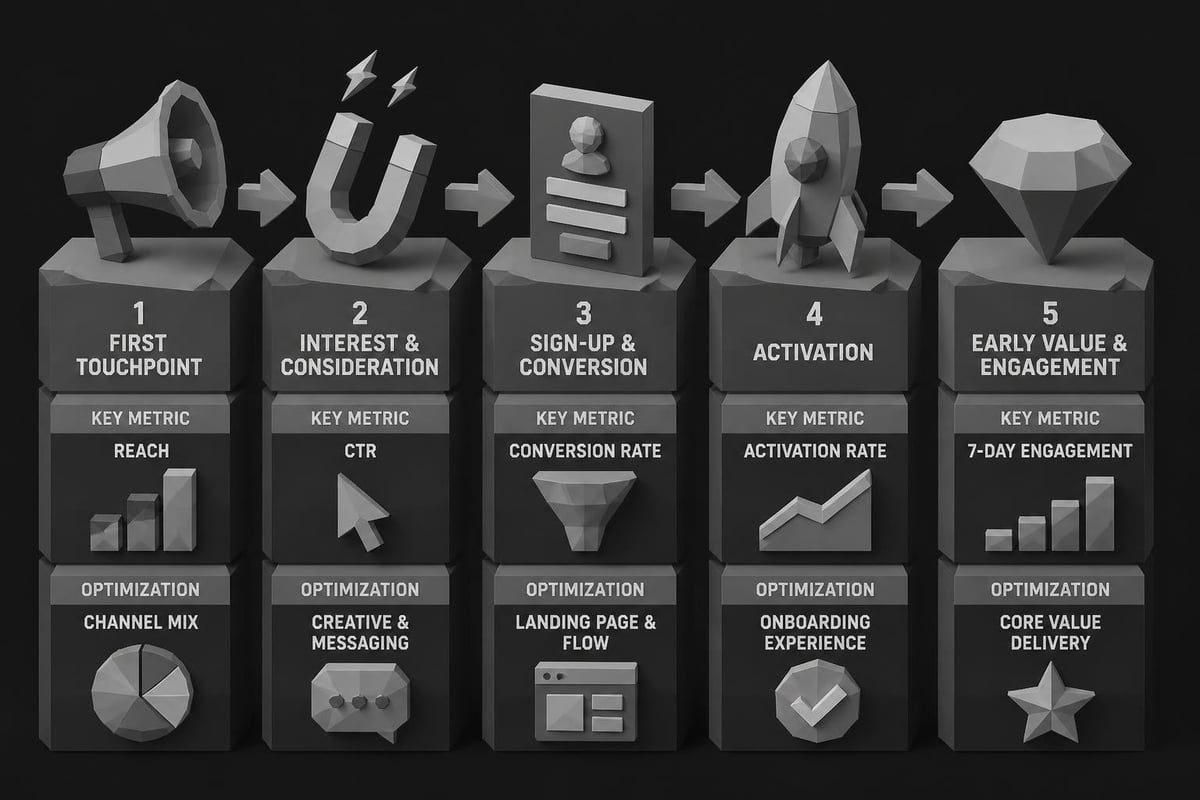
Many digital product creators obsess over top-of-funnel metrics while ignoring activation. But if you're acquiring users who never experience your product's core value, you're just wasting money.
Leveraging Product-Led Growth
For digital products, your product itself can be your best acquisition channel. Product-led growth flips the traditional model-instead of selling first and delivering value later, you deliver value first and monetize later.
Think about how Dropbox grew. They gave you free storage, made it ridiculously easy to share files, and built in viral loops where inviting friends benefited both parties. The product did the marketing.
If you're building SaaS or mobile apps, consider how you can make your product inherently shareable or collaborative. Can users invite teammates? Does sharing content from your platform provide value to both the sharer and receiver?
For digital product creators, this might mean offering a genuinely useful free version that solves a real problem, then creating natural upgrade paths as users' needs grow. If you're building apps without code, you can implement these growth mechanisms from day one-like the approach taught in Build and Launch Your SaaS App in 14 Days, which covers not just building but also architecting products for sustainable growth.
Free Trials vs. Freemium
Both can work, but they attract different users and require different user acquisition strategies:
- Free trials work better for complex products where value takes time to experience
- Freemium works better when you can demonstrate core value immediately
- Free trials create urgency but higher signup friction
- Freemium generates more users but potentially lower conversion rates
Measuring What Matters
You can't optimize what you don't measure. But drowning in analytics is just as bad as flying blind. Focus on metrics that actually indicate business health.
Key Metrics for User Acquisition
| Metric | What It Tells You | Why It Matters |
|---|---|---|
| Customer Acquisition Cost (CAC) | How much you spend to acquire each user | Determines if your model is sustainable |
| Lifetime Value (LTV) | How much revenue each user generates | Must be higher than CAC for profitability |
| Conversion Rate | Percentage of visitors who become users | Indicates offer-market fit |
| Activation Rate | Percentage who reach "aha moment" | Shows if you're acquiring right users |
| Payback Period | How long to recoup acquisition cost | Affects cash flow and scaling ability |
The fintech startup case study demonstrates how focusing on the right metrics-particularly acquisition efficiency and user quality over pure volume-led to a 5x increase in active users in just 90 days.
Track cohorts, not just aggregate numbers. Users acquired from different channels behave differently, so you need to understand performance at a granular level.
Testing and Iteration
Your initial user acquisition strategy will be wrong. That's okay-it's supposed to be. The goal is to learn quickly and iterate.
Start with hypotheses, not assumptions. "I think users will convert better with a 7-day trial than a 30-day trial" is a hypothesis you can test. "Users want a free trial" is an assumption that might be wrong.
Rapid Testing Framework
- Identify the biggest bottleneck in your funnel
- Form a specific hypothesis about how to improve it
- Design a test that isolates one variable
- Run until statistical significance (don't stop tests early)
- Implement winners and move to next bottleneck
Small improvements compound. A 10% improvement in conversion rate plus a 10% improvement in activation rate equals a 21% overall improvement in effective acquisition.
Test across different dimensions:
- Messaging and positioning - Does "save time" resonate more than "increase productivity"?
- Pricing and packaging - Does $9/month convert better than $99/year?
- Onboarding flow - Does a guided tutorial increase activation vs. jumping straight in?
- Visual design - Do screenshots or videos work better in your app store listing?
Scaling What Works
Once you've found channels and tactics that work, the temptation is to pour all your resources there. Smart move, but with caveats.
Most acquisition channels have diminishing returns. The first $1,000 you spend on Facebook ads might acquire users at $5 each. The next $10,000 might increase to $8 per user. And when you try to scale to $50,000 per month, you're suddenly paying $15 per user.

Sustainable Scaling Strategies
Don't put all your eggs in one channel basket. As you scale your winners, simultaneously test new channels at smaller budgets. This creates a portfolio approach where you're always developing your next acquisition channel before your current ones saturate.
The Bibit robo-investing app achieved a 333% increase in install volume by continuously optimizing their campaigns rather than just increasing budgets blindly. They focused on improving creative, targeting, and bidding strategies as they scaled.
Also consider geographic expansion. If you've maxed out your primary market, can you replicate success in adjacent markets? The Booky lifestyle app used localization and hyper-targeting in different geographic markets to scale efficiently.
Creative and Messaging That Converts
All the channel selection and funnel optimization in the world won't help if your creative and messaging fall flat. Your user acquisition strategy needs compelling communication that speaks directly to user pain points.
Stop talking about features. Nobody wakes up thinking "I really need a product with AI-powered analytics." They wake up thinking "I'm drowning in data and can't make sense of it."
Your messaging should:
- Lead with the outcome or transformation
- Use language your users actually use (not jargon)
- Address specific situations or problems
- Differentiate clearly from alternatives
- Build credibility without bragging
Testing Creative Variations
For paid channels especially, creative fatigue is real. Your ad performance will decline over time as users see the same creative repeatedly. Plan for regular creative refreshes-new images, videos, copy angles, formats.
The Drop fintech startup leveraged influencer partnerships to acquire over 1.5 million users partly because authentic, varied content from different voices prevented creative fatigue and built trust through third-party validation.
Retention as Acquisition Strategy
Here's a counterintuitive truth: improving retention is often the most effective user acquisition strategy. Why? Because it improves your unit economics, allowing you to profitably spend more on acquisition than competitors.
If your average user is worth $100 and competitors' users are worth $50, you can bid up to $90 per user and still be profitable while they tap out at $40. You win more auctions, acquire more users, and create a flywheel effect.
Plus, retained users refer others. They create content. They provide social proof. A smaller number of highly engaged users is more valuable than a large number of ghosts.
Focus on activation-getting users to that "aha moment" where they experience core value. The faster someone reaches activation, the more likely they'll stick around.
Building Community-Driven Acquisition
Communities can become self-sustaining acquisition engines. When your users congregate around shared interests or goals, they naturally invite others who'd benefit.
This doesn't mean you need to build a social network. It might be:
- A Discord or Slack group for power users
- Regular virtual events or workshops
- A subreddit or Facebook group
- User-generated content platforms
- Ambassador or advocate programs
The key is facilitating connections between users, not just between users and your product. The case study on reducing acquisition costs by 82% shows how cohesive messaging and community engagement can dramatically improve efficiency.
Partnerships and Integration Strategy
Strategic partnerships can unlock entirely new user bases. Look for products or services that:
- Serve the same target audience
- Solve complementary problems
- Have users who would benefit from your product
Integrations work especially well for digital products. If your app integrates with tools your users already depend on, you tap into existing workflows rather than asking for behavior change.
Think about directory listings, app marketplaces, and integration partnerships. The Blinkist case study demonstrates how expanding beyond familiar channels-they acquired over 60,000 new sign-ups in six months by diversifying their approach and partnering with content discovery platforms.
Attribution and Multi-Touch Reality
Users rarely convert on their first interaction. They might see your ad, ignore it, then later search for a solution, read your blog post, and finally download your app.
Which channel gets credit? With last-click attribution, the organic search does. But the ad created initial awareness. Your user acquisition strategy needs to account for this complexity.
Consider using multi-touch attribution models that give credit across the journey. This prevents you from over-investing in bottom-funnel channels while neglecting awareness and consideration stages.
Attribution Challenges
- Cross-device tracking - Users research on desktop, download on mobile
- Long consideration cycles - B2B products especially have weeks or months between first touch and conversion
- Dark social - People share links in messaging apps where you can't track source
- Privacy changes - iOS 14.5+ and other privacy measures limit tracking
Accept that you won't have perfect attribution. Focus on directional accuracy and test incrementally. Run brand lift studies. Use unique promo codes or landing pages for different channels.
Adapting to Market Changes
Your user acquisition strategy can't be static. Market conditions shift. Platforms change their algorithms. Competitors copy what works. New channels emerge while others decline.
Stay curious and keep testing. What worked in 2025 might be saturated in 2026. The dating app Once achieved a 4x increase in premium subscribers by adopting newer ad formats and staying ahead of market saturation.
Monitor industry trends, but don't chase every shiny object. Test new channels at small scale before committing serious resources. And remember-sometimes the best strategy is doubling down on fundamentals while others chase trends.
Building a sustainable user acquisition strategy isn't about finding one magic channel or hack-it's about understanding your users deeply, meeting them where they are, and continuously optimizing the journey from stranger to advocate. The digital product landscape in 2026 rewards creators who combine systematic strategy with authentic value delivery. If you're ready to transition from trading time for money to building products that sell while you sleep, CreateSell provides the roadmap and tools to create, launch, and scale your digital product business with proven frameworks for sustainable growth.