
Mobile Application Monetization in 2026

Modest Mitkus
May 22, 2026
So you've built a mobile app, or you're thinking about it. That's awesome! But here's the question that keeps every app creator up at night: how do you actually make money from it? Mobile application monetization isn't just about slapping ads everywhere and hoping for the best. It's about finding the right strategy that works for your app, your users, and your business goals. In 2026, there are more ways than ever to turn your app into a revenue-generating machine, but the key is choosing the approach that fits your specific situation. Let's dive into what actually works right now.
Understanding the Mobile App Revenue Landscape
The mobile app economy is massive. We're talking hundreds of billions of dollars flowing through app stores and direct channels every year. But here's what's changed: users are getting pickier about how they spend their money, and the old playbook doesn't always work anymore.
Consumer behavior has shifted dramatically:
- Subscription fatigue is real, but subscriptions still dominate revenue
- Users expect free trials before committing
- Privacy changes have made targeted advertising more challenging
- Quality experiences command premium prices
According to recent analysis of consumer spending patterns, subscription-based apps continue to see the strongest growth, but only when they deliver genuine ongoing value. The days of tricking users into subscriptions they don't want are over.
The Reality of App Store Economics
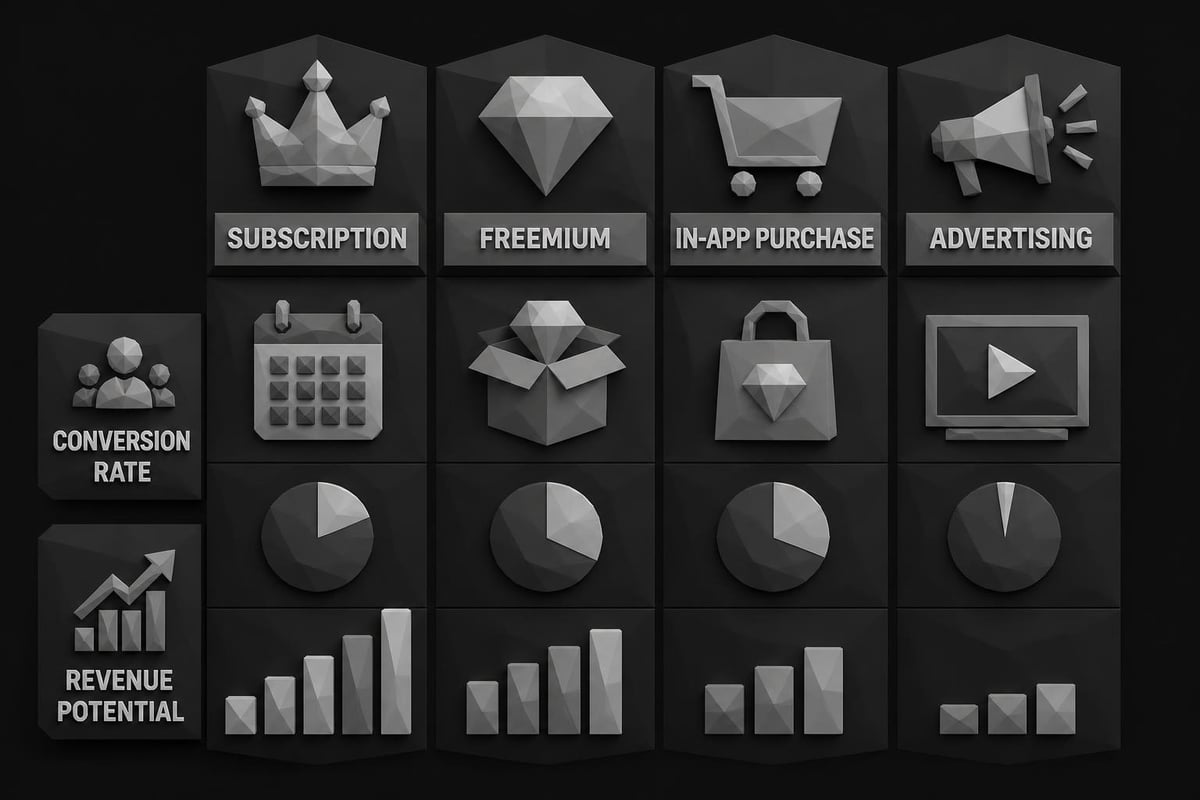
Let's be honest about the numbers. Most apps don't make money. Like, seriously, most of them generate next to nothing. But the ones that do? They can be incredibly profitable. The difference usually comes down to mobile application monetization strategy and execution.
| Revenue Model | Average Conversion Rate | User Retention | Setup Complexity |
|---|---|---|---|
| Subscriptions | 2-5% | High | Medium |
| One-time purchase | 1-3% | Medium | Low |
| Freemium + IAP | 5-10% (to paying) | High | High |
| Ad-supported | 100% (all users) | Variable | Low |
Subscription Models That Actually Work
Subscriptions are the heavyweight champion of mobile application monetization right now. But you can't just throw up a paywall and expect people to subscribe. You need to think about value delivery.
The apps crushing it with subscriptions are doing a few things right. First, they're offering free trials that actually let users experience the core value. Second, they're being transparent about pricing. Third, they're constantly adding features that justify the ongoing cost.
Pricing Your Subscription
Here's where it gets tactical. Your pricing can't be random. Look at what competing apps charge, but more importantly, look at what value you're delivering.
Common subscription pricing tiers that work:
- Basic: $2.99-$4.99/month (single user, core features)
- Pro: $9.99-$14.99/month (advanced features, priority support)
- Premium: $19.99-$29.99/month (full access, team features, integrations)
Annual plans should offer at least 20-30% savings compared to monthly to incentivize commitment. And here's a pro tip: don't be afraid to experiment with pricing. Apps that optimize their monetization strategies test different price points constantly.
Making Free Trials Convert
Your free trial is your handshake with potential subscribers. Make it count. Seven days is often too short for complex apps; 14 or even 30 days works better for apps with deeper functionality.
During the trial, focus on activation. Get users to experience your app's core value proposition as quickly as possible. Send helpful onboarding emails. Offer in-app guidance. The goal is to make them dependent on your app before the trial ends.
Freemium: The Balancing Act
Freemium is tricky. Give away too much, and nobody upgrades. Give away too little, and nobody sticks around long enough to see the value. The sweet spot? Offer enough free functionality that users get real value, but hold back features that power users absolutely need.
Think about it like this: your free tier is a long-term audition. Users are trying to decide if your app deserves space in their life and their wallet. You want to prove value over time, building trust until upgrading feels obvious.

Features that work well behind paywalls:
- Advanced analytics and reporting
- Team collaboration tools
- Export and integration capabilities
- Unlimited usage (after free limits)
- Premium templates or content
- Priority support
The apps getting this right are using data to figure out exactly which features drive upgrades. They're tracking user behavior and testing different feature combinations constantly.
In-App Purchases That Don't Feel Pushy
In-app purchases (IAP) are different from subscriptions. They're one-time transactions for specific items or capabilities. Games have mastered this with virtual goods, but non-gaming apps can use IAP effectively too.
The key to mobile application monetization through IAP is making purchases feel optional but desirable. You're not forcing anything. You're offering something cool that enhances the experience.
Types of In-App Purchases
| Purchase Type | Best For | Example |
|---|---|---|
| Consumables | Items used once | Extra credits, boosts |
| Non-consumables | Permanent upgrades | Pro features, removal of ads |
| Content packs | Additional materials | Templates, themes, courses |
| Unlocks | Access to sections | Premium levels, chapters |
Pricing psychology matters here. $0.99, $1.99, $4.99 - these numbers feel different to users than round numbers. Test what works for your audience.
Advertising Without Annoying Everyone
Let's talk about ads. Yeah, I know - everyone hates ads. But advertising can be a viable mobile application monetization strategy if you do it right. The secret? Respect your users' experience.
Different advertising methods have different impacts on user experience. Banner ads are least intrusive but generate the least revenue. Interstitial ads (full-screen ads between content) generate more but risk annoying users. Rewarded video ads, where users choose to watch an ad for a reward, often perform best because they're optional.
Ad placement best practices:
- Never interrupt core functionality
- Offer rewards for watching ads (extra lives, premium content, etc.)
- Cap ad frequency to avoid overwhelming users
- Use native ads that match your app's design
- Give users an option to remove ads via purchase
The apps making serious money from ads have tens of thousands of daily active users. If you're just starting out, ads probably shouldn't be your primary monetization strategy.
Ad Network Selection
Not all ad networks are created equal. Google AdMob is the biggest, but networks like AppLovin, Unity Ads, and Meta Audience Network might perform better depending on your app category and audience.
Consider using mediation platforms that automatically optimize between networks to maximize your revenue. The difference in eCPM (effective cost per thousand impressions) between networks can be significant.
Hybrid Monetization Strategies
Here's where it gets interesting. The most successful apps in 2026 aren't using just one mobile application monetization method. They're combining strategies intelligently.
A common hybrid approach: offer a freemium app with optional ads. Free users see ads. Paying subscribers don't. You can also offer in-app purchases for specific features on top of a subscription model.
Example hybrid model:
- Free tier with ads and limited features
- Premium subscription removes ads, unlocks advanced features
- One-time purchases for specific content packs
- Rewarded video ads for bonus content (available to all users)
This gives users multiple paths to value and multiple ways for you to generate revenue. Some users will never pay for a subscription but might watch ads or make small purchases.
Monetizing Outside the App Stores
Here's something that doesn't get talked about enough: you don't have to monetize only through app stores. App stores take 15-30% of your revenue. That's a huge cut.
Smart developers are building web-based payment systems and directing users there for subscriptions or purchases. Yes, this requires users to subscribe via your website rather than in-app, but you keep significantly more revenue.
Apple and Google have rules about this, so you need to be careful. You generally can't tell users about cheaper web pricing in your app. But you can offer web subscriptions, send email campaigns, and use other channels to drive direct signups.
If you're building apps as digital products, this approach makes even more sense. You control the customer relationship, the data, and the revenue.
Building an app that generates revenue while you sleep isn't just about the code. It's about the business model. If you're ready to create a mobile app that actually makes money, Build and Launch Your Mobile App in 14 Days gives you everything you need to build a profitable iOS app without knowing how to code, including monetization strategies that work.
Testing and Optimization
Mobile application monetization isn't set-it-and-forget-it. The apps making serious money are constantly testing and optimizing their monetization strategies.
What to Test
Price points: Try different subscription prices with different user segments. A 10% price increase might only reduce conversions by 5%, netting you more revenue.
Trial lengths: Does a 7-day, 14-day, or 30-day trial convert better? It depends on your app's complexity and value prop.
Paywall placement: When do you ask users to upgrade? After they've used certain features? After a certain number of sessions?
Feature packaging: Which features should be free versus paid? Test different combinations.
Use tools like A/B testing platforms to run proper experiments. Don't just guess - let data drive your decisions.
Key Metrics to Track
You can't optimize what you don't measure. Here are the metrics that actually matter for mobile application monetization:
- ARPU (Average Revenue Per User): Total revenue divided by total users
- ARPPU (Average Revenue Per Paying User): Total revenue divided by paying users only
- Conversion rate: Percentage of users who become paying customers
- Churn rate: Percentage of subscribers who cancel
- LTV (Lifetime Value): Total revenue you expect from a user over their lifetime
- CAC (Customer Acquisition Cost): How much you spend to acquire a customer
The golden rule: LTV should be at least 3x your CAC for a sustainable business.
Platform-Specific Considerations
iOS and Android users behave differently. iOS users generally spend more money in apps. Android has more users globally, but lower average revenue per user.
Your monetization strategy might need to differ by platform. Some developers offer subscriptions on iOS but use ad-supported freemium on Android. Others price differently on each platform based on what users on that platform typically pay.
iOS advantages:
- Higher willingness to pay
- Better subscription revenue
- Clearer policies (though restrictive)
- Wealthier user base on average
Android advantages:
- Larger global audience
- More flexibility in payment methods
- Better for emerging markets
- Lower barriers to monetization
Don't assume what works on one platform will work on the other. Test separately and optimize for each platform's user behavior.
The Role of User Experience in Monetization
Here's the thing nobody wants to hear: if your app sucks, no monetization strategy will save it. User experience is the foundation everything else is built on.
Apps with great UX can charge premium prices. Apps with poor UX struggle to monetize even with free users. Before you obsess over monetization tactics, make sure your app actually solves a problem and does it well.
UX elements that impact monetization:
- Onboarding quality (confused users don't convert)
- App performance (crashes kill conversions)
- Feature discoverability (users can't buy what they don't know exists)
- Support quality (good support reduces refunds)
- Regular updates (shows you care about the product)
Research on user satisfaction shows that intrusive monetization tactics, especially poorly implemented ads, directly correlate with negative reviews and lower retention.
Building for Long-Term Revenue
Think beyond the first purchase. The real money in mobile application monetization comes from long-term customer relationships. A user who subscribes for 12 months is worth 12x more than one who subscribes for one month.
Focus on retention. Add features your existing users want. Fix bugs quickly. Communicate openly about your roadmap. Show users you're invested in making the app better.
Build a community around your app. Users who feel part of something are less likely to churn. This could be a Discord server, a subreddit, a newsletter, or even just an engaging social media presence.
Retention tactics that work:
- Regular feature updates announced via email
- User-requested features implemented and acknowledged
- Loyalty rewards for long-term subscribers
- Excellent customer support that actually helps
- Transparent communication about changes and improvements
The difference between a mediocre app and a successful one often isn't the initial idea. It's the sustained effort to keep users engaged and satisfied over time.
Mobile application monetization in 2026 is about finding the right mix of strategies that work for your specific app and audience. Whether you choose subscriptions, freemium, in-app purchases, advertising, or a hybrid approach, the key is testing, optimizing, and always prioritizing user experience. If you're ready to turn your app ideas into profitable digital products, CreateSell can help you build and launch apps that generate revenue while you sleep, with expert guidance on everything from development to monetization strategies that actually work.