
Mobile App Monetization: Turn Your App Into Income

Modest Mitkus
May 11, 2026
You've built an app, poured your heart into it, and now it's live in the app store. But here's the million-dollar question: how do you actually make money from it? Mobile app monetization isn't just about slapping ads everywhere and hoping for the best. It's about understanding your users, choosing the right revenue model, and building a sustainable income stream that doesn't annoy people off your platform. Whether you're a solo developer or building your first digital product business, getting your monetization strategy right from the start can mean the difference between a side project and a thriving revenue source.
Understanding the Mobile App Monetization Landscape
The app economy has evolved massively over the past few years. What worked in 2020 might not cut it in 2026. Users are savvier about what they're willing to pay for, and they've got higher expectations for free content too.
Mobile app monetization is basically the art and science of generating revenue from your application. But it's not one-size-fits-all. Your monetization approach needs to match your app type, your target audience, and your long-term business goals.
Here's what's changed recently:
- Users expect premium experiences even in free apps
- Subscription fatigue is real, but quality subscriptions still convert
- Privacy regulations have reshaped how ads work
- Hybrid models are becoming the norm rather than the exception
The key is finding that sweet spot where you're generating solid revenue without destroying the user experience. Because let's be real, if your monetization strategy drives users away, you've got nothing to monetize.
Subscription Models: The Recurring Revenue Dream
Subscriptions have become the darling of mobile app monetization strategies, and for good reason. Predictable, recurring revenue is the holy grail for any digital product business. But getting people to commit to monthly or yearly payments? That's where the challenge lies.
Building a Subscription Worth Paying For
Your subscription model needs to deliver ongoing value. One-and-done features don't justify recurring payments. Think about what you can offer continuously:
- Regular content updates
- Exclusive features that evolve
- Community access or support
- Cloud storage or syncing across devices
- Premium templates or resources that refresh monthly
Netflix doesn't charge monthly because you might watch a movie. They charge because there's always something new to watch. Your app needs that same value proposition.
Pricing Tiers That Actually Convert
Don't just throw out random numbers. Your pricing needs strategy behind it. Here's a simple framework that works:
| Tier | Price Point | What It Includes | Target User |
|---|---|---|---|
| Free | $0 | Core features, limited usage | Casual users, trial seekers |
| Basic | $4.99-9.99/mo | Full features, standard limits | Regular users |
| Pro | $14.99-29.99/mo | Everything + advanced tools | Power users, professionals |
| Team/Enterprise | $49.99+/mo | Multi-user, priority support | Businesses, organizations |
The latest trends in mobile app monetization for 2026 show that apps with tiered subscriptions see 40% higher conversion rates than those with single-tier pricing. Give people options, and they'll choose the one that fits.
Free trials are your friend here. Seven-day trials convert better than monthly ones for most apps. People want to dive in, see value quickly, and make a decision. Don't drag it out.
In-App Purchases: The Transaction Approach
In-app purchases (IAP) are perfect for apps where users want specific items, features, or content on demand. Games have mastered this model, but it works for tons of other app categories too.
Consumable vs. Non-Consumable Purchases
Consumable purchases are items users buy repeatedly. Think extra lives in a game, credits in a photo editing app, or boosts in a productivity tool. They're gone once used, creating recurring purchase opportunities.
Non-consumable purchases are one-time buys that unlock permanent features. A pro camera mode, an advanced template pack, or removing ads forever. Users pay once and keep the benefit.
Which should you use? Honestly, probably both. Give users consumable options for immediate gratification and non-consumable options for long-term value.
Making IAP Feel Natural
The worst IAP strategies feel like constant sales pitches. The best ones feel like natural extensions of the app experience. Here's how to get it right:
- Timing matters: Offer purchases when users actually need them, not randomly
- Show value clearly: Let users preview what they're getting
- Don't gate core functionality: IAP should enhance, not enable basic usage
- Offer bundles: Package related items together at a discount
- Create urgency carefully: Limited-time offers work, but don't spam them
The key is making purchases feel like helpful solutions, not annoying interruptions.
Advertising: Making Money Without Direct Charges
Ads get a bad rap, but they're still one of the most accessible forms of mobile app monetization. You don't need users to open their wallets directly. You just need eyeballs and engagement.
Ad Formats That Don't Destroy User Experience
Not all ads are created equal. Some are profit killers disguised as revenue generators. Choose formats that respect your users:
- Banner ads: Low engagement but non-intrusive, good for passive revenue
- Interstitial ads: Full-screen ads at natural breaks (level completion, etc.)
- Rewarded video ads: Users choose to watch for in-app benefits (this is gold)
- Native ads: Blend into your app's design and content flow
- Playable ads: Interactive previews, mainly for gaming apps
Research on user concerns regarding mobile in-app advertisements shows that intrusive ad placement is the number one complaint. Don't interrupt core functionality. Don't force ads during critical user tasks. Don't make people wait through ads to access features they already "paid" for with their attention.
Rewarded ads are secretly the best option for many apps. Users choose to watch them for extra coins, hints, or premium content. Win-win. Your eCPM rates go up because engagement is higher, and users don't resent the ads because they're optional.
Ad Network Strategy
You'll need to pick ad networks, and most developers use mediation platforms to maximize revenue:
| Approach | Pros | Cons |
|---|---|---|
| Single network | Simple setup, easy management | Limited revenue potential |
| Multiple networks | Better fill rates, competitive pricing | More complex integration |
| Mediation platform | Optimizes between networks automatically | Additional fees, learning curve |
Google AdMob, Unity Ads, and AppLovin are solid starting points. But don't just set it and forget it. Monitor your eCPM rates, experiment with placements, and A/B test ad frequencies.
Freemium: The Gateway Drug to Premium
Freemium is probably the most popular mobile app monetization model out there. Give away core features for free, charge for premium stuff. Simple concept, tricky execution.
What to Give Away vs. What to Charge For
This is where most developers mess up. Give away too much, nobody pays. Give away too little, nobody downloads. Here's a framework that works:
Free tier should include:
- Core functionality that demonstrates value
- Enough usage to build a habit
- A taste of premium features
- Basic support or community access
Premium tier should include:
- Advanced features that power users need
- Unlimited or significantly increased usage limits
- Priority support
- Exclusive content or templates
- Ad-free experience
The magic number? About 2-5% of free users convert to paid in successful freemium apps. That sounds low, but if you've got 100,000 free users, that's 2,000-5,000 paying customers. Not bad.
Conversion Tactics That Work
Getting free users to upgrade takes more than just hoping they'll figure it out. You need strategy:
- Show the wall at the right time: Hit usage limits when users are engaged, not when they're just starting
- Demonstrate premium value: Let users preview or trial premium features temporarily
- Use social proof: Show how many users have upgraded or testimonials
- Create comparison charts: Make it crystal clear what they're missing
- Offer upgrade prompts contextually: When users try to use a premium feature, that's your moment
If you're building your app and thinking about monetization from day one, check out the Build and Launch Your Mobile App in 14 Days course. It covers everything from concept to launch, including how to build monetization into your app architecture from the start, so you're not retrofitting it later.
Hybrid Monetization: Mixing and Matching
Here's the truth: most successful apps in 2026 don't use just one monetization method. They blend multiple approaches to maximize revenue without alienating users.
A solid hybrid model might look like this:
- Free tier: Core features with banner ads
- Premium subscription: Removes ads, adds advanced features
- In-app purchases: One-off purchases for extra content or tools
- Affiliate partnerships: Recommend relevant products or services
The comprehensive guide to mobile app monetization strategies emphasizes that hybrid approaches can increase overall revenue by 30-60% compared to single-method monetization. You're capturing different user segments with different purchasing behaviors.
Avoiding Monetization Overload
But here's the catch: too many monetization methods create confusion and resentment. Users start feeling like everything's a transaction. Keep it simple:
Do this:
- Pick 2-3 complementary methods max
- Make the monetization logic clear and consistent
- Always offer a way to engage without spending money
- Be transparent about what costs what
Don't do this:
- Bombard users with different payment prompts
- Change your monetization model frequently
- Hide costs or surprise users with charges
- Make free users feel like second-class citizens
Alternative Monetization Approaches
Let's get creative. Mobile app monetization doesn't have to fit into traditional boxes. Here are some less common approaches that work brilliantly for certain apps:
Sponsorships and Partnerships
If you've built a niche app with a dedicated audience, brands will pay to reach them. A fitness app might partner with supplement companies. A productivity app might work with software tools. A learning app might feature educational institutions.
These deals can be way more lucrative than ads because they're targeted and integrated naturally.
Data Monetization (Ethically)
Before you freak out, I'm talking about anonymized, aggregated data sold ethically and transparently. If your app generates valuable insights, there's a market for that. Always get user consent and be crystal clear about what you're doing.
White-Label Licensing
Built something amazing? License it to other companies. Your app becomes their branded solution, and you collect licensing fees. This works especially well for B2B apps or specialized tools.
Freemium to Platform Strategy
Start with a simple app, then expand into a full platform with API access, integrations, and developer tools. Charge for platform access, API calls, or white-label solutions.
Understanding how competition dynamics in mobile app markets work through user feedback can help you identify unique monetization opportunities that competitors haven't tapped into yet.
Implementing Your Monetization Strategy
Okay, you've picked your approach. Now what? Implementation is where theory meets reality, and it's messier than you'd think.
Technical Integration Basics
You'll need SDKs for whatever monetization methods you choose:
- In-app purchases: Apple's StoreKit or Google Play Billing
- Subscriptions: Same as above, plus subscription management systems
- Ads: Ad network SDKs (AdMob, Unity Ads, etc.)
- Payment processing: Stripe, Paddle, or similar for web-based purchases
Don't underestimate the testing phase. Payment flows break in weird ways. Test every scenario: successful purchases, failed transactions, subscription renewals, cancellations, refunds. All of it.
Pricing Psychology That Converts
Numbers matter. Not just how much you charge, but how you present prices:
- $9.99 converts better than $10.00 (yeah, it's still true in 2026)
- Annual subscriptions should be priced at 10-11 months of monthly cost
- Show savings percentages when offering deals
- Anchor high-value items first to make others seem reasonable
The right revenue model selection guide breaks down how different pricing approaches perform across app categories.
Analytics and Iteration
Your first monetization implementation won't be perfect. That's okay. What matters is measuring everything:
- Conversion rates at each step of the funnel
- Average revenue per user (ARPU)
- Lifetime value (LTV) of paid users
- Churn rates for subscriptions
- Ad revenue per session or per user
Set up A/B tests for pricing, placement, and messaging. Small tweaks can have massive impact. A 0.5% improvement in conversion rate could mean thousands of dollars annually.
Regulatory and Platform Considerations
You can't talk about mobile app monetization without addressing the elephant in the room: platform rules and regulations.
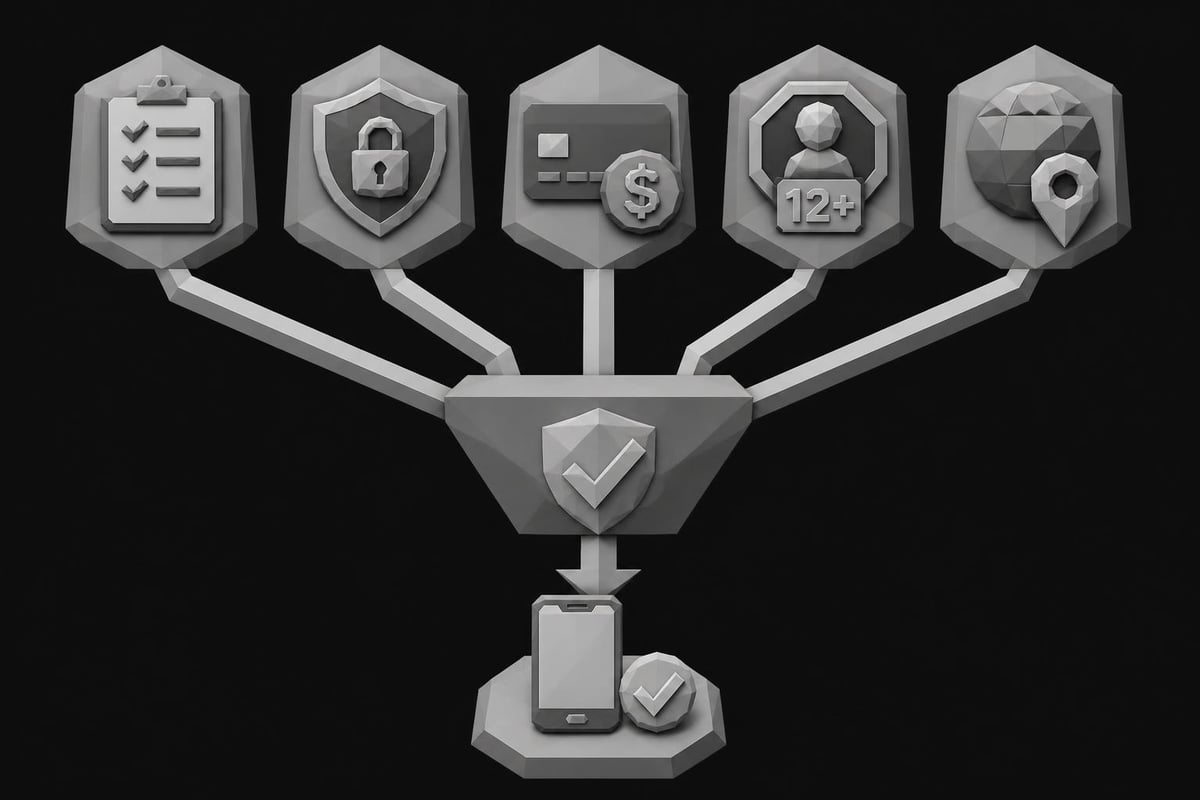
App Store Guidelines and Fees
Apple and Google want their cut. That's 15-30% of your revenue depending on your earnings and subscription timing. Factor this into your pricing from day one.
Key rules to know:
- In-app purchases required: Digital goods must use platform payment systems (with some recent exceptions)
- Subscription disclosures: You must clearly state terms, renewal policies, and cancellation processes
- Privacy requirements: Especially around ads and data collection
- Age ratings impact monetization: Kids' apps have strict limitations on ads and data collection
Privacy Laws and Ad Tracking
iOS App Tracking Transparency and similar Android features have changed advertising economics. Fewer users opt into tracking means less targeted ads and lower eCPMs.
Adapt by:
- Focusing on contextual rather than behavioral targeting
- Building first-party data relationships with users
- Emphasizing subscription or IAP revenue over ads
- Being transparent about what data you collect and why
Regional Differences
Monetization success varies wildly by geography. Users in the US and Western Europe have higher average revenue per user than many other markets. But emerging markets have volume. Adjust your strategy regionally if your app scales internationally.
User Retention and Monetization Balance
Here's something many developers learn the hard way: aggressive monetization kills retention, and dead users generate zero revenue.
Finding the Sweet Spot
Your monetization should feel like a natural part of the app experience. When you nail this balance:
- User satisfaction scores stay high
- Retention rates remain stable or improve
- Word-of-mouth growth continues
- Revenue per user increases over time
When you mess it up:
- Negative reviews mention "money grab" or "too many ads"
- Users uninstall quickly after hitting paywalls
- Engagement metrics drop
- Revenue might spike short-term but crashes long-term
Building Value First
The apps that monetize best are the ones that deliver crazy value before asking for money. Make your free tier genuinely useful. Make your ads skippable or rewarding. Make your premium features obviously worth the price.
Think of monetization as harvesting the value you've created, not manufacturing value out of thin air.
Mobile app monetization is part art, part science, and entirely essential to building a sustainable digital product business. The key is choosing methods that align with your app's value proposition, respecting your users' experience, and continuously optimizing based on real data. Whether you go with subscriptions, ads, freemium, or a hybrid approach, success comes from delivering genuine value first and monetizing second. Ready to turn your app idea into a profitable reality? CreateSell provides everything you need to build, launch, and monetize your mobile app, even without coding experience, helping you create digital products that generate income while you sleep.