
Minimum Viable Product Software: Your Launch Guide

Modest Mitkus
May 15, 2026
Let's be real: building software is hard. Building software nobody wants? That's devastating. You pour months (or years) of your life into creating the perfect product, only to discover your audience doesn't care about half your features. That's exactly why minimum viable product software exists. It's your safety net, your reality check, and honestly, your smartest move when launching anything in 2026. Whether you're building a SaaS platform, mobile app, or any digital product, understanding MVPs can save you time, money, and a whole lot of heartache.
What Minimum Viable Product Software Actually Means
Here's the thing: most people get MVPs wrong. They think it means "crappy first version" or "half-finished software." Nope. A minimum viable product is the simplest version of your software that solves a real problem for real users. It's got just enough features to attract early adopters and validate your core assumptions.
Think of it like this: if you're building a meal delivery app, your MVP isn't going to have AI-powered recipe suggestions, loyalty points, and social sharing. It's going to let people order food and get it delivered. Period. You're testing the fundamental question: will people actually use this service?
The Core Elements That Define an MVP
Every minimum viable product software needs three essential components to actually work:
- One core value proposition that solves a specific pain point
- Enough functionality to be usable (not just a demo or prototype)
- A feedback mechanism to learn from early users
The beauty of this approach is that you're not guessing what people want. You're putting something real in front of them and watching what happens. Sometimes your assumptions are right. Often they're wrong. Either way, you're learning with minimal investment.
Why Digital Product Creators Need MVPs More Than Ever
The digital product landscape in 2026 is absolutely saturated. There's an app for everything, a SaaS tool for every workflow, and a platform for every niche. So how do you compete? By being smarter about what you build and when you build it.
Building minimum viable product software lets you move fast without breaking everything. You're not committing six months to development before knowing if anyone cares. You're testing your riskiest assumptions first. Will people pay for this? Do they understand the value? Is this problem actually worth solving?
The Real Benefits Beyond Saving Time
Sure, MVPs are faster to build. But that's just scratching the surface. Here's what you're really getting:
| Benefit | Impact on Your Business |
|---|---|
| Market validation | Know if your idea has legs before major investment |
| User-driven development | Build features people actually want, not what you think they want |
| Faster time to revenue | Start generating income and learning simultaneously |
| Reduced risk | Fail fast and cheap if you're going to fail |
| Investor appeal | Show traction and validated learning, not just promises |
This approach completely changes your relationship with failure. Instead of a catastrophic waste of resources, a failed MVP is just useful data. You learned something, you spent weeks instead of months, and you can pivot quickly.
Building Your First Minimum Viable Product Software
Alright, let's get practical. You've got an idea bouncing around in your head. How do you turn it into an MVP without overbuilding?
Step One: Identify Your Riskiest Assumption
Every product idea rests on assumptions. "People will pay $20/month for this." "Users prefer automation over manual control." "Small businesses need better invoicing tools." Your job is figuring out which assumption, if wrong, kills your entire concept.
That's your starting point. Your MVP exists to test that one critical thing. Everything else is secondary.
Step Two: Strip Everything to the Bone
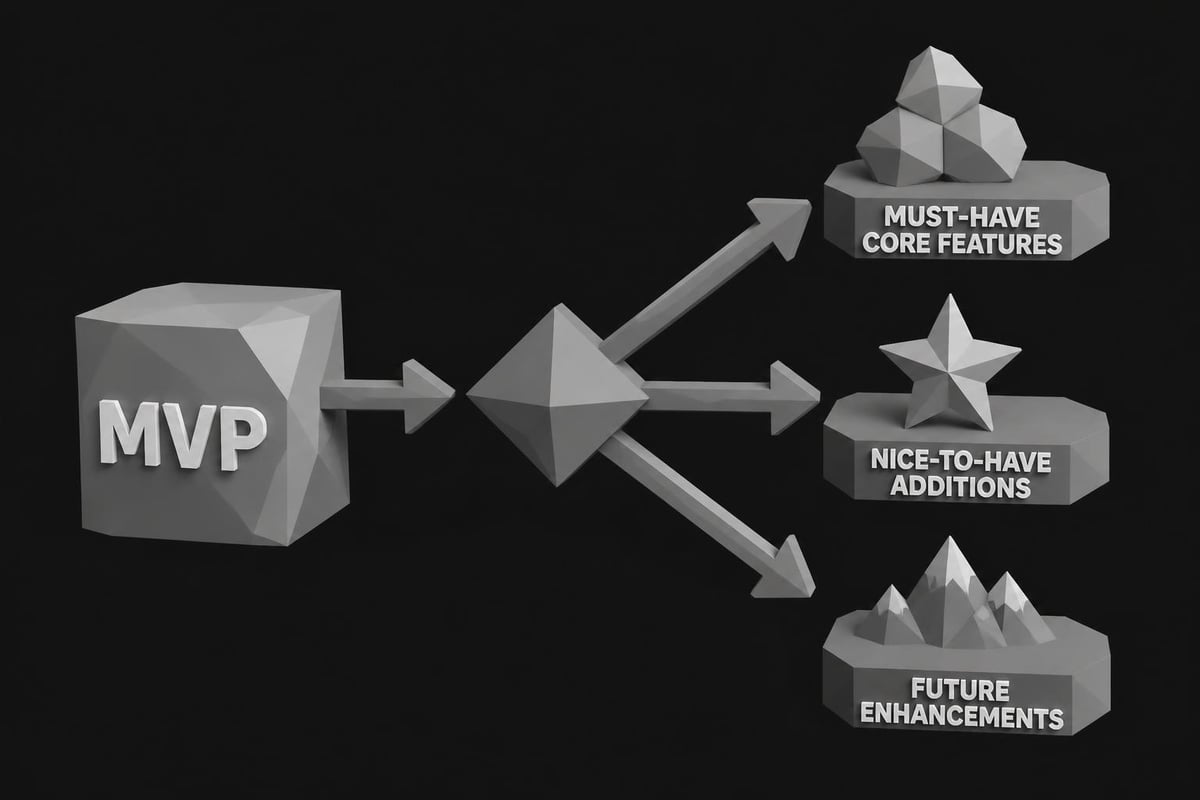
This is where it gets uncomfortable. You need to cut features you love. Here's a framework that helps:
- List every feature you initially imagined
- Mark which ones test your riskiest assumption
- Mark which ones are absolutely required for basic functionality
- Delete everything else (seriously, be ruthless)
You'll end up with maybe 3-5 core features. That's perfect. According to product development experts, this constraint forces clarity and prevents feature bloat that confuses early users.
Step Three: Choose Your Development Approach
Here's where things get interesting for solo creators and small teams. You've got options in 2026 that didn't exist even a couple years ago.
Traditional coding still works if you've got the skills. But it's slow and expensive. No-code platforms have matured significantly, letting you build functional software without writing a line of code. AI-assisted development (vibe coding) sits in the middle, letting you describe what you want and having AI help you build it.
For digital product creators who want to move fast, learning to leverage these modern tools makes the difference between launching in weeks versus months. Building your first SaaS or mobile app has never been more accessible.
Common MVP Mistakes That Kill Products
Let's talk about what NOT to do, because honestly, I see these mistakes constantly.
Building in a Vacuum
The biggest trap? Disappearing for three months to "perfect" your MVP before showing anyone. That's not an MVP, that's a regular product with extra steps. You need to be getting feedback from day one, even if it's just mockups or a clickable prototype.
Share early, share often, and share with people who'll give you honest feedback (not just your mom saying everything's great).
Confusing MVP with Prototype
Here's a crucial distinction: a prototype is a demo. An MVP is a real product that real users can actually use. Understanding this difference prevents a lot of wasted effort building things that look good in screenshots but don't function in reality.
Your minimum viable product software needs to actually work. It might be limited, it might be rough around the edges, but it solves the problem you promised to solve.
Ignoring the "Viable" Part
Minimum doesn't mean broken. Viable means it provides value. If your MVP is so bare-bones that users can't accomplish anything meaningful, you're not testing your product. You're just annoying people.
The balance is tricky but essential: minimum scope, viable solution.
Real Examples of Successful MVPs
Nothing clarifies a concept like seeing it in action. Let's look at how some now-huge companies started with ridiculously simple MVPs.
Dropbox began with just a video showing how file syncing would work. That's it. No actual product, just a demonstration that proved people wanted this solution. The video generated massive interest and validated the concept before they built the full platform.
Airbnb started with the founders renting out air mattresses in their apartment during a design conference. No sophisticated booking system, no payment processing, no professional photography. Just a simple website and three air mattresses. They learned that people would actually pay to stay in strangers' homes.
Twitter launched as an internal tool for Odeo employees to share short status updates. It had one feature: post a 140-character message. That constraint (which seemed limiting at the time) became its defining characteristic.
Notice the pattern? Each of these started by solving one specific problem with the simplest possible solution. They didn't wait for perfection.
Measuring Success for Your MVP
So you've launched your minimum viable product software. Now what? How do you know if it's working?
Metrics That Actually Matter
Forget vanity metrics like page views or app downloads. Focus on signals that indicate real value:
- Activation rate: What percentage of users complete the core action?
- Retention: Do people come back after their first use?
- Referral: Are users telling others about it?
- Revenue: Will people actually pay for this?
Even better, define your success criteria BEFORE you launch. "Success means 100 users in the first month, with 40% coming back within a week." Now you've got a clear target.
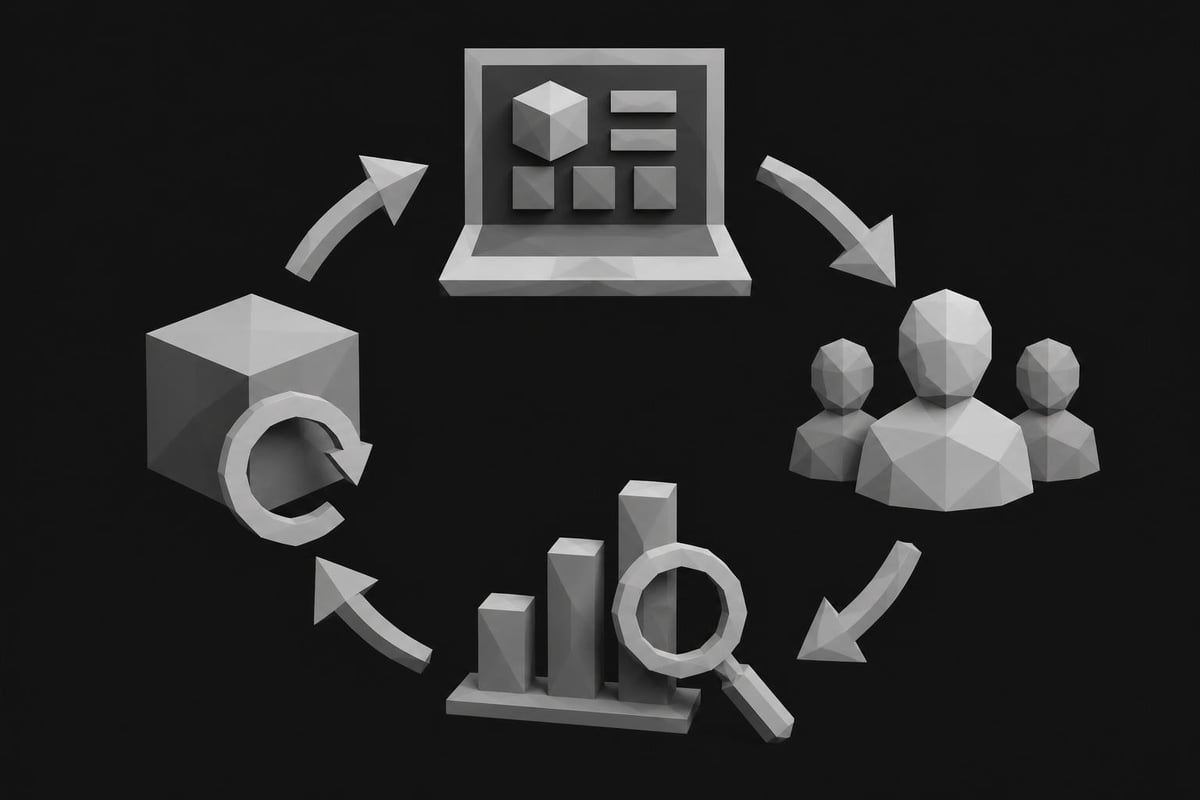
The Feedback Loop That Drives Iteration
Here's your post-launch workflow:
- Release your MVP to a small group
- Watch how they actually use it (not what they say, what they DO)
- Collect both quantitative data and qualitative feedback
- Identify the biggest friction points or opportunities
- Make targeted improvements
- Repeat
This cycle is continuous. You're not building to a final state, you're constantly evolving based on real-world usage. This agile approach keeps you aligned with what users actually need.
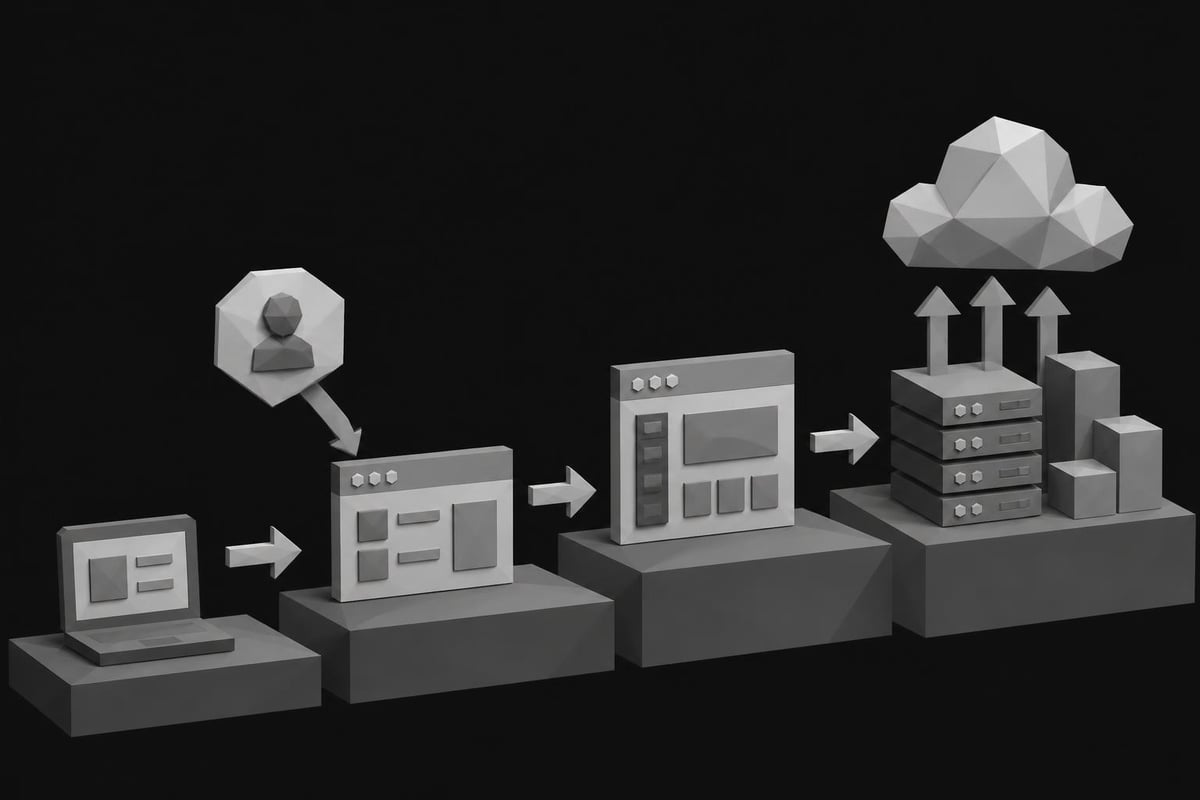
From MVP to Full Product: The Evolution Path
Your MVP isn't meant to stay minimal forever. It's the foundation you build on. But how do you decide what to add next?
Let User Behavior Guide Your Roadmap
The data tells you everything. Which features do power users keep trying to access (that don't exist yet)? Where do people get stuck? What workflows do they hack together using your limited features?
These friction points and workarounds are your roadmap. Each one represents a feature request backed by actual behavior, not just someone saying "it would be cool if..."
Maintaining the MVP Mindset
Even as your product grows, keep that MVP thinking alive. For every new feature, ask:
- Does this solve a validated problem?
- What's the simplest version we could ship?
- How will we measure if this actually helps users?
Sometimes the answer is "don't build this yet." And that's okay. Just like building your first version, strategic focus matters more than feature quantity as you scale.
The Mindset Shift Behind MVP Success
Here's what nobody tells you: adopting minimum viable product software isn't just a development methodology. It's a complete mindset shift about how you approach building anything.
You're moving from "build it and they will come" to "build WITH them." You're trading ego for learning. You're accepting that your first idea probably isn't perfect, and that's totally fine.
This connects to something bigger too. Just like building software iteratively, building yourself as an entrepreneur is a process of constant iteration. If you're working on breaking old patterns and rebuilding your approach to business and life, resources like DoReset can provide that structured framework for personal transformation alongside your product development journey.
Overcoming the Perfectionist Trap
The hardest part for most creators? Shipping something that feels incomplete. Your internal voice screams "just one more feature" or "this isn't ready yet."
That voice is lying to you. Or at least, it's optimizing for the wrong thing. The lean startup methodology teaches us that validated learning beats perfect execution every single time.
Your users don't need perfect. They need helpful. They need something that solves their problem today, not something flawless that arrives six months from now when they've already found another solution.
Building MVPs in the No-Code Era
Let's get specific about 2026 realities. The tools available now make building minimum viable product software accessible to anyone with an idea and commitment to learning.
You don't need a computer science degree. You don't need to hire a development team. You need clarity about what you're building and willingness to learn modern tools.
For digital product creators specifically, this changes everything. That SaaS idea you've been sitting on? You can validate it in weeks, not months. That mobile app concept? Same deal.
The biggest barrier isn't technical anymore. It's decisional. You've got to decide what to build, commit to shipping it incomplete, and be ready to learn from real users. The technical execution is increasingly just about choosing the right tools and putting in focused work.
If you're ready to move from idea to launched product quickly, modern approaches make this totally achievable. Learning to build and validate your digital products efficiently turns your knowledge into assets that generate revenue while you sleep.
The MVP Framework for Digital Products
Let me give you a concrete framework you can use starting today:
Week 1: Validation
- Define your target user and their specific problem
- Identify your riskiest assumption
- Create a simple landing page describing the solution
- Get 10 conversations with potential users
Week 2: Planning
- Map the absolute minimum feature set
- Choose your development approach
- Set clear success metrics
- Build your feedback collection system
Week 3-4: Building
- Build only the core features
- Test each piece as you go
- Resist adding "quick extras"
- Prepare your launch communication
Week 5: Launch & Learn
- Release to a small group (50-100 users max)
- Watch usage patterns obsessively
- Collect qualitative feedback
- Measure against your success criteria
This timeline works whether you're building with code, no-code, or AI assistance. The principle stays the same: move fast, learn quickly, iterate constantly.
Why Most MVPs Actually Fail (And How to Avoid It)
Let's get uncomfortable for a second. According to product development research, most MVPs don't succeed in their initial form. But that's not actually failure, that's the point.
An MVP "fails" successfully when it teaches you what NOT to build. It fails destructively when you ignore the lessons or give up after the first iteration.
The key differentiator? How you respond to the data. Winners adjust. They pivot when needed. They double down on what works and kill what doesn't. Losers blame the market, the timing, or the users for "not getting it."
Your minimum viable product software is a learning tool first and a product second. Treat it that way.
Building minimum viable product software isn't about cutting corners or shipping garbage. It's about being smart with your time, money, and energy. It's about validating your ideas with real users before investing everything into features nobody wants. Whether you're launching your first SaaS, building a mobile app, or creating any digital product, the MVP approach gives you the best shot at success. Ready to turn your ideas into products that actually sell? CreateSell helps you learn to build and launch digital products from scratch, transforming your knowledge into income-generating assets that work for you 24/7.